
Strength Training With Dumbbells: Benefits & Exercises
Why Strength Training With Dumbbells Works
Estimated Reading Time: 22 Minutes
Strength training with dumbbells is one of the most flexible ways to build muscle, improve strength, and train the entire body with a relatively small amount of equipment. A pair of dumbbells can be used for presses, rows, squats, lunges, hinges, carries, curls, extensions, and many other movements. That makes dumbbells useful in home gyms, school weight rooms, apartment fitness centers, hotel gyms, training studios, and full commercial facilities.
The biggest advantage is not that dumbbells are automatically better than barbells or machines. It is that each hand controls its own load while you retain freedom to adjust your grip, arm path, stance, and exercise setup. Those qualities make dumbbells especially useful for unilateral training, exercise variety, small-space strength programs, and workouts that need to scale from beginner loads to demanding resistance.
Quick Answer: Dumbbells can build strength and muscle just as effectively as other forms of resistance training when the exercises are challenging enough and progress over time. Their main advantages are versatility, independent loading for each side of the body, freedom of movement, easy unilateral exercise selection, and a compact equipment footprint. For general health, current U.S. guidelines recommend muscle-strengthening activity on at least two days per week, while the best training volume and load depend on your goal and experience.
The health benefits come from resistance training itself; dumbbells are one practical way to deliver that resistance. They should be viewed as a highly adaptable training tool rather than a shortcut or universally superior form of strength equipment.
Table of Contents
- What Is Dumbbell Strength Training?
- 12 Benefits of Strength Training With Dumbbells
- Dumbbells vs. Barbells vs. Machines
- Can You Build Muscle With Dumbbells?
- Can You Build Serious Strength With Dumbbells?
- Best Dumbbell Exercises by Movement Pattern
- Beginner Dumbbell Strength Workout
- How to Choose the Right Dumbbell Weight
- Sets, Reps, Frequency & Progression
- Fixed vs. Adjustable Dumbbells
- Common Dumbbell Training Mistakes
- Dumbbell Training Safety Tips
- Frequently Asked Questions
What Is Dumbbell Strength Training?
Dumbbell strength training is resistance exercise performed with one or two handheld weights. Unlike a barbell, which connects both hands to one implement, dumbbells allow the right and left sides to control separate loads. Unlike many weight machines, dumbbells do not guide the weight through a fixed mechanical path. The lifter controls the path, grip, tempo, and range of motion within the limits of the exercise.
Dumbbells can be used bilaterally, with both sides working at the same time, or unilaterally, with one side working independently. A dumbbell bench press is commonly performed with two weights together, while a one-arm row, split squat, suitcase carry, or single-arm overhead press places a greater emphasis on one side at a time. That flexibility is one reason dumbbells work so well across general fitness, bodybuilding, athletic accessory training, and home strength programs.
They also fit under the broader category of free weights, which means the user must control the resistance instead of relying on a machine to stabilize the load. This does not automatically make dumbbells more effective than machines. It simply changes the training demands and gives the user more freedom to select movement patterns.
Research Note: The American College of Sports Medicine's 2026 resistance-training position stand found that equipment type did not consistently determine strength or hypertrophy outcomes. The larger priorities are progressive resistance, sufficient training volume, appropriate effort, and consistency. View the ACSM position stand.
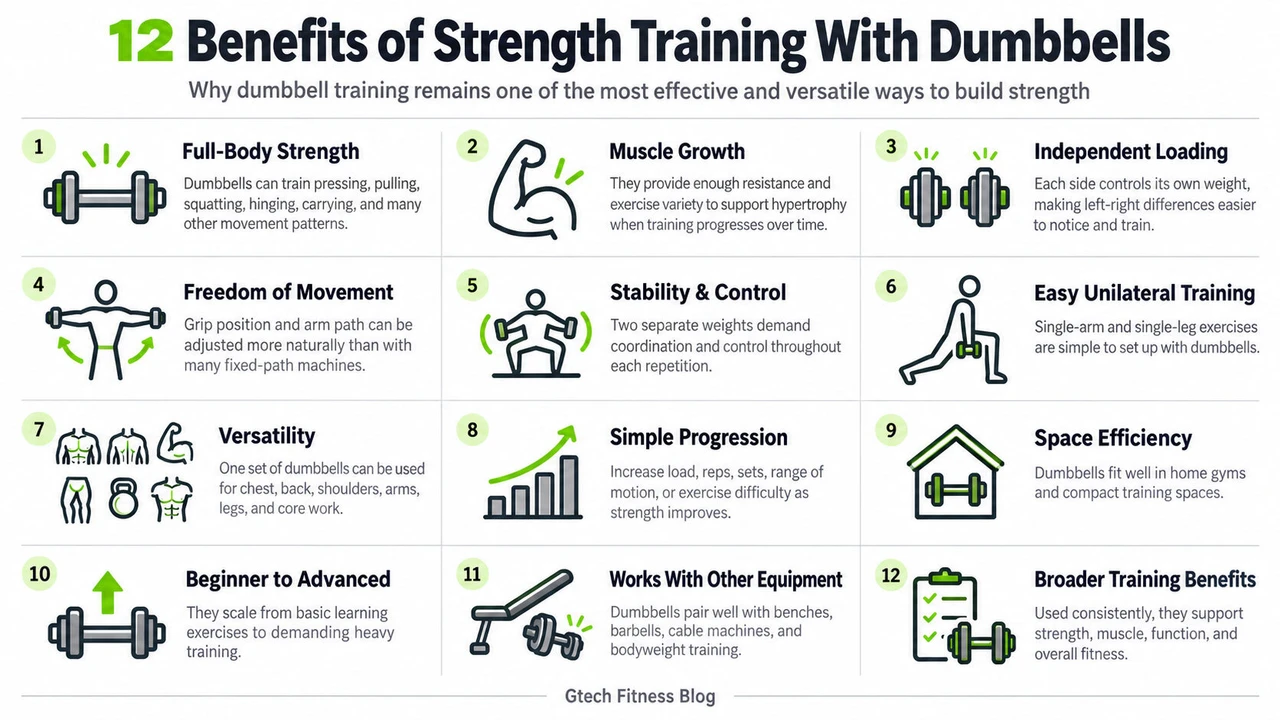
12 Benefits of Strength Training With Dumbbells
1. Dumbbells Can Build Full-Body Strength
Dumbbells can load nearly every major movement pattern used in a well-rounded strength program. Squats and lunges train the lower body, Romanian deadlifts and hip hinges target the posterior chain, presses train the chest and shoulders, rows strengthen the back, and loaded carries challenge the grip and trunk. That range makes it possible to build an effective full-body program without moving between multiple dedicated machines.
For strength gains, the most important factor is not simply owning dumbbells; it is using resistance that becomes progressively more challenging. Heavier dumbbells, additional repetitions, more sets, a longer range of motion, or more demanding exercise variations can all increase training stress over time.
2. They Support Muscle Growth
Dumbbells are effective for hypertrophy because they can create the mechanical tension and training volume needed for muscle growth. They work for both compound movements, such as presses, rows, squats, and lunges, and isolation exercises, such as curls, lateral raises, fly variations, and triceps extensions.
Current resistance-training evidence does not show that one equipment category is universally required for hypertrophy. A well-designed dumbbell program can therefore be a primary muscle-building system or part of a broader routine that also includes barbells, cable machines, and selectorized equipment.
3. Each Side Controls Its Own Load
One of the clearest differences between dumbbells and a barbell is independent loading. Each arm must control its own dumbbell rather than contributing force to a shared bar. This can make side-to-side differences easier to notice during presses, rows, curls, and other upper-body movements.
Independent loading does not automatically eliminate a strength imbalance, but it makes it harder for the stronger side to quietly take over a shared implement. When a difference appears, you can keep the same load and repetition target on both sides or use appropriate unilateral work to train the weaker side without increasing the stronger side's workload.
4. Dumbbells Allow More Freedom of Movement
A barbell fixes both hands to the same bar, while many machines guide the user along a predetermined path. Dumbbells give each hand more freedom to rotate and travel independently. For example, a lifter can use a neutral, semi-neutral, or pronated grip during pressing movements and can adjust elbow position to suit the exercise and individual comfort.
This freedom can make dumbbells easier to adapt to different body sizes and training preferences. It should not be interpreted as a guarantee that every dumbbell exercise is more joint-friendly or provides a greater useful range of motion. Exercise selection, load, technique, mobility, and individual anatomy still matter.
5. They Challenge Stability and Control
Because two dumbbells can move independently, the lifter must control each weight throughout the repetition. That increases the coordination demands of many presses, rows, split-stance movements, and single-arm exercises. The goal is not to make every exercise unstable; it is to control a freely moving load while maintaining the intended position.
This is one reason new lifters often need to use less total weight with dumbbells than with a comparable barbell exercise. The reduced load is not necessarily a disadvantage. It reflects the added task of positioning and controlling two separate implements.
6. Dumbbells Make Unilateral Training Simple
Single-arm and single-leg exercises are easy to set up with dumbbells. Common examples include one-arm rows, single-arm overhead presses, split squats, reverse lunges, step-ups, single-leg Romanian deadlifts, and suitcase carries. These movements can add variety and challenge trunk control while allowing each side to perform its own work.
Unilateral training is useful, but it does not need to replace bilateral training. Most programs benefit from a mixture. You might use a two-dumbbell Romanian deadlift for efficient bilateral loading and a split squat later in the session for single-leg work.
7. One Set of Dumbbells Can Train Many Muscle Groups
Dumbbells are exceptionally versatile. A single pair can be used for chest, back, shoulders, arms, legs, glutes, and loaded core exercises. Add an adjustable weight bench, and the exercise library expands further to include flat presses, incline presses, supported rows, seated shoulder work, incline curls, chest-supported raises, and other bench-supported movements.
That versatility is valuable when floor space is limited or when a facility needs equipment that can support many training goals. It is also why dumbbell racks remain a core part of school, hotel, apartment, studio, and commercial fitness rooms.
8. Progression Can Be Straightforward
Fixed dumbbells create a simple progression system: use the same pair until you can complete the target repetitions with good technique, then move to the next available weight. Adjustable dumbbells provide the same concept in a compact format, although the exact increment depends on the model.
When the next dumbbell jump feels too large, you do not have to force the heavier pair immediately. Add repetitions within a planned range, improve control, add a set, or choose a slightly harder variation before increasing the load. This approach is often called double progression: build repetitions first, then increase weight.
9. Dumbbells Work Well in Small Spaces
A complete strength room can include racks, platforms, machines, cable stations, and benches, but dumbbells can deliver a surprisingly broad exercise selection in a small footprint. This makes them useful for home gyms and facilities where every square foot matters.
Adjustable dumbbells reduce the footprint even further by combining several weight settings into one compact system. Fixed dumbbells require more storage but provide faster access and are generally better suited to busy shared environments where multiple users may train at once.
10. They Scale From Beginner to Advanced Training
Dumbbells are not only beginner equipment. Light pairs can help a new lifter learn movement patterns, while heavier commercial dumbbells support demanding presses, rows, split squats, carries, and other strength exercises. The same movement can often be progressed for years by changing load, repetitions, range, tempo, or exercise variation.
The limiting factor at advanced strength levels is often equipment availability and setup rather than the dumbbell itself. Very strong lifters may eventually need barbells or machines to load certain lower-body or pressing movements more efficiently, especially when maximal strength becomes the primary goal.
11. Dumbbells Are Easy to Combine With Other Equipment
Dumbbell training does not need to be an all-or-nothing system. Dumbbells pair naturally with barbells, weight machines, cable machines, resistance bands, and bodyweight exercises. A lifter might use a barbell for a heavy squat, dumbbells for pressing and rows, and a cable station for targeted accessory work in the same session.
This is important because different tools solve different training problems. Barbells are efficient for very heavy bilateral loading. Machines provide stability and can make target-muscle loading easier. Dumbbells provide independent loading and movement freedom. A good facility can use all three rather than treating them as competitors.
12. They Provide the Broader Benefits of Resistance Training
When dumbbells are used as part of a progressive resistance-training program, they can contribute to the same broad outcomes associated with resistance exercise: increased muscular strength, muscle growth, muscular endurance, and improved physical function. Resistance training also supports the maintenance of muscle and bone health as people age.
These are not special benefits that occur only because the resistance comes from dumbbells. The advantage of dumbbells is that they provide an accessible, scalable way to perform the training consistently. The U.S. Centers for Disease Control and Prevention currently recommends muscle-strengthening activity for all major muscle groups on at least two days each week. View the CDC adult activity guidelines.
Dumbbells vs. Barbells vs. Machines
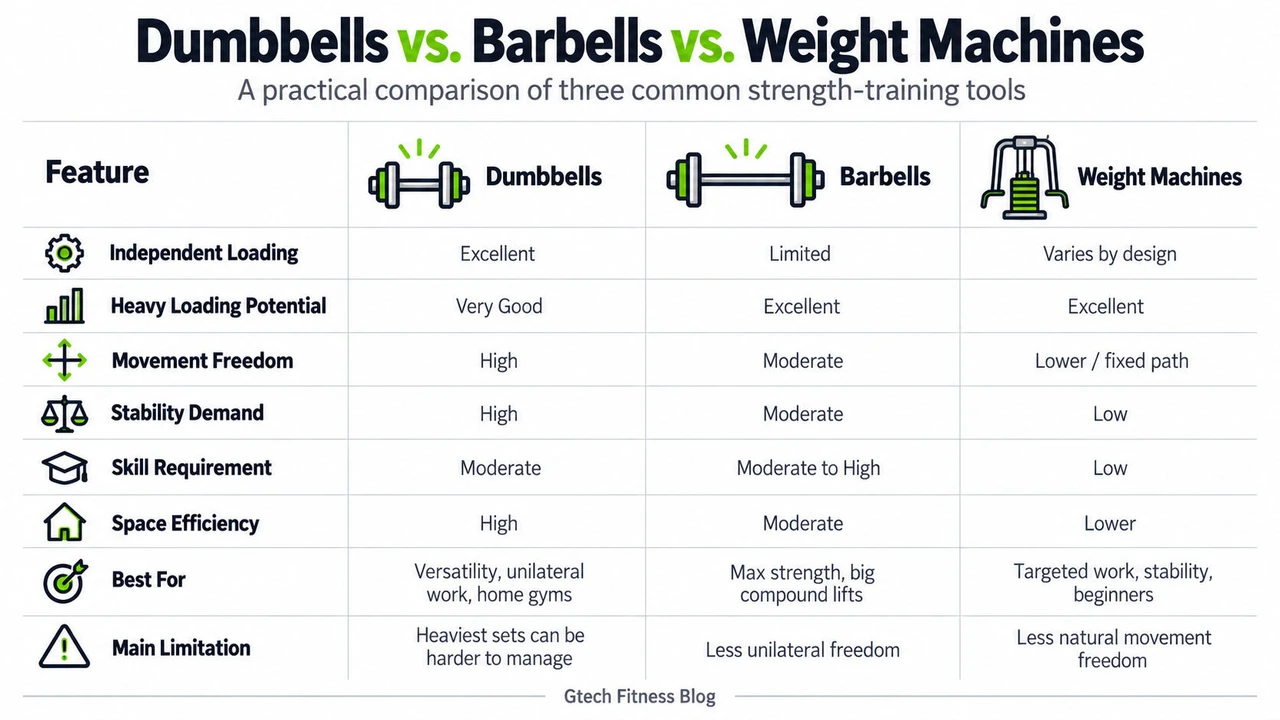
There is no universal winner between dumbbells, barbells, and machines. The better choice depends on the exercise, training goal, available space, experience level, and equipment setup. The comparison below shows where each tool tends to fit best.
| Training Factor | Dumbbells | Barbells | Weight Machines |
|---|---|---|---|
| Independent sides | Excellent; each hand controls its own load | Limited because both hands share one bar | Depends on machine design |
| Maximum loading | High, but eventually limited by dumbbell size, grip, and setup | Excellent for heavy bilateral loading | High within the machine's stack or plate capacity |
| Movement freedom | High; grip and path can adjust independently | Moderate; both hands remain fixed to the same bar | Usually lower because the machine guides the path |
| Stability demand | Moderate to high, depending on the exercise | Moderate; the single bar links both sides | Generally lower because the equipment provides more support |
| Space efficiency | Very good, especially with adjustable dumbbells | Usually requires a bar, plates, and often a rack | Varies; dedicated machines can require substantial floor space |
| Best fit | Versatility, unilateral work, home gyms, accessory training, full-body programs | Heavy compound lifting, maximal strength, powerlifting-specific practice | Stable target-muscle training, easy setup, high-volume facility use |
Are Dumbbells Better Than Barbells?
Not across the board. Dumbbells are especially useful when you want each side to work independently, want more freedom to adjust grip and arm path, or need versatile equipment for a smaller space. Barbells are usually easier to load very heavily and in smaller increments, which makes them a strong choice for maximal bilateral strength and barbell-specific sports.
If your goal is general strength and muscle development, both can work. If your goal is specifically to improve a barbell squat, bench press, or deadlift, practicing the barbell lift matters because strength is specific to the task being trained.
Are Dumbbells Better Than Machines?
Again, neither is universally better. Dumbbells require the user to control the load, while machines provide more external stability. That extra stability can be useful when the goal is to challenge a target muscle without spending as much effort controlling the implement. Dumbbells may be preferable when the goal includes unilateral work, movement freedom, or a broader exercise library from one piece of equipment.
The strongest program is often the one that uses each tool where it makes sense instead of trying to prove that one category is superior.
Can You Build Muscle With Dumbbells?
Yes. You can build substantial muscle with dumbbells as long as the resistance is challenging enough, weekly training volume is sufficient, and the exercises progress over time. The body responds to training stress; it does not require that the stress come from a barbell or machine.
For muscle growth, a practical dumbbell program should include enough work for each major muscle group, use controlled repetitions through an appropriate range of motion, and bring working sets reasonably close to muscular fatigue. The 2026 ACSM position stand found that muscle growth can occur across a broad range of loads and that higher weekly volume is one of the clearer variables associated with greater hypertrophy. It also found that taking every set to momentary muscular failure is not required.
Practical Hypertrophy Guideline: Use a weight that makes the target rep range challenging while leaving roughly a few good repetitions in reserve on most sets. Track your repetitions and load. When you consistently reach the top of the range with clean form, increase the resistance or use another progression method.
Dumbbells are especially well suited to hypertrophy because they can cover both large compound exercises and targeted accessory movements. A chest workout might include dumbbell bench presses followed by fly variations, while a back session might combine heavy rows with rear-delt raises and curls. For chest-specific programming, see our complete dumbbell chest workout guide.
Can You Build Serious Strength With Dumbbells?
Yes, especially for general strength. Heavy dumbbell presses, rows, split squats, Romanian deadlifts, step-ups, lunges, and loaded carries can create a demanding strength stimulus. The key is progressively increasing the challenge while keeping technique repeatable.
Dumbbells do have practical limits. As loads become very heavy, getting the weights into position can become difficult. Grip strength may limit heavy lower-body exercises before the legs or hips do. Fixed dumbbell sets also commonly increase in larger jumps than a plate-loaded barbell, making small load increases harder. These limitations are most important for advanced lifters pursuing maximal strength.
For that reason, dumbbells can serve as a complete resistance system for many home and general-fitness programs, while advanced strength athletes may combine them with barbells and machines to make heavy loading and progression more efficient.
Best Dumbbell Exercises by Movement Pattern
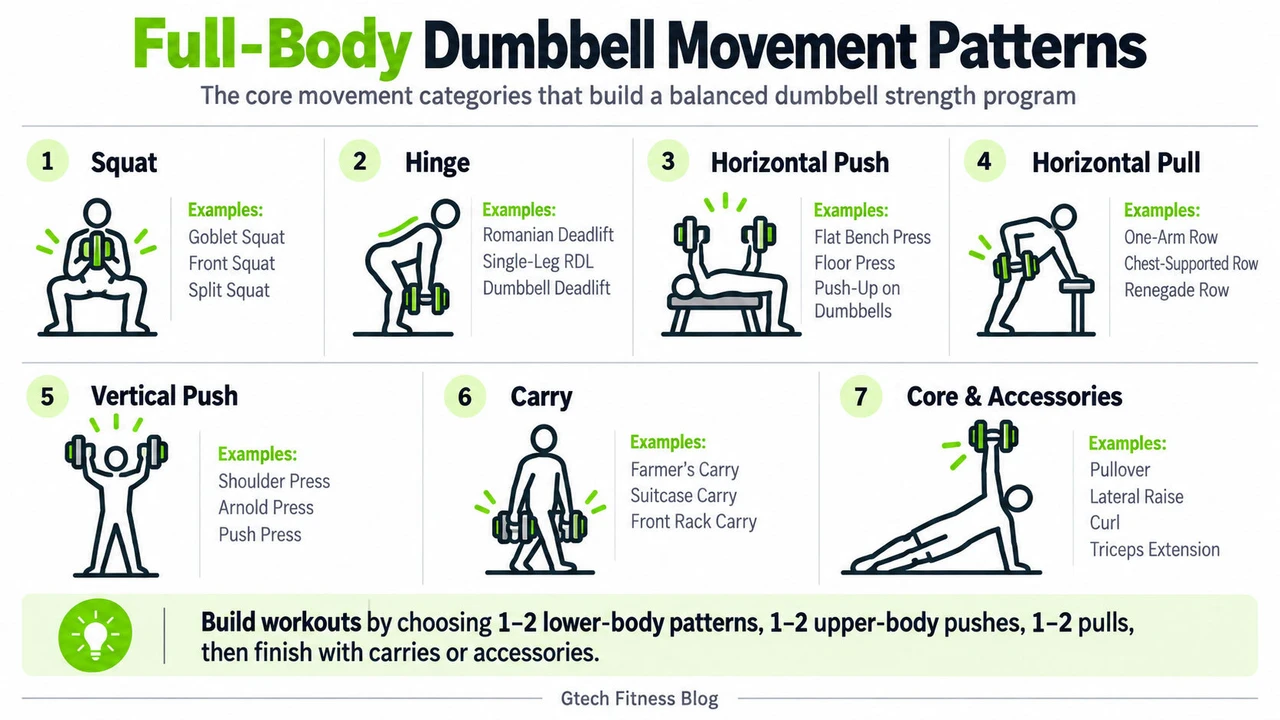
A comprehensive dumbbell routine should do more than collect random exercises. It should cover the major movement patterns needed to train the whole body. The table below provides a practical starting point.
| Movement Pattern | Dumbbell Exercises | Primary Training Role |
|---|---|---|
| Squat / Knee Dominant | Goblet squat, front-loaded squat, split squat, reverse lunge, step-up | Quadriceps, glutes, single-leg strength |
| Hip Hinge | Romanian deadlift, dumbbell deadlift, single-leg Romanian deadlift | Hamstrings, glutes, hip extension |
| Horizontal Push | Bench press, incline press, floor press, neutral-grip press | Chest, triceps, anterior shoulders |
| Horizontal Pull | One-arm row, bent-over row, chest-supported row | Upper back, lats, rear shoulders, biceps |
| Vertical Push | Standing overhead press, seated press, single-arm press | Shoulders, triceps, overhead strength |
| Carry / Core | Farmer carry, suitcase carry, front-rack carry | Grip, trunk control, loaded walking |
| Arms & Accessories | Biceps curl, hammer curl, triceps extension, lateral raise, rear-delt raise | Targeted accessory work |
One limitation is that dumbbells do not reproduce a true vertical pulling movement as directly as a pull-up or lat pulldown. Rows and pullovers can train many of the same upper-body muscles, but facilities with access to a pull-up station or cable machine can use those tools to round out the program.
Beginner Dumbbell Strength Workout
Beginners do not need a complicated split. Two full-body sessions per week can cover the major movement patterns, create regular practice, and meet the current public-health minimum for muscle-strengthening frequency. As technique and work capacity improve, a third weekly session can be added if recovery and schedule allow.
Workout A
| Exercise | Sets | Repetitions | Rest |
|---|---|---|---|
| Goblet Squat | 2–3 | 8–12 | 1–2 minutes |
| Dumbbell Bench Press or Floor Press | 2–3 | 8–12 | 1–2 minutes |
| One-Arm Dumbbell Row | 2–3 | 8–12 each side | 1–2 minutes |
| Dumbbell Romanian Deadlift | 2–3 | 8–12 | 1–2 minutes |
| Farmer Carry | 2 | 20–40 seconds | 1 minute |
Workout B
| Exercise | Sets | Repetitions | Rest |
|---|---|---|---|
| Reverse Lunge | 2–3 | 8–10 each side | 1–2 minutes |
| Dumbbell Overhead Press | 2–3 | 8–12 | 1–2 minutes |
| Chest-Supported or Bent-Over Row | 2–3 | 8–12 | 1–2 minutes |
| Dumbbell Hip Thrust or Glute Bridge | 2–3 | 10–15 | 1–2 minutes |
| Hammer Curl + Triceps Extension | 2 each | 10–15 | About 1 minute |
Start with a load that allows every repetition to look controlled. The last few repetitions should feel challenging, but beginners do not need to train every set to failure. Once you can complete the top of the target range across all sets with consistent technique, move to the next appropriate dumbbell or add another progression variable.
How to Choose the Right Dumbbell Weight
The correct dumbbell weight depends on the exercise. Most people can use much heavier dumbbells for Romanian deadlifts and rows than for lateral raises or curls. That is why a useful dumbbell setup includes multiple weight options rather than expecting one pair to cover every movement equally well.
A practical starting rule is to choose a load that allows you to finish the planned repetitions with good form while feeling that you could perform roughly two or three additional quality repetitions if needed. If you could easily perform many more repetitions, the weight may be too light for the intended training goal. If technique breaks down before reaching the minimum target, reduce the load.
Use Rep Quality Instead of Ego
The heaviest dumbbell you can move is not necessarily the best dumbbell for the set. A productive load lets you control the lowering phase, maintain the intended joint positions, and complete the planned range of motion without turning the exercise into a different movement.
Match the Weight to the Goal
Lower-repetition strength work usually requires heavier dumbbells, while moderate and higher repetition ranges use lighter resistance. For muscle growth, a wide range of loads can work when sets are performed with enough effort. For new lifters, moderate repetition ranges are often easier for learning technique because they avoid both extremely heavy loading and very long fatigue-driven sets.
Sets, Reps, Frequency & Progression
There is no single perfect set-and-rep scheme for every dumbbell workout. Programming should match the outcome you care about most.
| Goal | Practical Rep Range | Programming Focus |
|---|---|---|
| Strength | Often 5–8 reps for major dumbbell lifts | Heavier resistance, full range of motion, multiple quality sets, longer rest as needed |
| Muscle Growth | Commonly 6–15 reps, though effective ranges can be broader | Sufficient weekly volume, challenging sets, progressive overload |
| Muscular Endurance | Often 12–20+ reps | Lighter resistance, sustained quality repetitions, shorter rest when appropriate |
| General Fitness | Usually 8–15 reps | Simple full-body exercises, consistent technique, gradual progression |
How Often Should You Train With Dumbbells?
For general health, at least two weekly muscle-strengthening days is the current public-health minimum for adults. For strength, the 2026 ACSM position stand also identified training a muscle or movement at least twice per week as a useful reference point, although total volume and individual recovery matter.
You can train with dumbbells more often if the weekly workload is distributed intelligently. A three-day full-body routine, four-day upper/lower split, or mixed dumbbell-and-machine program can all work. Daily hard training for the same muscles is usually unnecessary.
How Many Sets Do You Need?
Beginners can make progress with relatively modest volumes, such as two or three working sets per exercise. As training experience increases, additional weekly volume may be useful, especially for hypertrophy. ACSM's 2026 review identified higher weekly volume, including roughly 10 or more sets per muscle group per week, as one factor associated with greater muscle growth. That is a reference point rather than a requirement for every beginner or every muscle group.
Do You Need to Train to Failure?
No. Training to momentary muscular failure is not required for strength or hypertrophy. Most sets can stop when repetition speed slows and only a small number of good repetitions appear to remain. This helps maintain technique while still creating a meaningful training stimulus.
How to Progress a Dumbbell Workout
Progressive overload simply means increasing the training challenge as your body adapts. With dumbbells, progression can come from several directions:
- Increase the dumbbell weight.
- Add repetitions within a planned range.
- Add a working set when more volume is appropriate.
- Improve range of motion or control.
- Move from a bilateral exercise to a more demanding unilateral variation.
- Reduce unnecessary assistance or momentum.
- Use a harder exercise variation while keeping technique consistent.
The easiest system for most lifters is to log each workout. If your plan calls for 8–12 repetitions and you can perform 12 clean repetitions on every working set, increase the resistance at the next session or when the next suitable dumbbell is available.
Programming Principle: Progress should come from better performance, not worse form. A heavier dumbbell is only an improvement if you can still control the repetition and train the intended movement.
Fixed vs. Adjustable Dumbbells
The best dumbbell style depends on where it will be used and how many people need access to it. A home gym may prioritize compact storage, while a school or commercial facility may prioritize fast weight changes, durability, and simultaneous use by multiple lifters.
| Dumbbell Type | Best For | Main Considerations |
|---|---|---|
| Fixed Dumbbells | Commercial gyms, schools, studios, busy home gyms | Fast weight changes and multiple users; requires rack space for a full set |
| Adjustable Dumbbells | Home gyms and compact training areas | Space efficient; adjustment speed, available increments, and handling vary by design |
| Rubber Dumbbells | Home, school, and commercial free-weight areas | Common fixed-weight option with coated heads and multiple shape choices |
| Urethane Dumbbells | High-use commercial and institutional facilities | Premium finish and appearance; generally positioned above standard rubber options |
For compact home setups, compare our adjustable dumbbells. For traditional fixed-weight setups, browse rubber dumbbells and urethane dumbbells. Facilities building a complete free-weight area can also shop dumbbell sets with racks.
Do You Need a Dumbbell Rack?
A rack is not required for a small adjustable set, but it becomes increasingly useful as the number of fixed dumbbells grows. Proper storage keeps weights organized, improves floor access, and makes it easier for users to return each pair to a predictable location. Browse dumbbell racks for fixed-weight training areas.
If you are planning a larger school, apartment, hotel, studio, or commercial installation, our commercial dumbbell buying guide covers material choices, weight ranges, rack planning, and facility considerations in greater detail.
Common Dumbbell Training Mistakes
Using the Same Weight for Every Exercise
Different movements have very different strength demands. A weight that challenges a lateral raise may be far too light for a row or Romanian deadlift. Use the load that fits the exercise instead of trying to simplify every movement around one pair.
Increasing Weight Before Owning the Repetition
Progressing too quickly often turns controlled strength work into shortened ranges, excessive momentum, or altered positions. Reach the top of your planned repetition range with repeatable technique before moving to the next load.
Turning Every Set Into a Maximum-Effort Set
You do not need to train to failure on every exercise. Repeated all-out sets can add fatigue and make technique less consistent without being necessary for progress. Most training can be hard without being maximal.
Ignoring Lower-Body Training
Dumbbells are often associated with curls and shoulder work, but they can also load squats, lunges, hinges, step-ups, hip thrusts, and carries. A complete program should train the lower body as deliberately as the upper body.
Skipping Pulling Movements
Presses are easy to program, but rows and other pulling work deserve equal attention. Include horizontal pulling regularly, and add pull-ups or cable pulldowns when available to cover vertical pulling more directly.
Using Momentum Instead of Muscle
Some athletic and power exercises intentionally use speed, but most hypertrophy and general strength exercises should remain controlled. If you have to swing the dumbbell or change the movement dramatically to finish the set, the load may be too heavy for the intended exercise.
Dumbbell Training Safety Tips
Dumbbells are simple equipment, but heavy free weights still require attention to setup and surroundings. Keep the lifting area clear, use stable flooring, and make sure benches and storage equipment are positioned securely before beginning a set.
- Warm up with lighter resistance before demanding working sets.
- Use a controlled squat or hip-hinge pattern when moving dumbbells from low storage positions.
- Keep wrists, elbows, shoulders, hips, and spine in positions you can control for the selected exercise.
- Use a stable bench for pressing and supported exercises.
- Do not drop dumbbells unless the equipment, flooring, and training area are designed for that use.
- Use a spotter or a safer exercise setup when attempting heavy dumbbell presses.
- Stop if you feel sharp, sudden, or unusual pain rather than normal muscular effort.
- Increase load gradually instead of making large jumps simply because the next pair is available.
People returning from an injury, managing a chronic condition, or beginning vigorous exercise after a long period of inactivity may benefit from guidance from a qualified health or fitness professional. Exercise should be matched to the person's abilities and medical circumstances.
Frequently Asked Questions
Are dumbbells enough to build muscle?
Yes. Dumbbells can provide enough resistance and exercise variety to build muscle throughout the body. Progress depends on challenging the muscles, accumulating enough weekly training volume, and increasing the difficulty as you adapt.
Can you build strength using only dumbbells?
Yes, especially for general strength and fitness. Heavy presses, rows, split squats, Romanian deadlifts, lunges, step-ups, and carries can produce meaningful strength gains. Advanced lifters may eventually prefer barbells or machines for exercises that require more load than their available dumbbells can provide.
How often should I work out with dumbbells?
Two full-body dumbbell sessions per week are a practical starting point and meet the current U.S. muscle-strengthening guideline for adults. More frequent training can work when volume and recovery are managed appropriately.
What weight dumbbells should a beginner use?
There is no single beginner weight because exercises vary greatly in difficulty. Choose a load that lets you complete the planned repetitions with controlled form while leaving roughly a few good repetitions in reserve. Use lighter dumbbells for smaller isolation movements and heavier dumbbells for large compound exercises when appropriate.
Are dumbbells better than barbells for building muscle?
Neither is universally better. Both can build muscle effectively. Dumbbells provide independent loading and more freedom of movement, while barbells make very heavy loading and small weight increases easier. The best option is the one that lets you train the target muscles consistently and progressively.
Are dumbbells better than weight machines?
They offer different advantages. Dumbbells require more control and allow more movement freedom, while machines provide external stability and can make it easier to focus on a target muscle. Many effective programs use both.
Do dumbbells help with muscle imbalances?
Dumbbells can make left-to-right strength differences easier to identify because each side controls its own load. They do not automatically fix an imbalance, but unilateral exercises and equal loading can be useful tools within a well-planned program.
Can dumbbells train your whole body?
Yes. Dumbbells can train the legs, hips, chest, back, shoulders, arms, grip, and core through squats, lunges, hinges, presses, rows, carries, and accessory exercises. A pull-up station or cable machine can complement dumbbells by adding a more direct vertical pulling option.
Do you need to train to failure with dumbbells?
No. Current resistance-training evidence does not show that every set must reach momentary muscular failure. Training close enough to fatigue to create a meaningful stimulus, while preserving good technique, is sufficient for most strength and muscle-building work.
Can dumbbell training help with weight management?
Dumbbell workouts can contribute to overall physical activity and help build or maintain lean muscle as part of a broader resistance-training program. Weight management still depends on total energy balance, nutrition, activity, sleep, and other lifestyle factors, so dumbbell training should not be treated as a stand-alone weight-loss solution.
Are adjustable dumbbells as effective as fixed dumbbells?
For training results, the resistance matters more than whether the load comes from an adjustable or fixed dumbbell. Adjustable models are especially useful when space is limited. Fixed dumbbells are faster to switch between and are often better suited to shared or high-traffic facilities.
What is the biggest advantage of dumbbell training?
The biggest overall advantage is versatility. Dumbbells can train nearly the entire body, support both bilateral and unilateral exercise, allow independent movement of each side, and fit into spaces where a larger collection of machines or barbell stations may not be practical.
Final Thoughts on Strength Training With Dumbbells
Dumbbells have remained a foundation of strength training because they solve many training needs with one simple tool. They can build muscle, increase strength, support unilateral work, and provide exercise options for nearly every major muscle group. They also scale well from compact home gyms to complete institutional and commercial free-weight areas.
The key is to use them as part of a structured program rather than relying on random exercises. Choose movements that cover the major patterns, select weights that match the exercise, train consistently, and progress the workload as your strength improves. Dumbbells do not need to replace barbells or machines to be valuable; they work exceptionally well on their own and even better when used alongside other resistance tools when the training goal calls for it.
To build or upgrade your training space, browse dumbbells for home and commercial gyms at Gtech Fitness.
EXPLORE POPULAR ARTICLES
-
Strength Training With Dumbbells: Benefits & Exercises
Oct 05, 2026Why Strength Training With Dumbbells Works Estimated Reading Time: 22 Minutes Strength training wit
-
Dumbbell Chest Workout: Exercises, Form & Workout Plans
Oct 05, 2026How to Build a Complete Chest Workout with Dumbbells Estimated Reading Time: 22 minutes A well-desi
-
Benefits of Training with Free Weights: Complete Guide
Oct 04, 2026Why Free Weights Remain a Foundation of Strength Training Estimated Reading Time: 22 minutes Free w