
Cable Machine Exercises: Complete Guide
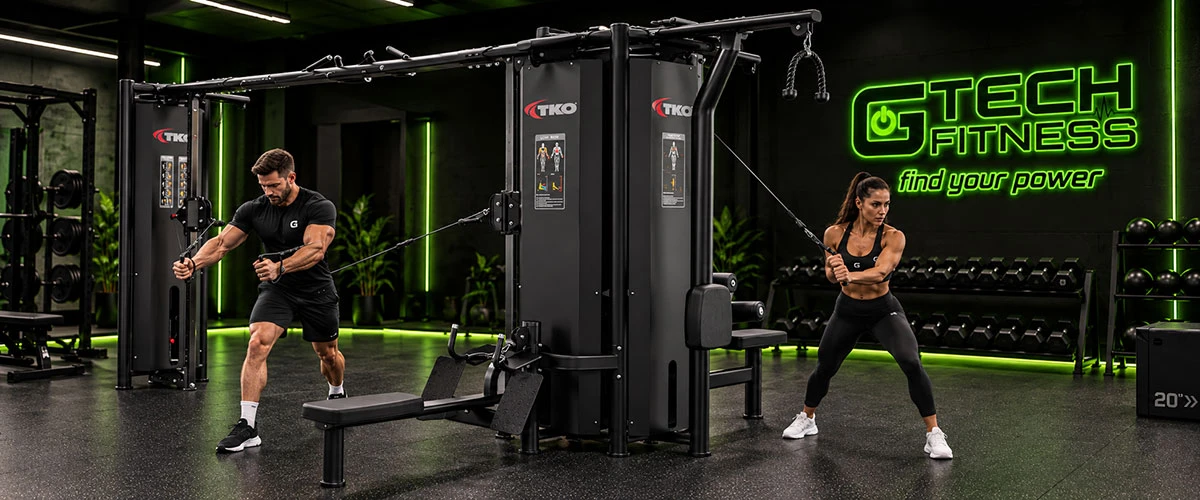
A Complete Guide to Cable Exercises, Pulley Positions and Attachments
Estimated Reading Time: 30 Minutes
Cable machine exercises can train nearly every major muscle group while letting you change the direction of resistance simply by moving the pulley, changing the attachment or adjusting your body position. A high pulley can support pulldowns, triceps work and cable crunches, a mid-height pulley can be used for rows, presses and rotational exercises, and a low pulley can support curls, raises, leg work and other movements. That versatility is one reason cable stations are common in home gyms, school weight rooms, training studios and commercial fitness centers.
This guide explains cable exercises for the back, chest, shoulders, arms, legs, glutes and core, along with common pulley positions and cable attachments. You will also learn how functional trainers, cable crossovers and single cable columns differ, how to choose exercises that fit the station in front of you, and how to organize cable movements into practical workouts. If you are still learning the broader equipment categories found in a gym, our gym equipment identification guide provides a wider overview of strength machines, free weights, racks, benches and cardio equipment.
Quick Answer: Cable machines can train the back, chest, shoulders, biceps, triceps, legs, glutes and core. Common exercises include cable rows, pulldowns, chest presses, flyes, lateral raises, curls, triceps pressdowns, glute kickbacks, pull-throughs, hip abduction and adduction, cable crunches, Pallof presses and wood chops.
The best exercise depends on the pulley height, attachment, cable travel, available working space and design of the machine. Use the station's intended handles, adjustment points and exercise positions rather than assuming every cable machine supports every movement.
Table of Contents
- What Is a Cable Machine?
- Cable Machine Exercises at a Glance
- Cable Back Exercises
- Cable Chest Exercises
- Cable Shoulder Exercises
- Cable Bicep Exercises
- Cable Tricep Exercises
- Cable Leg and Glute Exercises
- Cable Core and Ab Exercises
- How to Choose the Right Pulley Height
- Cable Machine Attachments and What They Do
- Single-Pulley vs. Dual-Pulley Exercises
- Functional Trainer vs. Cable Crossover Exercises
- Example Cable Machine Workouts
- Cable Machines vs. Free Weights
- Choosing a Cable Machine for Home or Commercial Use
- Common Cable Exercise Mistakes
- Frequently Asked Questions
What Is a Cable Machine?
A cable machine transfers resistance from a weight stack, plate-loaded system or other resistance source through one or more cables and pulleys. The user connects a handle, bar, rope, strap or other approved attachment to the cable and moves against resistance. Because the cable can pull from different heights and directions, one station may support pressing, pulling, arm, shoulder, lower-body and core exercises.
The term cable machine covers several equipment layouts. A single cable column usually has one adjustable pulley carriage. A functional trainer commonly uses two independently adjustable pulleys. A cable crossover often uses two columns spaced farther apart. Other cable-based machines use fixed high and low pulleys for movements such as pulldowns and rows. Gtech Fitness offers adjustable cable strength machines in several configurations for different training spaces and user needs.
Why Cable Resistance Feels Different
With a cable exercise, the resistance follows the direction of the cable rather than always pulling straight toward the floor. Moving the pulley changes the line of pull, and changing your stance changes how that line of resistance meets the body. This allows the same station to create horizontal, vertical, diagonal and rotational exercise patterns without moving a large machine from place to place.
Fixed Pulley vs. Adjustable Pulley
A fixed pulley stays at one height, such as the high pulley on a traditional lat pulldown or the low pulley on a seated row station. An adjustable pulley moves along a vertical track and can be positioned high, low or somewhere in between. Adjustable systems provide more exercise variety, but fixed stations can offer easier setup for movements they are specifically designed to perform.
Cable Machine Exercises at a Glance
The table below organizes common cable exercises by body area, typical pulley position and attachment. These are general starting points rather than universal setup rules. The correct height and attachment can change with machine design, user height and the exact variation being performed.
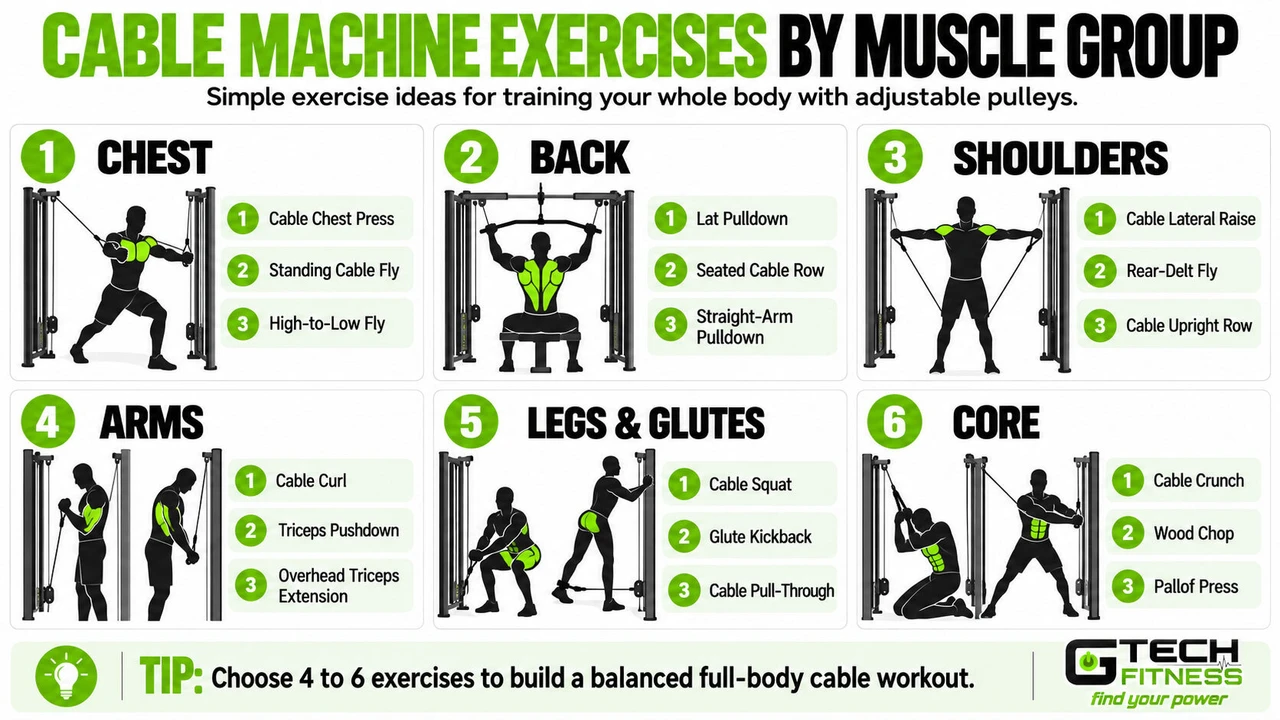
| Body Area | Cable Exercise | Typical Pulley Position | Common Attachment | Main Training Emphasis |
|---|---|---|---|---|
| Back | Cable row | Low to mid | D-handle, straight bar or row handle | Lats, mid-back, upper back |
| Back | Straight-arm pulldown | High | Straight bar or rope | Lats and shoulder extension |
| Chest | Cable chest press | Mid | Two D-handles | Chest, front shoulders, triceps |
| Chest | Cable fly | High, mid or low | Two D-handles | Chest through horizontal or angled adduction |
| Shoulders | Cable lateral raise | Low | D-handle | Side deltoids |
| Shoulders / Upper Back | Face pull | Upper-mid to high | Rope | Rear shoulders and upper-back muscles |
| Biceps | Cable curl | Low | Straight bar, curl bar or D-handle | Elbow flexors / biceps |
| Triceps | Triceps pressdown | High | Rope, straight bar or V-bar | Triceps / elbow extension |
| Glutes / Hips | Cable glute kickback | Low | Ankle strap | Glutes through hip extension |
| Posterior Chain | Cable pull-through | Low | Rope | Hip hinge, glutes and hamstrings |
| Core | Pallof press | Mid | D-handle | Anti-rotation / trunk stability |
| Abs | Cable crunch | High | Rope | Trunk flexion / abdominal muscles |
Cable Back Exercises
Cable back exercises can cover both horizontal and vertical pulling patterns. Rows bring the resistance toward the torso, while pulldown variations bring the arms downward from an overhead position. A balanced back program often includes both patterns because they place the arms and shoulder blades in different movement paths. Our back workout machine guide explains how cable movements compare with dedicated pulldown, row and back-extension stations.
Cable Row
A cable row uses a low or mid-height pulley while the user pulls the handle toward the torso. The exercise can be performed seated, standing or in a staggered stance depending on the station and available working space. Keep the torso controlled while drawing the handle back, then return smoothly without allowing the weight stack to pull the shoulders forward abruptly.
Single-Arm Cable Row
A single-arm row uses one handle and trains one side at a time. The unilateral setup can make it easier to adjust stance and arm path independently. Keep the body stable and avoid turning the exercise into a large torso rotation unless a rotational variation is intentionally being performed.
Straight-Arm Cable Pulldown
A straight-arm pulldown begins with the cable above the body and brings the attachment downward while the elbows remain only slightly bent. This emphasizes shoulder extension rather than the elbow-flexion pattern used in a traditional pulldown. A straight bar or rope is common, provided the attachment is approved for the station.
Lat Pulldown on a Cable Station
Some cable machines can support pulldown variations, but a functional trainer does not automatically replace a dedicated lat pulldown. A traditional pulldown station normally provides a seat and thigh restraint that help stabilize the user against the upward pull of the cable. If an adjustable cable system is designed for pulldowns, use its intended bench, seat or body position rather than improvising a restraint.
Face Pull
A face pull uses an upper-mid or high pulley and commonly a rope attachment. The user pulls toward the face or upper chest while the elbows move outward. The rear shoulders and upper-back muscles are heavily involved. Use a load that allows the arms and shoulder blades to move under control without turning the exercise into a backward body lean.
Cable Chest Exercises
Cable chest exercises generally use pressing or fly movements. A press bends and straightens the elbows while the arms move forward, whereas a fly keeps a softer elbow angle while the arms sweep inward. Adjustable cables allow these movements to be performed from different heights, but changing the cable angle does not isolate one small portion of the chest completely.
Standing Cable Chest Press
A standing cable chest press usually starts with two handles positioned around chest or shoulder height. Step into a stable stance and press the handles forward while keeping the trunk controlled. Because the user is not supported by a bench, stance and body position become part of the setup. A dual-pulley system is the most direct configuration for a two-arm press.
Cable Fly
A cable fly brings the arms inward from a wider starting position. The elbows remain slightly bent while the shoulders perform most of the movement. Mid-height pulleys create a more horizontal fly path, while higher or lower settings change the direction of the cable. Keep the movement controlled and avoid stretching farther than the shoulders can comfortably manage.
High-to-Low Cable Fly
For a high-to-low fly, the handles begin above shoulder level and move forward and downward in an arcing path. The exercise still trains the chest, with the cable angle changing the resistance direction. Use a stance that allows the cables to clear the body and machine frame throughout the repetition.
Low-to-High Cable Fly
A low-to-high fly begins with the pulleys near the bottom of the columns and brings the handles upward and inward. The movement can be useful when a lifter wants an upward pressing or fly angle without using a bench. Keep the ribs and torso controlled rather than using a large backward lean to move the weight.
Dedicated chest presses and pec fly machines provide a more fixed setup, while cables provide greater freedom to change the line of pull. If you are comparing both approaches, browse chest and shoulder strength machines to see how fixed-path pressing equipment differs from adjustable cable stations.
Cable Shoulder Exercises
Cables work well for shoulder raises because a low pulley can apply resistance from the beginning of the movement. They can also support rear-delt and face-pull variations from higher positions. Shoulder training is especially sensitive to individual comfort and range, so choose an arm path that can be controlled without forcing the joint into an uncomfortable position.
Cable Lateral Raise
A cable lateral raise usually uses a low pulley positioned beside or slightly behind the body. Hold a single handle and raise the arm outward under control. The exercise emphasizes the side deltoid. A light-to-moderate resistance is often enough because the long lever created by the arm increases the challenge.
Cable Front Raise
A front raise uses a low pulley while the arm moves forward and upward. It can be performed one arm at a time with a D-handle or with an appropriate bar attachment. Keep the torso upright and stop at a comfortable height rather than using momentum to continue the movement.
Cable Rear-Delt Fly
A rear-delt cable fly uses one or two cables around shoulder height. The arms move outward and back while the torso remains controlled. Cross-body starting positions can be used on some dual-pulley systems, but cable routing and working space must allow the handles to move without rubbing against the machine.
Single-Arm Cable Shoulder Press
Some adjustable cable columns can support a one-arm press from a low-to-mid pulley. The user presses upward while maintaining a stable stance. This is a different setup from a dedicated shoulder press machine because the resistance line is not fixed by a lever arm or guided press path.
Cable Bicep Exercises
Cable bicep exercises use elbow flexion while the upper arm position remains relatively stable. Low pulleys are most common because they allow the handle or bar to travel upward against resistance. Straight bars, angled curl bars, ropes and single handles can all create useful variations when they are compatible with the cable station.
Standing Cable Curl
A standing cable curl begins with the attachment connected to a low pulley. Keep the elbows near the sides of the body while curling the handle upward, then lower it smoothly. A straight or angled bar allows both arms to work together, while a single handle supports unilateral training.
Single-Arm Cable Curl
A single-arm cable curl lets each arm work independently. Stand far enough from the column to keep tension on the cable through the desired range while remaining inside the machine's intended exercise area. Avoid stepping so far away that the cable contacts the frame or reaches an unsuitable angle.
Rope Hammer Curl
A rope can be used from a low pulley for a neutral-grip curl. The hands remain in a more thumbs-up orientation while the elbows flex. The biceps and other elbow flexors contribute, with the grip changing how the exercise feels compared with a straight-bar curl.
Cable curls are one way to train the arms, but selectorized and plate-loaded arm stations provide a more supported path. Our biceps and triceps machines include dedicated and combination options for facilities that want guided arm-training stations.
Cable Tricep Exercises
Most cable triceps exercises use a high pulley so the user can press or extend the attachment downward or forward. The elbow is the primary moving joint, although shoulder position changes between pressdowns and overhead extensions. Attachment choice affects grip and hand position more than the basic purpose of the exercise.
Triceps Pressdown
A pressdown begins with the elbows bent and close to the body while the attachment is held around chest height. Extend the elbows until the arms reach a controlled finish, then return without letting the shoulders roll forward. Straight bars, V-bars and ropes are common options.
Rope Triceps Pressdown
The rope version allows the hands to move independently at the bottom of the repetition. Keep the elbows relatively stable and resist the urge to turn the movement into a full-body push. If the resistance requires substantial torso movement, reduce the load and re-establish the exercise position.
Overhead Cable Triceps Extension
An overhead extension positions the cable behind or above the user while the elbows bend and straighten overhead. A rope is often convenient because the hands can separate slightly. The setup requires adequate clearance from the cable column, so confirm that the station provides enough intended working space before beginning.
Single-Arm Cable Triceps Extension
A single-handle extension can be performed from several body positions depending on pulley height and machine design. Working one arm at a time can make it easier to adjust hand orientation and elbow position independently.
Cable Leg and Glute Exercises
Cable leg exercises usually use a low pulley and either an ankle strap, rope or handle. These movements can complement dedicated lower-body machines by adding hip extension, abduction, adduction or a cable-resisted squat or lunge pattern. Our leg workout machine guide compares cable movements with leg presses, hack squats, extensions, curls, hip stations and calf machines.
Cable Glute Kickback
A glute kickback connects an ankle strap to a low pulley while the working leg moves backward against resistance. Hold the machine's designated support point if the station provides one and keep the torso controlled. The goal is hip extension rather than creating a large lower-back movement to swing the leg farther behind the body.
Cable Hip Abduction
Hip abduction moves the leg away from the body's midline. Connect the ankle strap to a low cable, position the working leg so the cable can travel freely, and move outward under control. A small range performed with stable posture is more useful than leaning dramatically to move a heavier load.
Cable Hip Adduction
Hip adduction moves the leg toward the body's midline against resistance. The working leg typically starts farther from the pulley and moves inward. As with abduction, machine clearance matters because the cable needs an unobstructed path between the pulley and ankle strap.
Cable Pull-Through
A cable pull-through uses a low pulley and usually a rope. The user faces away from the machine with the cable traveling between the legs, then performs a hip-hinge pattern while keeping the attachment clear of the body. The exercise trains the glutes and hamstrings through hip extension. Use only a station with enough intended space to perform the movement without contacting the frame.
Cable Squats and Lunges
Some cable stations support squats, reverse lunges or split-stance exercises with the resistance coming from a low or mid-height pulley. These movements require more open floor space than a curl or pressdown. The cable should remain aligned with the intended exercise path rather than pulling across the frame or around another part of the machine.
Cable Core and Ab Exercises
Cable core exercises can train trunk flexion, rotation and anti-rotation. The important distinction is whether the torso is meant to move or resist movement. A cable crunch deliberately flexes the trunk, a wood chop uses rotation or diagonal movement, and a Pallof press challenges the trunk to resist rotation while the arms move away from the body.
Cable Crunch
A cable crunch typically uses a high pulley and rope while the user kneels or stands in an appropriate position below the cable. The torso flexes against resistance while the hips remain relatively controlled. Avoid turning the movement into a large arm pull; the attachment mainly connects the resistance to the body.
Pallof Press
The Pallof press uses a cable set around mid-torso height. Stand sideways to the pulley, hold the handle near the chest, and press the hands away while resisting the cable's attempt to rotate the body. The challenge comes from maintaining trunk position rather than turning toward the machine.
Cable Wood Chop
A wood chop moves the hands along a diagonal path while the torso and hips contribute according to the chosen variation. High-to-low and low-to-high versions create different resistance directions. Use a controlled range and make sure the cable can travel freely without crossing the machine frame.
Standing Cable Rotation
A standing rotation uses a mid-height pulley while the hands move across the body. Stance width, distance from the machine and the amount of hip movement determine how the exercise feels. Start with a manageable load so the trunk movement stays deliberate rather than being pulled by the weight stack.
Dedicated abdominal and low-back stations provide more guided trunk training. If your facility needs both cable versatility and fixed-path core equipment, compare ab and low-back machines with the cable movements above.
How to Choose the Right Pulley Height
Pulley height determines the direction from which the cable pulls. Rather than memorizing one exact notch for every exercise, think about the desired line of resistance. High settings pull downward, mid-height settings create a more horizontal line, and low settings pull upward. Your height and distance from the machine also change the effective cable angle.
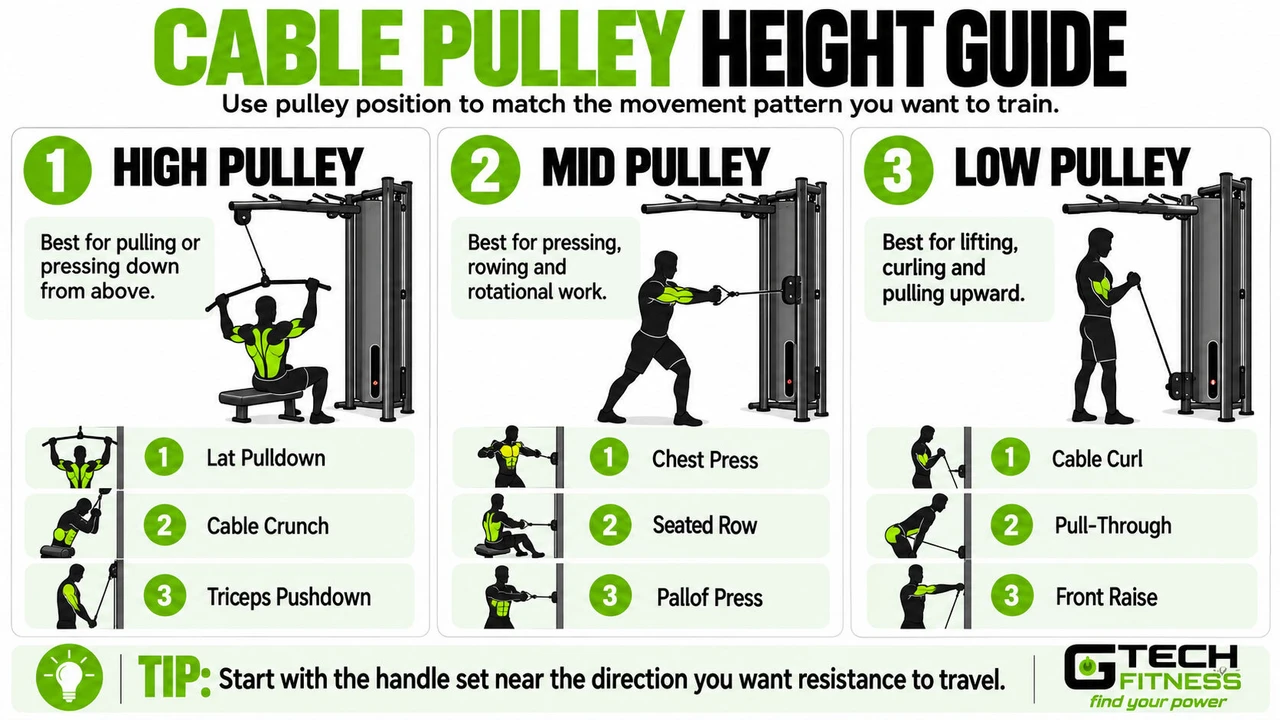
| Pulley Position | Resistance Direction | Common Exercise Examples |
|---|---|---|
| High | Downward or high-to-low | Pressdowns, straight-arm pulldowns, cable crunches, high-to-low flyes, some face pulls |
| Mid | Mostly horizontal | Chest presses, rows, flyes, Pallof presses, rotations, rear-delt flyes |
| Low | Upward or low-to-high | Curls, lateral raises, low-to-high flyes, kickbacks, abduction, adduction, pull-throughs |
Match the Pulley to the Exercise, Not the Label
Two users may choose slightly different pulley notches for the same exercise because of height, stance and machine geometry. The useful question is whether the cable remains aligned with the intended movement without pulling the body into an awkward position. If the cable angle feels wrong, adjust the pulley or your position rather than forcing the repetition.
Check Cable Travel Before You Start
Some exercises require more cable travel than others. Before increasing resistance, move through the exercise with a light load and confirm that the cable does not reach the end of its travel, contact the frame or create an unstable start or finish position.
Cable Machine Attachments and What They Do
Attachments change grip, hand spacing and the way the user connects to the cable. They do not automatically determine the exercise; the same rope can be used for pressdowns, curls, face pulls, crunches and pull-throughs. Compatibility matters, so use attachments that fit the machine's connection hardware and intended load.
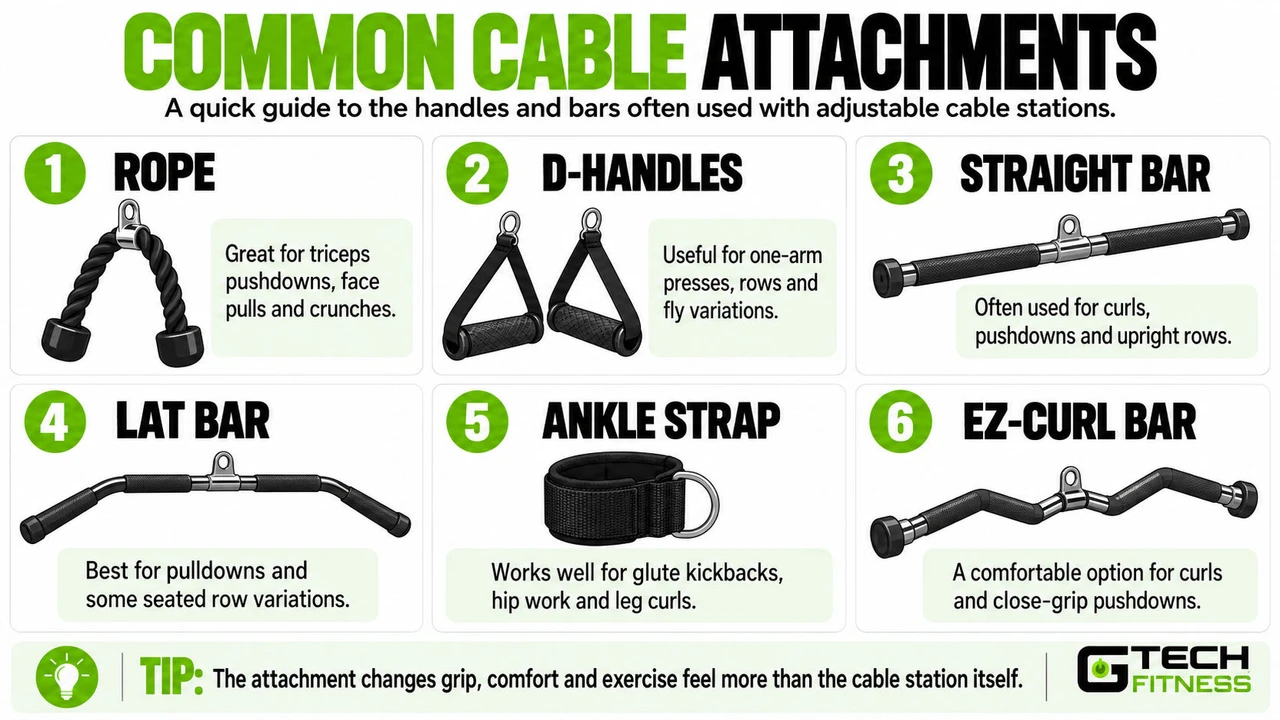
| Attachment | Common Uses | Why It Is Useful |
|---|---|---|
| Single D-Handle | Rows, presses, curls, raises, rotations, Pallof presses | Supports one-arm work and independent hand positioning |
| Triceps Rope | Pressdowns, overhead extensions, face pulls, curls, crunches, pull-throughs | Allows the hands to separate and change orientation |
| Straight Bar | Curls, pressdowns, rows, straight-arm pulldowns | Connects both hands to one attachment with fixed spacing |
| Angled Curl Bar | Curls and triceps extensions | Provides angled hand positions compared with a straight bar |
| Lat Bar | Pulldowns and some straight-arm pulling movements | Offers wider hand spacing on compatible high-pulley stations |
| Close-Grip Row Handle / V-Handle | Seated rows and some pulldown variations | Keeps the hands close together with a compact neutral-style grip |
| Ankle Strap | Kickbacks, hip abduction, hip adduction and other approved leg movements | Connects low-cable resistance to the lower leg or ankle area |
A well-chosen attachment set can make one pulley station much more versatile. Gtech Fitness carries cable machine attachments including grips, bars, ropes and specialty handles for compatible strength equipment.
Single-Pulley vs. Dual-Pulley Exercises
A single cable column uses one adjustable cable line, while a dual-pulley station provides two independent cable paths. Both can support full-body training, but the exercise setup differs. A single column is especially useful for unilateral movements, rows, curls, pressdowns, raises and rotational work. A dual-pulley system makes bilateral flyes, presses, cross-body movements and other two-handle exercises easier to set up.
Exercises That Work Well on a Single Cable Column
Single-arm rows, curls, triceps extensions, lateral raises, Pallof presses, wood chops, glute kickbacks and hip abduction/adduction are natural fits for one adjustable cable. Bilateral exercises can still be possible with one cable when a bar or rope connects both hands to the same resistance line.
Exercises That Benefit from Two Independent Cables
Standing chest presses, cable flyes, reverse flyes and some bilateral shoulder movements are easier to perform when each hand has its own cable. Independent resistance also lets each arm move through its own path rather than being linked by one bar.
Functional Trainer vs. Cable Crossover Exercises
The terms functional trainer and cable crossover overlap, and manufacturers do not always use them the same way. In general, a functional trainer uses two adjustable pulleys on a relatively compact frame, while a traditional cable crossover places the pulley columns farther apart. Both can support multi-angle cable training when the pulleys adjust through enough height positions.
Functional Trainer Exercises
A functional trainer is well suited to presses, rows, flyes, curls, triceps work, raises, rotations, core exercises and many lower-body cable movements. The closer column spacing can make the machine easier to fit into a home gym or smaller training area, while still providing two independent cable paths.
Cable Crossover Exercises
A wider cable crossover provides more space between the columns, which can be useful for flyes, cross-body movements and exercises that require the user to stand between the stacks. Some crossover systems also include fixed high and low pulleys or pull-up bars. The wider footprint can be useful in commercial gyms but requires more floor space.
Is One Better for Exercise Variety?
Not automatically. Pulley adjustment range, cable travel, weight-stack resistance, column spacing, included handles and available floor space all matter. A compact functional trainer with long cable travel may support more practical exercises in a small room than a larger crossover that does not fit the space well.
Example Cable Machine Workouts
You do not need dozens of cable exercises in one workout. Choose a few movements that cover the major patterns you want to train, learn the setup, and add complexity only when it improves the program. The examples below are illustrative templates rather than required prescriptions. Training experience, weekly schedule, recovery and available equipment should determine the final routine.
Beginner Full-Body Cable Machine Workout
This example keeps the exercise list short and covers pushing, pulling, lower-body and core work. Use movements your specific station supports and begin with resistance that allows controlled repetitions.
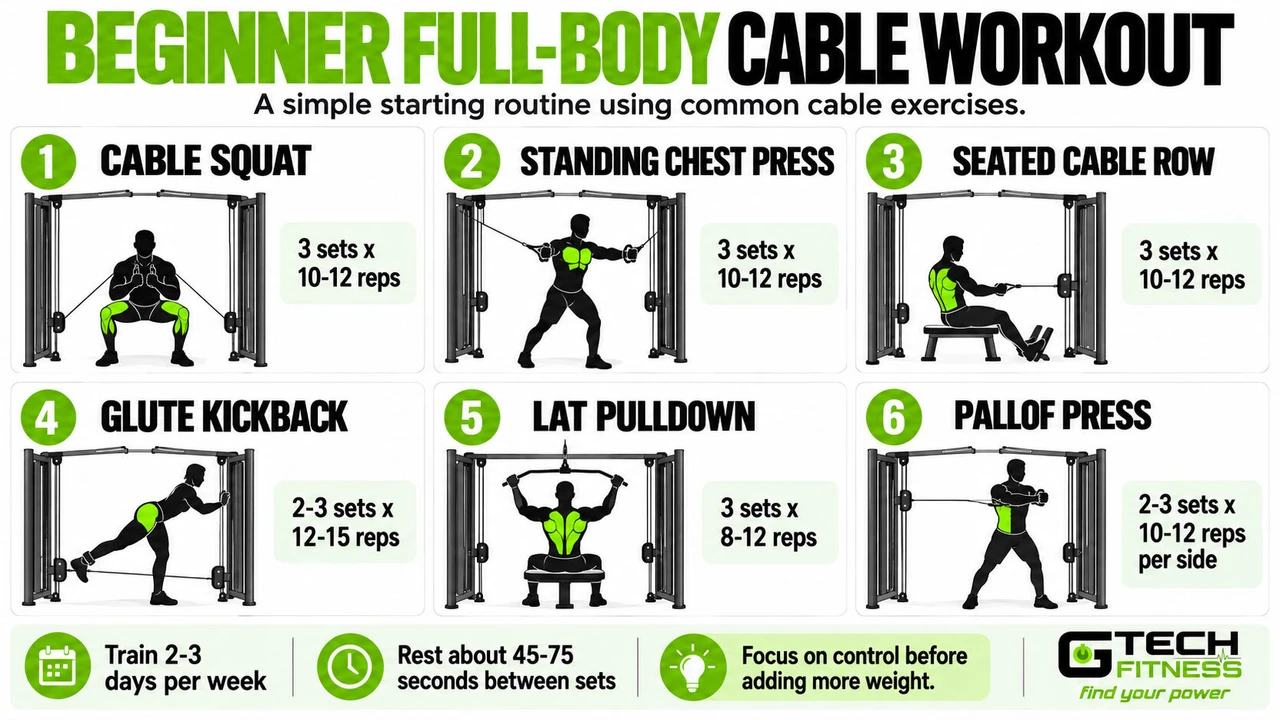
| Exercise | Sets | Repetitions | Focus |
|---|---|---|---|
| Cable chest press | 2 | 8-12 | Chest, shoulders, triceps |
| Cable row | 2 | 8-12 | Back and arms |
| Cable squat or reverse lunge | 2 | 8-12 | Lower body |
| Cable lateral raise | 1-2 | 10-15 | Shoulders |
| Cable curl or triceps pressdown | 1-2 | 10-15 | Arms |
| Pallof press | 2 | 8-12 per side | Core / anti-rotation |
Warm up with easy movement and lighter practice repetitions before working sets. If you are new to resistance training, our beginner strength training guide explains basic exercise selection, progression and workout organization.
Upper-Body Cable Workout
| Exercise | Sets | Repetitions |
|---|---|---|
| Standing cable chest press | 3 | 8-12 |
| Cable row | 3 | 8-12 |
| Cable lateral raise | 2 | 10-15 |
| Cable curl | 2 | 10-15 |
| Triceps pressdown | 2 | 10-15 |
Lower-Body and Core Cable Workout
| Exercise | Sets | Repetitions |
|---|---|---|
| Cable squat or reverse lunge | 3 | 8-12 |
| Cable pull-through | 2-3 | 8-15 |
| Glute kickback | 2 | 10-15 per side |
| Pallof press | 2 | 8-12 per side |
| Cable crunch | 2 | 10-15 |
Cable Machines vs. Free Weights
Cables and free weights both provide useful strength-training options, but the resistance behaves differently. Dumbbells and barbells are primarily loaded by gravity, while a cable can pull from the direction of the pulley. This makes cables convenient for horizontal and diagonal resistance patterns that would require a different body position with a free weight.
Advantages of Cable Machines
Cable stations can support many exercises from one footprint, change resistance quickly, and allow the line of pull to be adjusted. Dual adjustable pulleys also make unilateral and bilateral exercises easy to switch between. In shared facilities, one machine can serve users training several different body areas without requiring a separate selectorized station for every movement.
Advantages of Free Weights
Barbells, dumbbells and kettlebells allow the user to control the resistance path without being connected to a pulley or machine frame. They support squats, presses, rows, hinges, carries and many other movements while being easy to combine with racks and benches. Gtech Fitness offers free-weight strength equipment for facilities that want both machine-based and unrestricted resistance training.
Can You Use Both in the Same Program?
Yes. A workout might use barbell squats and dumbbell presses for larger free-weight movements, then add cable rows, lateral raises, curls, triceps work or Pallof presses. Another program might use a functional trainer as the primary resistance system and add dumbbells only where they provide a useful movement or loading option.
Choosing a Cable Machine for Home or Commercial Use
If you are buying a cable machine rather than simply using one, start with the exercises you want to perform, the available floor space and the expected users. A compact home gym may prioritize a functional trainer with two adjustable pulleys, while a commercial facility may want a wider crossover, multiple cable columns or a multi-station system that lets several people train at once.
Home Gyms: Prioritize Versatility per Square Foot
A home cable machine should earn its floor space by covering movements that complement the rest of the gym. If you already have a rack, bench and free weights, an adjustable cable station can add flyes, pulldown-style movements, arm exercises, raises, rotations and lower-body accessory work. Measure the machine plus the working space needed in front of and beside the pulleys. Our home gym planning guide explains how to account for equipment footprint, flooring and movement clearance.
School Weight Rooms: Consider Adjustment Speed and Supervision
School and college facilities should use equipment rated for the intended institutional environment. Pulley carriages, attachment changes and weight-stack adjustments should be straightforward enough for repeated use, and the machine should fit the traffic pattern of the room. Gtech Fitness provides school weight-room equipment for K-12, college and athletic training settings.
Commercial Gyms: Plan for User Traffic
A busy commercial gym may benefit from several cable stations rather than relying on one functional trainer for every user. Separate cable columns, crossover stations, lat pulldown/row machines and multi-station gyms can reduce bottlenecks while giving members multiple exercise options. Column spacing and working areas should also allow adjacent users to move without interfering with one another.
Home vs. Commercial Cable Machines
The exercise list alone does not determine whether a cable machine is appropriate for a particular facility. A home-use functional trainer and a commercial functional trainer may support similar movements while differing in construction, adjustment hardware, component durability, intended traffic level and overall size. Our home vs. commercial fitness equipment guide explains why the equipment-use rating should match the training environment.
| Planning Question | What to Check |
|---|---|
| How many independent cable paths are needed? | Single column, dual adjustable pulleys, crossover or multi-station configuration |
| Which exercises are priorities? | Presses, rows, pulldowns, flyes, arm work, lower-body movements, core training |
| How much pulley adjustment is available? | Number and range of carriage positions from low to high |
| Is cable travel sufficient? | Usable movement range for the exercises you intend to perform |
| What attachments are compatible? | Included handles, connection style and approved accessory options |
| How much working space is required? | Machine footprint plus room for stepping, pressing, rowing and cross-body movements |
Common Cable Exercise Mistakes
Standing Too Far From the Machine
More distance does not automatically make a cable exercise better. Stepping too far away can use excessive cable travel, change the intended line of pull or place the user outside the machine's working area. Position yourself far enough to maintain appropriate cable tension without stretching the station beyond the exercise setup it was designed to support.
Using the Wrong Pulley Height
If the pulley is too high or too low, the cable may pull the body in a direction that does not match the intended movement. Adjust the carriage until the line of resistance fits the exercise and your body position rather than forcing your shoulders, arms or trunk to compensate.
Letting the Weight Stack Slam
Allowing the stack to drop between repetitions reduces control and can make setup inconsistent. Keep both the working and return phases deliberate so the cable remains tensioned and the attachment follows a predictable path.
Using Momentum Instead of Resistance
Large body swings, abrupt leaning or twisting can shift the exercise away from the intended movement. Some cable exercises intentionally use the hips or torso, but that movement should be part of the exercise rather than an uncontrolled response to excessive resistance.
Crossing the Cable Over the Frame
The cable should travel through its intended pulley path without rubbing against uprights, weight-stack shrouds or other machine components. If the exercise requires the cable to wrap around the frame or pull sharply sideways from the pulley, choose a different setup.
Assuming Every Cable Machine Supports Every Exercise
Functional trainers, cable crossovers, single columns and fixed high/low pulley stations differ in cable travel, pulley adjustment, attachments, column spacing and available support features. Use the machine in front of you rather than assuming a movement shown on another cable system will work the same way.
Frequently Asked Questions
What exercises can you do on a cable machine?
A cable machine can support rows, pulldowns, chest presses, flyes, lateral raises, rear-delt flyes, curls, triceps pressdowns, overhead triceps extensions, glute kickbacks, hip abduction and adduction, pull-throughs, cable crunches, Pallof presses, wood chops and other movements depending on the machine design, attachments and available working space.
Can you get a full-body workout with a cable machine?
Yes. An adjustable cable station can train pushing, pulling, arms, shoulders, lower body and core. A full-body workout might combine a cable press, row, squat or lunge variation, arm exercise and anti-rotation core movement. The exact exercise list should match the capabilities of the machine.
What pulley height should I use for cable exercises?
High pulleys are commonly used for pressdowns, straight-arm pulldowns, crunches and high-to-low movements. Mid-height pulleys work well for rows, presses, flyes and rotational exercises. Low pulleys are common for curls, raises, leg exercises, pull-throughs and low-to-high movements. Adjust the exact height for your body and the cable angle you need.
What is the difference between a functional trainer and a cable crossover?
Both use adjustable cable pulleys, and the names sometimes overlap. A functional trainer usually places two adjustable pulleys on a relatively compact frame, while a traditional cable crossover often spaces the columns farther apart. Column width, cable travel and pulley range matter more than the label alone.
What cable attachment is best for back exercises?
It depends on the movement. D-handles work well for single-arm rows, row handles or straight bars can be used for bilateral rows, lat bars are common on pulldown stations, and ropes can be useful for face pulls or straight-arm pulldowns. Use attachments that are compatible with the machine and fit the exercise.
What cable attachment is best for triceps?
Ropes, straight bars and V-bars are all common for triceps pressdowns. A rope is also useful for overhead extensions because the hands can separate. The best choice is the one that provides a comfortable grip and works with the pulley station.
Are cable machines good for beginners?
They can be. Weight-stack cable machines often make resistance changes simple, and adjustable pulleys let beginners practice several movement patterns from one station. The main challenge is learning where to position the pulley, body and attachment, so begin with a small exercise selection and manageable resistance.
Are cable machines better than free weights?
Neither is automatically better for every goal. Cables make it easy to change the resistance direction and perform multi-angle exercises, while free weights provide unrestricted movement and work well for many large compound lifts. Many training programs use both.
Can cable machines build muscle?
Cable exercises can provide progressive resistance for the chest, back, shoulders, arms, legs and core. Building muscle depends on the overall training program, including exercise selection, resistance, volume, progression, recovery and nutrition rather than the resistance system alone.
Can you train legs on a cable machine?
Yes. Depending on the station, common options include glute kickbacks, hip abduction, hip adduction, pull-throughs, cable squats and lunge variations. Dedicated leg machines and free weights can provide additional lower-body movements when a cable station does not offer the required setup or loading.
How many cable exercises should I do in one workout?
You do not need to perform every cable exercise in one session. Choose movements that cover the muscle groups and patterns required by your program. A beginner full-body session may use only a few cable exercises, while an experienced lifter might use cables mainly for accessory work after other strength movements.
Do I need cable attachments to use a cable machine?
Most cable machines require some type of handle, bar, rope, strap or machine-specific connection for many exercises. The exact attachments included with the machine vary, and additional accessories should only be used when they are compatible with the cable connection and intended resistance.
EXPLORE POPULAR ARTICLES
-
Cable Machine Exercises: Complete Guide
Oct 09, 2026A Complete Guide to Cable Exercises, Pulley Positions and Attachments Estimated Reading Time: 30 Min
-
Leg Workout Machines: Names, Exercises & Muscles Worked
Oct 09, 2026A Complete Guide to Leg Machines, Exercises and Muscles Worked Estimated Reading Time: 30 Minutes Le
-
Back Workout Machines: Names, Exercises & Muscles Worked
Oct 07, 2026A Complete Guide to Back Machines, Exercises and Muscles Worked Estimated Reading Time: 30 Minutes B