Gym Equipment Names: Machines, Free Weights & Uses
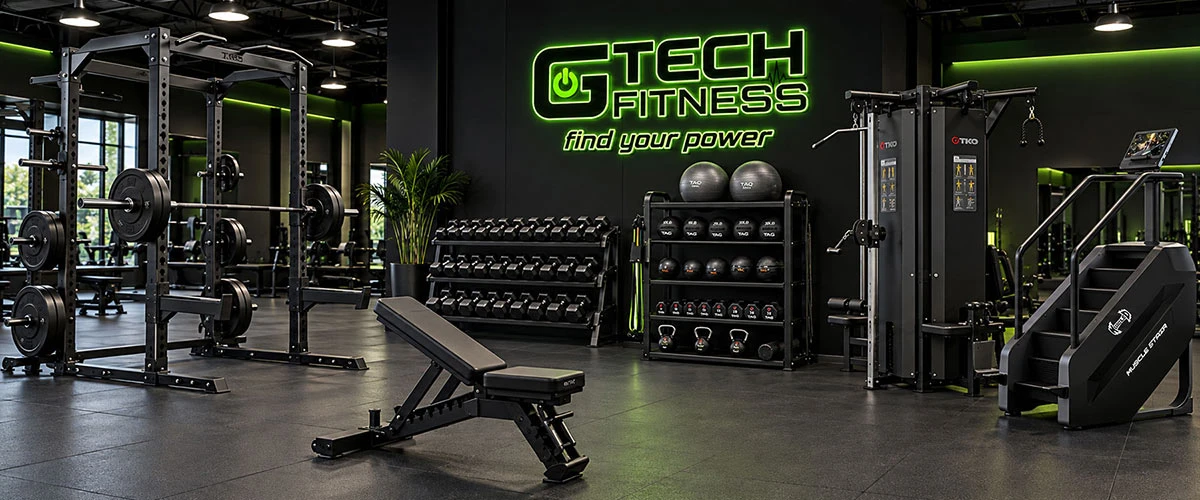
Learn the Names of Common Gym Equipment and What Each Piece Does
Estimated Reading Time: 28 Minutes
Gym equipment names can be confusing because the same movement may appear on several different machine designs, and manufacturers do not always use identical terminology. A chest press may be selectorized or plate-loaded, a leg press may use a sled or a pivoting lever, and a cable station may be called a functional trainer, cable crossover, or adjustable pulley system depending on its layout.
This guide identifies the most common machines, free weights, benches, racks, cardio equipment, and functional training tools you are likely to see in a home gym, school weight room, hotel fitness room, training studio, or commercial fitness center. Each section explains what the equipment is called, what it is designed to do, common alternate names, and where it fits within a complete training space.
Quick Answer: The most common gym equipment names include dumbbells, barbells, weight plates, kettlebells, power racks, squat racks, weight benches, Smith machines, cable machines, chest presses, shoulder presses, lat pulldowns, seated rows, leg presses, leg extensions, leg curls, functional trainers, treadmills, ellipticals, exercise bikes, rowing machines, and stair climbers.
The easiest way to identify unfamiliar equipment is to first determine its category: free weight, rack or bench, selectorized machine, plate-loaded machine, cable system, bodyweight station, cardio machine, or functional training accessory. From there, look at the direction of movement, body position, pads or handles, and resistance system.
Table of Contents
- Main Types of Gym Equipment
- Common Gym Equipment Names at a Glance
- Free Weight Equipment Names
- Gym Racks and Weight Bench Names
- Upper-Body Gym Machine Names
- Lower-Body Gym Machine Names
- Cable and Multi-Station Gym Equipment
- Bodyweight and Core Equipment Names
- Cardio Machine Names
- Functional Training Equipment Names
- Gym Equipment Names by Muscle Group
- How to Identify an Unknown Gym Machine
- How Beginners Should Approach Unfamiliar Equipment
- Home vs. Commercial Gym Equipment
- Frequently Asked Questions
Main Types of Gym Equipment
Gym equipment is easier to understand when it is grouped by how resistance is created and how the user interacts with it. Some equipment leaves the movement almost completely under your control, while other equipment guides the resistance through a defined path. Cardio machines create a different type of training demand, and benches or racks may support an exercise without providing resistance themselves.
Free Weights
Free weights include dumbbells, barbells, weight plates, kettlebells, fixed barbells, and similar implements that are not attached to a machine. The lifter controls the path of the weight. They can support a very large exercise library and are common in home gyms, athletic facilities, school weight rooms, and commercial fitness centers.
Selectorized Weight Machines
A selectorized machine uses a built-in weight stack and a removable selector pin or another integrated load-selection system. The user changes resistance without carrying loose plates. Chest presses, leg extensions, lat pulldowns, seated rows, and many other single- or dual-function machines are available in selectorized designs.
Plate-Loaded and Leverage Machines
Plate-loaded machines use loose weight plates as resistance. Many use pivoting leverage arms rather than cables and a weight stack. The machine guides much of the movement while allowing the facility to use the same Olympic plates found in the free-weight area. Plate-loaded leg presses, chest presses, rows, squat machines, and shoulder presses are common examples.
Cable Machines
Cable systems transfer resistance through pulleys and cables. Depending on the design, the pulley may be fixed or adjustable through many heights. Cable columns, functional trainers, cable crossovers, and lat pulldown/low-row stations belong to this family and can support pressing, pulling, arm, shoulder, lower-body, and core exercises.
Racks, Benches and Support Stations
Power racks, squat racks, weight benches, pull-up stations, and similar structures do not necessarily create resistance themselves. Instead, they position the lifter, support a barbell or dumbbells, and provide the framework for free-weight or bodyweight exercises.
Cardio Machines
Treadmills, ellipticals, exercise bikes, rowers, and stair climbers are designed primarily for cardiovascular and endurance training. They may use motors, flywheels, magnetic resistance, air resistance, friction, or the user's body weight depending on the machine.
Common Gym Equipment Names at a Glance
The infographic and reference table below introduce common gym equipment names, categories, uses, and alternate names. Many pieces support multiple exercises and muscle groups, so these summaries focus on helping you recognize equipment rather than explaining every possible workout.
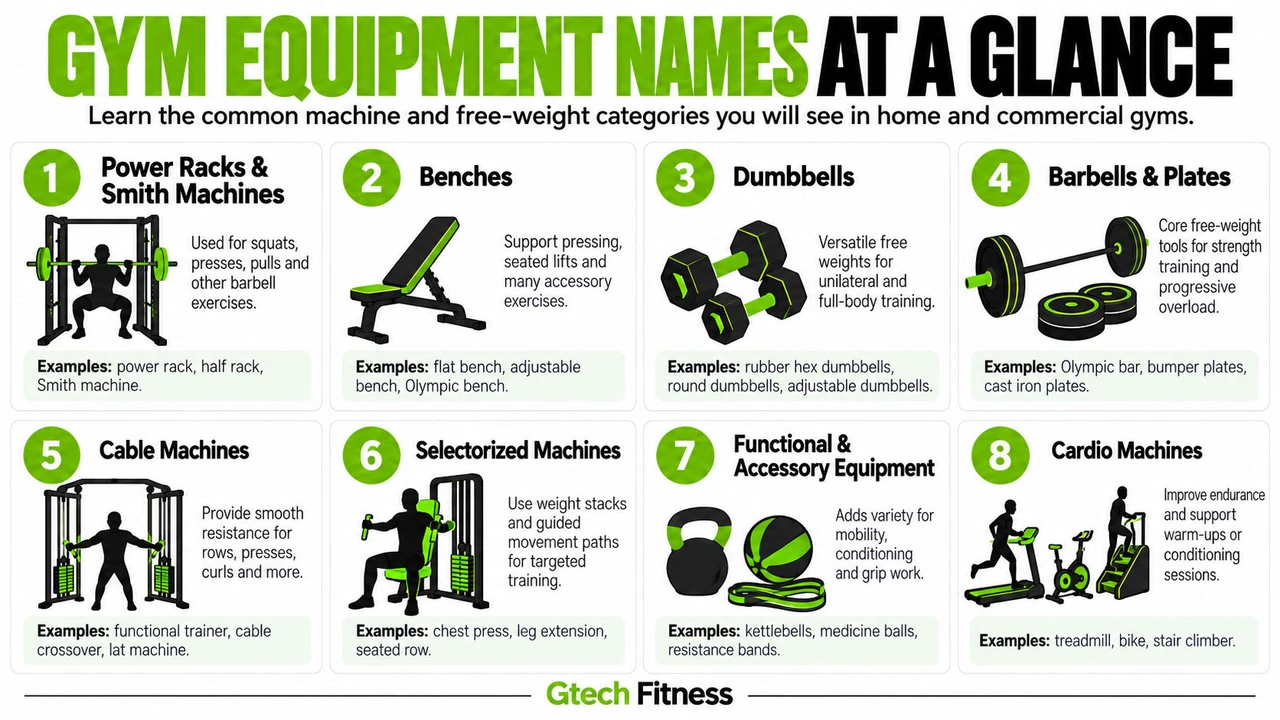
| Equipment Name | Category | Common Use | Common Alternate Name |
|---|---|---|---|
| Dumbbell | Free weight | Presses, rows, squats, hinges, curls and carries | Hand weight |
| Barbell | Free weight | Squats, presses, deadlifts and rows | Weight bar |
| Power Rack | Rack | Barbell squats, presses and rack exercises | Power cage |
| Adjustable Bench | Bench | Flat, incline and sometimes decline exercises | FID bench |
| Smith Machine | Guided bar system | Squats, presses, lunges and other guided bar exercises | Smith rack |
| Chest Press | Weight machine | Horizontal pressing for chest, shoulders and triceps | Machine press |
| Lat Pulldown | Weight/cable machine | Vertical pulling for the back and arms | High pulley |
| Seated Row | Weight/cable machine | Horizontal pulling for the upper back and arms | Mid row or low row |
| Leg Press | Weight machine | Lower-body pressing | Seated, horizontal or 45-degree leg press |
| Leg Extension | Weight machine | Quadriceps isolation | Knee extension machine |
| Leg Curl | Weight machine | Hamstring isolation | Hamstring curl |
| Functional Trainer | Cable machine | Adjustable multi-angle cable exercises | Dual adjustable pulley |
| Power Tower | Bodyweight station | Pull-ups, dips and knee raises | VKRs/pull-up dip station |
| Treadmill | Cardio | Indoor walking or running | Running machine |
| Elliptical | Cardio | Low-impact elliptical stepping motion | Cross-trainer |
| Exercise Bike | Cardio | Indoor cycling | Stationary bike |
Free Weight Equipment Names
The free-weight area contains some of the most recognizable equipment in a gym, but the names can become confusing once different bar styles, plate types, and dumbbell designs are involved. These pieces allow the lifter to control the path of the resistance rather than following a fixed machine track.
Dumbbells
Dumbbells are handheld weights used individually or as a pair. They may have fixed heads or an adjustable design that allows the resistance to change. Common fixed styles include rubber hex, round rubber, urethane, pro-style, cast iron, and aerobic dumbbells. Dumbbells can be used for pressing, rowing, squatting, lunging, hinging, curling, triceps work, raises, carries, and many other movements.
Barbells
A barbell is a long bar designed to hold weight in both hands. Olympic barbells use rotating sleeves sized for Olympic plates and are common in strength training, school weight rooms, and commercial gyms. Barbells support squats, bench presses, overhead presses, deadlifts, rows, cleans, snatches, and other loaded movements.
EZ Curl Bars
An EZ curl bar is a shorter bar with angled hand positions. The bends create multiple grip options for curls, triceps extensions, and similar arm exercises. You may also hear it called an EZ bar or curl bar. Some versions use Olympic-size rotating sleeves, while others use standard-size sleeves or are manufactured as fixed-weight barbells.
Trap Bars or Hex Bars
A trap bar places the lifter inside or between the loaded portions of the bar rather than behind a straight bar. Many are hexagonal, which explains the alternate name hex bar. Trap bars are commonly used for deadlifts, loaded carries, shrugs, and lower-body strength work. Handle height and frame shape vary by model.
Weight Plates
Weight plates provide resistance for barbells, plate-loaded machines, and other strength equipment. Common names include Olympic plates, standard plates, bumper plates, grip plates, rubber-coated plates, urethane plates, and cast-iron plates. The important distinction is compatibility: Olympic plates and standard plates use different center-hole sizes and require matching bars or loading posts.
Bumper Plates
Bumper plates are full-diameter weight plates designed primarily for barbell training where the plates may contact the platform or floor under appropriate conditions. They are commonly associated with Olympic lifting and deadlift variations. Unlike small-diameter iron plates, bumper plates typically maintain a consistent outside diameter across multiple weight increments.
Kettlebells
Kettlebells place the mass below a large top handle. The offset shape supports exercises such as goblet squats, deadlifts, swings, cleans, presses, rows, and carries. Kettlebells may use cast-iron, powder-coated, vinyl-coated, rubber-coated, or competition-style construction depending on the intended setting and use.
Medicine Balls
Medicine balls are weighted exercise balls used for throws, passes, rotational work, core exercises, partner drills, and general conditioning. They should not automatically be treated as slam balls; ball construction differs, and equipment intended for repeated high-impact slams is designed differently from many traditional medicine balls.
Fixed Barbells
Fixed-weight barbells have permanently attached weight ends rather than removable plates. Commercial gyms often store complete straight-bar and EZ-curl-bar sets on vertical or horizontal racks. They provide fast weight changes for curls, rows, presses, lunges, and other exercises where a full Olympic barbell setup may be unnecessary.
Gym Racks and Weight Bench Names
Racks and benches form the structural foundation of many strength areas. Their names describe the type of support they provide, the amount of enclosure around the lifter, or the positions the bench can achieve.
Power Rack
A power rack is a four-post or similarly enclosed lifting structure that supports a barbell at adjustable heights. These strength training racks usually accept J-cups or bar catches and safety arms or straps, allowing exercises to begin from different positions. Power racks are used for squats, bench presses, overhead presses, rack pulls, pull-ups, and many accessory movements. The term power cage is often used for the same type of equipment.
Half Rack
A half rack provides a more open lifting area than a full power rack while still offering adjustable bar supports and safeties. It is common in school and commercial strength rooms where coaches want a durable barbell station with easier side access and a somewhat more open footprint.
Squat Rack or Squat Stand
A squat rack supports a loaded barbell for squats and related exercises. Designs range from compact independent stands to larger connected frames. Unlike a fully enclosed power rack, a squat stand usually provides less surrounding structure. The exact terms vary between manufacturers, which is why looking at the frame design is often more useful than relying on the product name alone.
Flat Weight Bench
A flat bench provides a fixed horizontal pad for dumbbell presses, barbell work inside a rack, rows, step-ups, seated exercises, and other movements. It is different from an Olympic bench press station because a standalone flat bench does not include built-in barbell uprights.
Adjustable Weight Bench
Adjustable benches change back-pad and, on many models, seat angles. Common positions include flat and several incline settings; some models also provide decline. This is why many adjustable benches are described as FID benches, short for flat, incline, decline.
Olympic Bench Press
An Olympic bench press combines a bench and barbell uprights into one station. Flat, incline, and decline versions are available. These stations are built specifically for barbell pressing and are common in school and commercial strength rooms where permanent dedicated lifting stations are useful.
Preacher Curl Bench
A preacher curl bench supports the upper arms on an angled pad during curls. Some are standalone benches used with a curl bar or dumbbells, while others are integrated into selectorized or plate-loaded arm machines. The name describes the supported curling position rather than one specific resistance system.
Smith Machine
Smith machines use a barbell attached to guide rails. The rails control the bar path, and built-in hooks or safety stops allow the bar to be secured at multiple heights. Smith systems are commonly used for squats, presses, lunges, calf raises, rows, and other strength exercises where a guided bar path is preferred.
Upper-Body Gym Machine Names
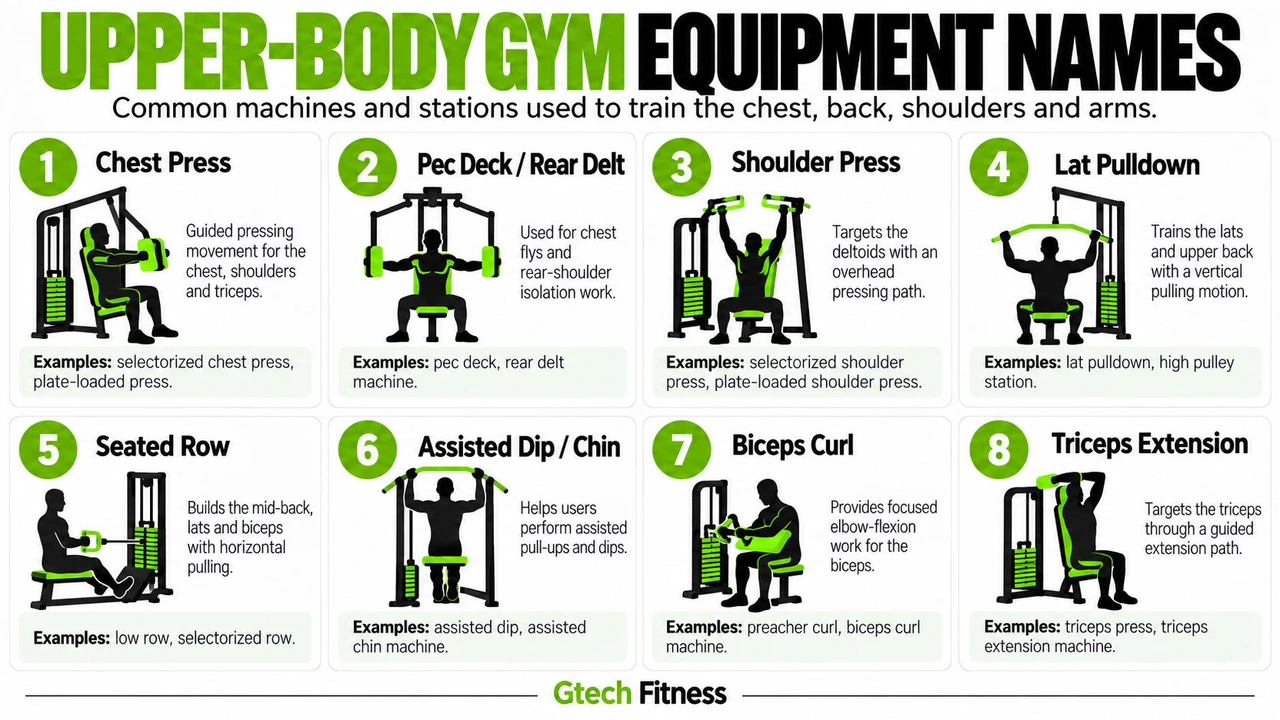
Upper-body machines are often named for either the movement they create or the muscle group they emphasize. Some are dedicated to one exercise, while dual-function machines may combine two related movements.
Chest Press Machine
A chest press guides a horizontal or slightly angled pressing motion from a seated or supported position. It primarily trains the chest while the shoulders and triceps assist. Selectorized, plate-loaded, converging-arm, and multi-press upper-body press machines are common. A machine labeled multi chest press may allow different seat or handle positions for flat, incline, or shoulder-oriented pressing.
Pec Fly / Rear Delt Machine
A pec fly machine brings the arms together in front of the torso to emphasize the chest. Many commercial units reverse the user position or handle direction to perform a rear-delt fly for the back of the shoulders and upper back. Common names include pec deck, chest fly, rear-delt machine, and pec fly/rear delt.
Shoulder Press Machine
A shoulder press machine guides an overhead pressing movement. The deltoids are the main target, with the triceps and upper chest contributing. The machine may use a selectorized stack, plates, or leverage arms. Some designs use independent arms so the left and right sides can move separately.
Lateral Raise Machine
A lateral raise machine applies resistance as the upper arms move outward to the sides. It is designed primarily for the lateral portion of the deltoids. The user may press against elbow or forearm pads rather than gripping a traditional handle, depending on the machine design.
Lat Pulldown Machine
Lat pulldown machines use an overhead resistance path for vertical pulling. The lats and other upper-back muscles perform much of the work while the biceps and forearms assist. Some units are dedicated pulldowns; others combine a high pulley with a low-row position in the same machine.
Seated Row Machine
A seated row moves resistance toward the torso in a horizontal pulling pattern. Common versions include cable rows, selectorized mid rows, chest-supported leverage rows, and independent-arm plate-loaded rows. The upper back, lats, rear shoulders, and biceps are commonly involved. Manufacturers may use names such as mid row, low row, seated row, or leverage row.
Assisted Pull-Up / Dip Machine
An assisted pull-up and dip machine uses a counterbalanced platform or knee pad to offset part of the user's body weight. Adding more assistance makes the bodyweight movement easier. These assisted chin and dip machines are useful for progressive pull-up and dip training and are sometimes called chin/dip assist machines.
Biceps Curl Machine
Biceps curl machines support the upper arm while resistance is applied through elbow flexion. They may resemble a preacher curl bench but include their own selectorized or plate-loaded resistance. Handle style and arm-pad angle vary, but the machine's purpose is focused biceps training.
Triceps Press or Dip Machine
Triceps machines guide an elbow-extension or pressing motion that emphasizes the triceps. A seated triceps press or seated dip usually uses handles beside the torso that are pushed downward. Other arm machines combine biceps curls and triceps extensions in one dual-function station.
Lower-Body Gym Machine Names
Lower-body equipment includes large compound machines as well as smaller isolation stations. The name often tells you which joint action or exercise the machine is designed to reproduce.
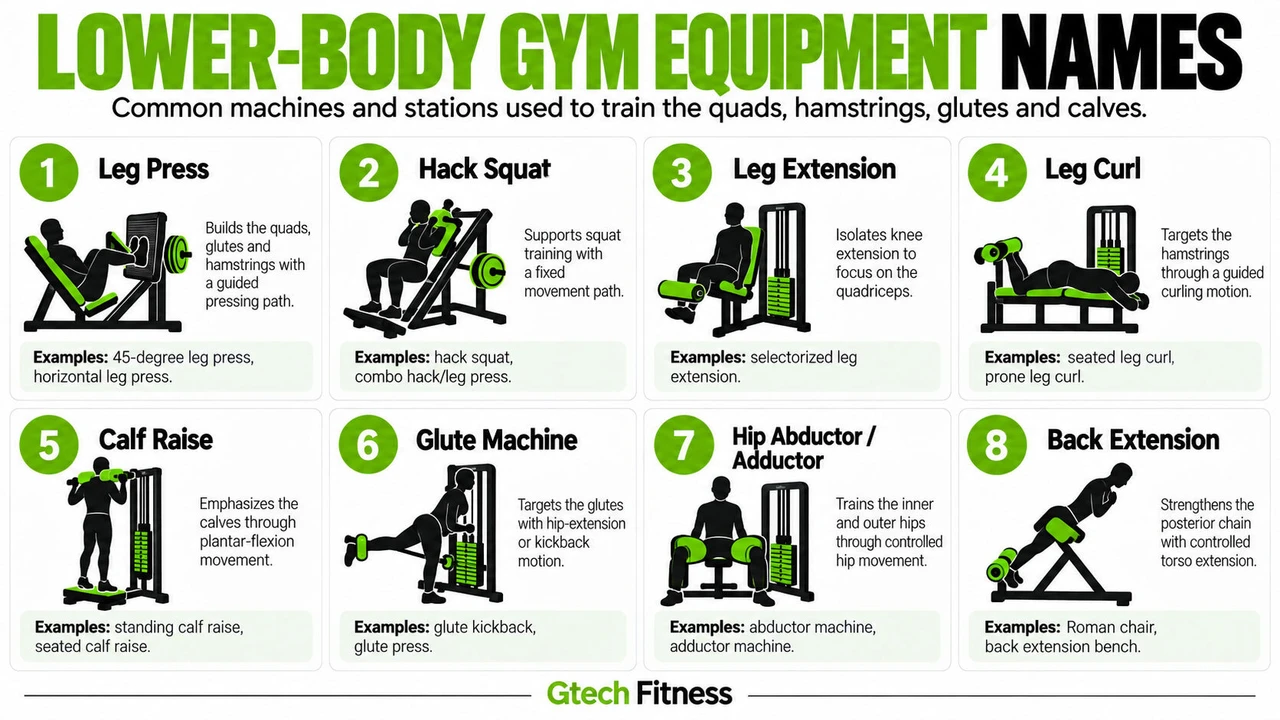
Leg Press Machine
Leg press machines place the feet against a platform while the user presses resistance away from the body. Common versions include seated, horizontal, leverage, vertical, and 45-degree sled designs. Leg presses train the quadriceps and glutes while the hamstrings and other lower-body muscles assist depending on the machine geometry and foot position.
Hack Squat Machine
A hack squat supports the torso while the user bends and extends the knees and hips against a guided sled or leverage system. Many machines place the shoulders beneath pads and the feet on an angled platform. Combination machines may convert between leg press and hack squat positions.
Leverage Squat or Squat Press
A leverage squat uses pivoting arms rather than a free barbell. Depending on the design, the shoulders, back, or hips contact pads while the lifter stands on a platform and drives through the legs. The movement path differs from a hack squat or Smith machine even though all three can be used for guided squat-pattern training.
Leg Extension Machine
Leg extension machines train the quadriceps by extending the knee against a padded resistance arm. The user sits with the back supported and the lower legs positioned behind or under a roller pad. Dedicated leg extensions and combination leg extension/curl machines are both common.
Leg Curl Machine
A leg curl trains the hamstrings through knee flexion. The three common formats are seated, lying or prone, and standing leg curl machines. Combination stations may pair a seated leg extension with either a seated or prone leg curl. The body position is the easiest way to distinguish the versions.
Hip Abductor / Adductor Machine
The hip abductor/adductor machine trains the outer and inner thigh through two opposing movements. In abduction, the legs move outward against resistance. In adduction, the legs move inward. Many commercial units combine both exercises by repositioning the thigh pads and changing the starting angle.
Glute Kickback Machine
Glute kickback machines create a backward leg-driving movement that emphasizes hip extension. The user may stand, kneel, or lean into a support pad depending on the design. Plate-loaded and selectorized versions are available, and some multi-hip machines can also train several additional hip movements.
Hip Thrust Machine
A hip thrust machine provides a dedicated setup for resisted hip extension without requiring the same barbell, bench, and pad arrangement used in a traditional barbell hip thrust. Resistance may come from a plate-loaded lever, belt, pad, or other guided mechanism. The glutes are the primary training focus.
Calf Raise Machine
Calf exercise machines apply resistance while the heel rises and lowers through plantar flexion. Common versions include standing calf raises, seated calf raises, leverage machines, and calf movements integrated into leg press stations. Body position changes the way the resistance is applied and can alter which calf muscles receive greater emphasis.
Cable and Multi-Station Gym Equipment
Cable equipment is sometimes difficult to name because the same frame may support dozens of exercises. The easiest way to distinguish cable systems is by the number of pulley columns, the distance between them, and whether several users can train at once.
Functional Trainer
A functional trainer usually has two adjustable pulley columns that can be moved through multiple heights. Independent cables support presses, rows, flyes, curls, extensions, raises, chops, lifts, squats, and many unilateral exercises. You may also hear this style called a dual adjustable pulley or DAP system.
Cable Crossover
A cable crossover uses two pulley stations separated by a wider frame. It is associated with standing cable flyes and crossover movements, but adjustable versions can perform many of the same exercises as a functional trainer. The terms overlap, especially on modern machines that combine wide cable spacing with adjustable pulley heights.
Cable Column
A cable column is a single vertical pulley station, often with an adjustable carriage. It provides a compact way to perform unilateral presses, rows, curls, triceps extensions, lateral raises, rotational movements, and other cable exercises without the width of a two-column system.
Lat Pulldown / Low Row Station
A combined lat pulldown and low-row machine provides a high pulley for pulldowns and a lower pulley for seated rows or other low-cable exercises. Some systems include a built-in seat and thigh hold-down, while others use a removable bench or floor position.
Multi-Station Gym
A multi-station gym system combines several exercise stations into one connected frame. Commercial versions may allow several people to train simultaneously, while compact home gyms may place multiple exercises around one or two weight stacks. Depending on the model, stations can include presses, pulldowns, rows, leg exercises, cable arms, and other movements.
Bodyweight and Core Equipment Names
Power Tower
A power tower station combines several bodyweight exercises on one frame. Typical features include a pull-up bar, dip handles, and a vertical knee-raise or leg-raise station. Some models add push-up handles or other attachments. Power towers are popular when a training space needs multiple upper-body bodyweight exercises without a full rack.
Vertical Knee Raise Station
A vertical knee raise station, often abbreviated VKR, supports the forearms and back while the user raises the knees or legs. Many VKR stations also include dip handles and may be built into a power tower. The equipment is primarily used for bodyweight core and hip-flexion exercises.
Ab Bench or Decline Bench
An ab bench positions the body for trunk-flexion or sit-up variations. Many use a decline angle with leg rollers that help secure the lower body. Adjustable decline benches can also support decline pressing and other exercises, so the same basic equipment may appear in both core and free-weight areas.
Hyperextension or Back Extension Bench
A back extension bench supports the thighs or hips while the torso moves around the hip area. It is commonly used for back extensions and hip-extension variations. Depending on the design and region, the equipment may also be called a Roman chair, 45-degree back extension, or horizontal back extension. Because Roman chair is used inconsistently, the physical setup is a better identifier than the nickname.
Ab / Low Back Machine
Ab and low back machines provide guided resistance for trunk flexion, trunk extension, or both movements in one station. They differ from bodyweight benches because the resistance is supplied by a weight stack, plates, leverage arms, or another built-in mechanism.
Cardio Machine Names
Cardio equipment is usually easier to recognize than strength equipment, but several machines have alternate names that can create confusion when comparing products or workout plans.
Treadmill
A treadmill uses a moving belt for indoor walking, jogging, or running. Motorized treadmills allow the user to control belt speed, and many also adjust incline. Commercial treadmills typically use larger frames and higher-duty drive systems than compact residential models.
Elliptical Trainer
An elliptical uses linked pedals that move through an elliptical path, often combined with moving handlebars. The feet remain supported by the pedals throughout the stride. Cross-trainer is a common alternate name, particularly for models with upper-body handles.
Upright Exercise Bike
An upright bike positions the rider in a relatively vertical cycling posture with the pedals below the body. Resistance may be magnetic, friction-based, electronic, or generated through another system. It is also commonly called a stationary bike.
Recumbent Exercise Bike
A recumbent bike uses a reclined seating position with a backrest and pedals positioned forward of the body. The larger seat and supported torso distinguish it from an upright exercise bike.
Indoor Cycle
An indoor cycle uses a cycling-oriented frame with a saddle and handlebars designed for higher-cadence or studio-style workouts. These bikes are sometimes casually called spin bikes, but indoor cycle is the more general equipment name.
Rowing Machine
A rowing machine reproduces a rowing-style movement that combines leg drive, trunk control, and upper-body pulling. Depending on the model, resistance may be created through air, water, magnets, hydraulics, or a combination of systems. Rower and rowing ergometer are common alternate names.
Stair Climber
Stair-climbing equipment creates a repeated stepping pattern. Designs include rotating staircases and pedal-style steppers. Because specific brand names are often used casually for this category, it is useful to distinguish the generic equipment name stair climber from any particular manufacturer or model.
Functional Training Equipment Names
Resistance Bands
Resistance bands are a common type of strength training accessory that uses elastic tension rather than iron or steel weight. Common versions include loop bands, flat therapy-style bands, tube bands with handles, and heavy pull-up or power bands. They can support warm-ups, strength exercises, assistance, accessory work, mobility drills, and rehabilitation-oriented movements.
Plyometric Box
A plyometric box, or plyo box, provides an elevated platform for step-ups, box squats, jumps, and other drills. Boxes may be made from wood, steel, or dense foam. Height and surface stability are important because the same basic name covers equipment intended for very different training environments.
Training Sled
A training sled is pushed, pulled, or dragged across a suitable surface. Some models use vertical weight posts for plates, while others are designed for compact indoor use. Common terms include push sled, drag sled, and prowler-style sled, although individual designs can differ substantially.
Battle Ropes
Battle ropes are heavy ropes anchored at one end and moved from the opposite ends to create waves, slams, circles, and other conditioning patterns. They are commonly used in functional training areas and athletic facilities where open floor space is available.
Suspension Trainer
A suspension trainer uses anchored straps and handles so body position determines much of the exercise difficulty. Rows, presses, squats, lunges, core exercises, and assisted movements can all be performed by changing leverage and stance.
Gym Equipment Names by Muscle Group
If you know which body area you want to train but not the equipment name, this table can help narrow the search. Most strength exercises involve more than one muscle, so the categories are based on common training emphasis rather than the idea that a machine works only one body part.
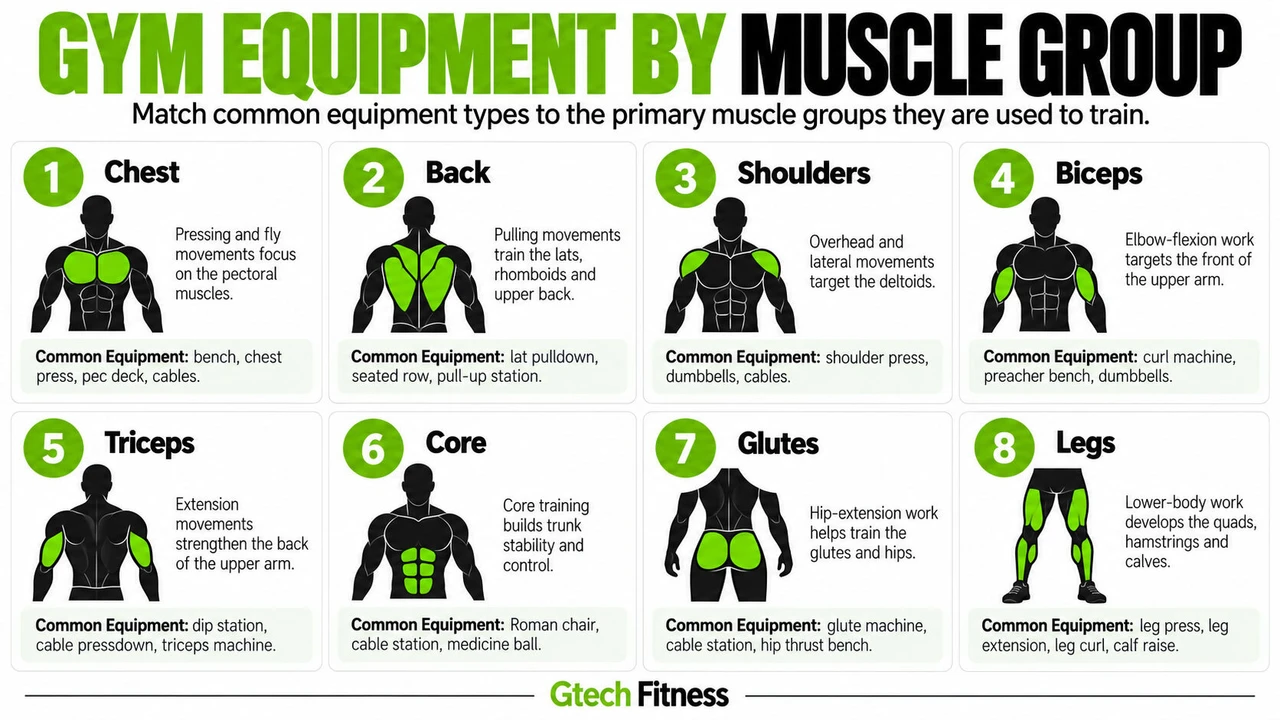
| Training Area | Common Equipment Names | Typical Movement |
|---|---|---|
| Chest | Chest press, pec fly, dumbbells, barbell, cable crossover | Pressing and fly movements |
| Back | Lat pulldown, seated row, leverage row, cable machine, pull-up station | Vertical and horizontal pulling |
| Shoulders | Shoulder press, lateral raise machine, rear-delt machine, dumbbells, cables | Overhead pressing and raises |
| Biceps & Triceps | Curl machine, triceps press, cable station, EZ bar, dumbbells | Elbow flexion and extension |
| Quadriceps | Leg press, hack squat, leg extension, squat machine, Smith machine | Knee-dominant lower-body training |
| Hamstrings & Glutes | Leg curl, hip thrust, glute kickback, dumbbells, barbells, kettlebells | Knee flexion and hip extension |
| Inner & Outer Thighs | Hip abductor/adductor, multi-hip machine, cable machine | Hip abduction and adduction |
| Calves | Standing calf raise, seated calf raise, leg press/calf press | Heel raising / plantar flexion |
| Core & Low Back | Ab machine, back extension, ab bench, VKR, cable machine | Trunk flexion, extension and stabilization |
How to Identify an Unknown Gym Machine
Machine names are useful, but identifying equipment by its physical features is often more reliable because product terminology varies. When you see an unfamiliar machine, work through a few basic clues before guessing based on appearance alone.
1. Identify the Resistance System
Look for a weight stack and selector pin, weight horns for loose plates, adjustable cables, a fixed bar on guide rails, or no external resistance at all. This immediately separates selectorized machines, plate-loaded equipment, cable systems, Smith machines, racks, and bodyweight stations.
2. Look at the User Position
A seat with thigh pads below an overhead cable strongly suggests a lat pulldown. A large footplate in front of a supported seat suggests a leg press. Forearm pads with dip handles and a back pad point toward a vertical knee raise station. The location of the seat, pads, foot supports, and handles usually reveals how the body is intended to face the machine.
3. Follow the Direction of Movement
Ask whether the handles push away, pull toward the torso, move overhead, swing outward, or rotate around a knee or hip pivot. The movement path is often more informative than the frame shape because manufacturers can make the same exercise machine look very different.
4. Read the Exercise Placard
Commercial strength machines often include a placard showing the exercise name, starting position, adjustment points, and intended movement. Use the placard for the exact unit in front of you instead of assuming that every machine with a similar silhouette adjusts the same way.
5. Look for Combination Functions
Many machines perform more than one exercise. A leg extension/curl machine, ab/back machine, biceps/triceps machine, multi-chest press, functional trainer, and multi-station gym can change function through adjustments. If a machine seems to have more handles, pads, or pivot settings than one exercise would require, it may be a dual- or multi-function design.
Identification Tip: Do not rely on color, upholstery, or overall frame shape. Focus on the resistance source, user position, moving arm or cable path, and adjustment points. Those details stay useful even when two manufacturers use different names for similar equipment.
How Beginners Should Approach Unfamiliar Equipment
Knowing the name of a machine is only the first step. If you are new to resistance training, use the equipment as part of a simple program rather than trying every station in the gym during the same workout. Our Strength Training for Beginners guide explains movement patterns, starting weights, sets, repetitions, progression, and complete beginner routines in more detail.
Adjust the Equipment Before Adding Challenge
Set the seat, pads, handles, safeties, and starting position so the movement fits your body and the machine's intended exercise. Commercial machines often include numbered adjustment points, which makes it easier to record a repeatable setup for future workouts.
Start With a Manageable Resistance
The first set on unfamiliar equipment should help you learn the movement. Choose resistance you can control through the intended range rather than selecting a heavy load before you understand the setup. Increase the challenge after the machine feels predictable and the movement is repeatable.
Use the Machine for Its Intended Movement
Modern gym equipment is versatile, but not every improvised use is appropriate. Use the manufacturer's designated handles, pads, platforms, safety stops, and loading areas as intended. If the setup is unclear, consult the exercise placard, equipment instructions, or a qualified staff member.
Learn Categories Instead of Memorizing Every Model
Once you understand that a machine is a chest press, lat pulldown, leg extension, functional trainer, or another familiar category, the brand and model become secondary. That category-based knowledge makes it much easier to move between gyms and recognize equivalent equipment even when the frames look different.
Home vs. Commercial Gym Equipment
The name of a piece of equipment does not tell you its usage rating. A home-use leg press and a commercial leg press may perform the same general exercise while differing substantially in frame construction, adjustment systems, upholstery, component durability, intended traffic level, footprint, and price.
That distinction matters when you are choosing equipment for a school, apartment, hotel, corporate wellness room, training studio, or public fitness facility. Higher-use settings should use equipment designed and rated for that environment rather than assuming any product with the correct exercise name will hold up to the expected traffic. Our Home vs. Commercial Fitness Equipment guide explains the differences in greater detail.
If you are planning a complete strength area, browse Gtech Fitness weight machines, benches and racks, gym weights, cable systems, and cardio equipment by category rather than selecting equipment only by appearance or price.
Frequently Asked Questions
What are the most common gym machine names?
Common gym machine names include chest press, shoulder press, pec fly/rear delt, lat pulldown, seated row, biceps curl, triceps press, leg press, hack squat, leg extension, leg curl, hip abductor/adductor, glute kickback, calf raise, Smith machine, functional trainer, cable crossover, and assisted pull-up/dip machine.
What are the main categories of gym equipment?
The major categories are free weights, racks and benches, selectorized weight machines, plate-loaded machines, cable machines, bodyweight stations, cardio equipment, and functional training accessories. Grouping equipment this way makes unfamiliar machines much easier to identify.
What is the difference between gym equipment and gym machines?
Gym equipment is the broader term. It includes machines along with dumbbells, barbells, benches, racks, bands, medicine balls, cardio equipment, and other training tools. Gym machines usually refers more specifically to equipment with a mechanical resistance path, cable system, guide rail, weight stack, or leverage mechanism.
What is the gym machine with cables called?
It depends on the design. A two-column adjustable cable system is commonly called a functional trainer. A wider two-sided frame may be called a cable crossover. A single adjustable tower is a cable column, while a high-and-low pulley machine may be called a lat pulldown/low row. Multi-station cable systems combine several workout positions in one connected frame.
What is the machine called where you push with your legs?
The most common answer is a leg press. Leg presses are available in seated, horizontal, vertical, leverage, and angled sled designs. A hack squat or squat press can look somewhat similar, so the user's body position and direction of the platform or sled help identify the exact machine.
What is the machine called for inner and outer thighs?
It is usually called a hip abductor/adductor machine or inner/outer thigh machine. Abduction moves the legs outward against resistance, while adduction moves them inward. Many commercial machines provide both exercises from one seat.
What is the machine called for pull-ups with assistance?
It is usually called an assisted pull-up/dip machine or chin/dip assist machine. A counterweighted knee or foot platform offsets part of the user's body weight during pull-ups, chin-ups, and dips.
What is an FID bench?
FID stands for flat, incline, decline. An FID bench is an adjustable weight bench designed to reach all three general back-pad positions. Not every adjustable bench includes a decline setting, so FID is more specific than simply calling a bench adjustable.
Why does the same gym equipment have different names?
Manufacturers, trainers, gyms, and different regions sometimes use different terms for similar designs. A seated row may be called a mid row, a cable crossover may overlap with the term functional trainer, and a back extension bench may be called a hyperextension bench or Roman chair. Focus on the equipment's resistance system and movement rather than assuming one nickname is universal.
Final Thoughts on Learning Gym Equipment Names
You do not need to memorize every model in a fitness center to understand the gym floor. Learn the main equipment families first, then recognize the movement each station is built to support. Once you know the difference between a free weight, rack, selectorized machine, plate-loaded machine, cable system, bodyweight station, and cardio machine, unfamiliar equipment becomes much easier to identify.
From there, names such as chest press, seated row, leg extension, functional trainer, power rack, and adjustable bench become useful shorthand rather than isolated vocabulary. That knowledge makes it easier to follow training programs, compare equipment, communicate with coaches or facility staff, and plan a home or commercial fitness space with confidence.
EXPLORE POPULAR ARTICLES
-
Back Workout Machines: Names, Exercises & Muscles Worked
Oct 07, 2026A Complete Guide to Back Machines, Exercises and Muscles Worked Estimated Reading Time: 30 Minutes B
-
Gym Equipment Names: Machines, Free Weights & Uses
Oct 06, 2026Learn the Names of Common Gym Equipment and What Each Piece Does Estimated Reading Time: 28 Minutes
-
Home Gym Setup Guide: How to Build a Home Gym
Oct 06, 2026How to Plan a Home Gym That Fits Your Space, Goals and Budget Estimated Reading Time: 26 Minutes A w