Leg Workout Machines: Names, Exercises & Muscles Worked
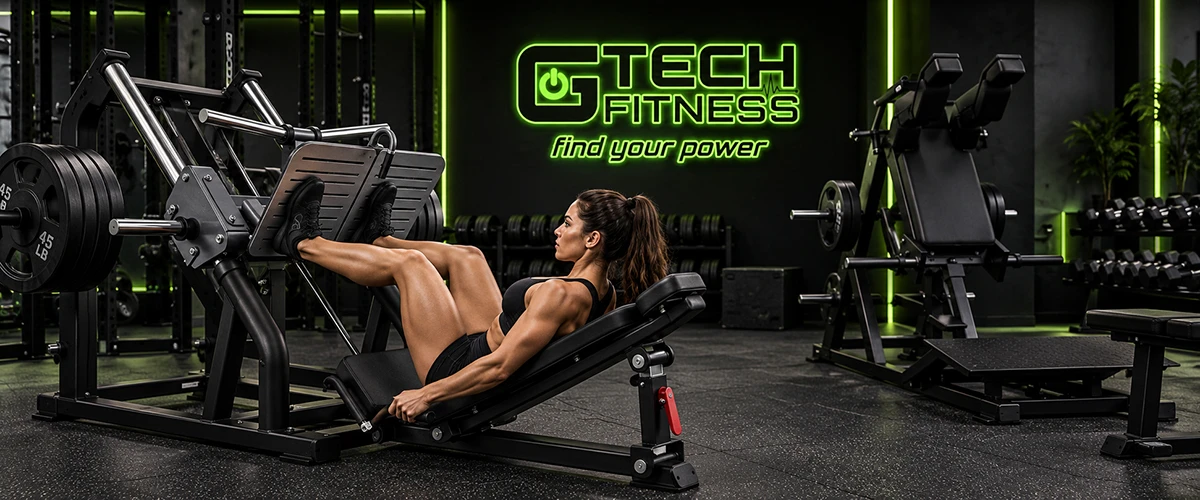
A Complete Guide to Leg Machines, Exercises and Muscles Worked
Estimated Reading Time: 30 Minutes
Leg workout machines can make lower-body training easier to organize because each station guides a specific movement or resistance path. A leg press trains a large portion of the lower body through a pressing motion, a leg extension focuses on knee extension for the quadriceps, a leg curl trains knee flexion for the hamstrings, and hip or calf machines add more targeted work. Understanding what each machine does makes it easier to build a balanced leg workout instead of simply moving from one machine to the next.
This guide explains the most common leg machines found in commercial gyms, school weight rooms, apartment fitness rooms, training studios and home gyms. You will learn the names of the machines, the muscles they emphasize, how major designs differ, how to set them up, and how to combine them into practical workouts. If you are still learning the broader equipment categories found around a fitness center, our gym equipment identification guide provides a wider overview of strength, cardio and free-weight equipment.
Quick Answer: The most common leg workout machines include the leg press, hack squat, squat press, leg extension, seated or lying leg curl, hip abductor/adductor machine, glute kickback machine, hip thrust machine, multi-hip station and calf raise machine. Smith machines and adjustable cable stations can also support several lower-body exercises.
For a balanced machine-based leg workout, combine one larger knee-and-hip movement such as a leg press or hack squat with targeted quadriceps, hamstring, glute or calf work based on your goals. You do not need to use every leg machine in a single session.
Table of Contents
- What Muscles Do Leg Workout Machines Train?
- Leg Workout Machine Names at a Glance
- Leg Press and Squat Machines
- Leg Extension Machines for the Quadriceps
- Leg Curl Machines for the Hamstrings
- Glute, Hip Abductor and Hip Adductor Machines
- Calf Raise Machines
- Leg Exercises Using Smith and Cable Machines
- Which Leg Machine Should You Use?
- How to Set Up and Use Leg Machines
- Example Leg Machine Workouts
- Leg Machines vs. Free Weights
- Choosing Leg Equipment for Home, School and Commercial Gyms
- Common Leg Machine Training Mistakes
- Frequently Asked Questions
What Muscles Do Leg Workout Machines Train?
The lower body includes several major muscle groups that work together during squatting, pressing, hinging, knee extension, knee flexion, hip movement and calf raising. Many leg machines train more than one muscle group, so it is usually more useful to think about the movement the machine creates than to assume each machine works only one muscle.
Quadriceps
The quadriceps are the large muscles on the front of the thighs. They straighten the knees and contribute strongly during leg presses, hack squats, squat presses and other knee-dominant lower-body movements. A leg extension machine provides the most direct machine-based knee-extension exercise because the user straightens the lower leg against resistance from a seated position.
Hamstrings
The hamstrings run along the back of the thighs and help bend the knees while also contributing to hip extension. Seated and lying leg curl machines train the hamstrings through resisted knee flexion. The hamstrings also contribute during many presses, squats, hinges and hip-extension exercises, although the amount of involvement depends on the movement and machine design.
Glutes
The gluteal muscles contribute to hip extension, stabilization and other hip movements. Leg presses, squat machines, hip thrust machines and glute kickback stations can all involve the glutes. Foot position, range of motion, torso position and the machine's resistance path influence how the movement feels, so one machine should not automatically be described as a complete substitute for every other glute exercise.
Hip Abductors and Adductors
Hip abduction moves the legs away from the body's midline, while hip adduction moves them toward the midline. Inner/outer thigh machines commonly combine both patterns by changing pad position or the starting angle. Multi-hip stations and adjustable cable machines may also support abduction, adduction, hip flexion and hip extension depending on their design.
Calves
The calf muscles create plantar flexion, the movement that raises the heels. Standing calf machines, seated calf machines and leg press/calf press combinations apply resistance to this movement from different body positions. Standing and seated versions are not identical, so facilities often choose based on available space, training goals and whether another machine already provides calf work.
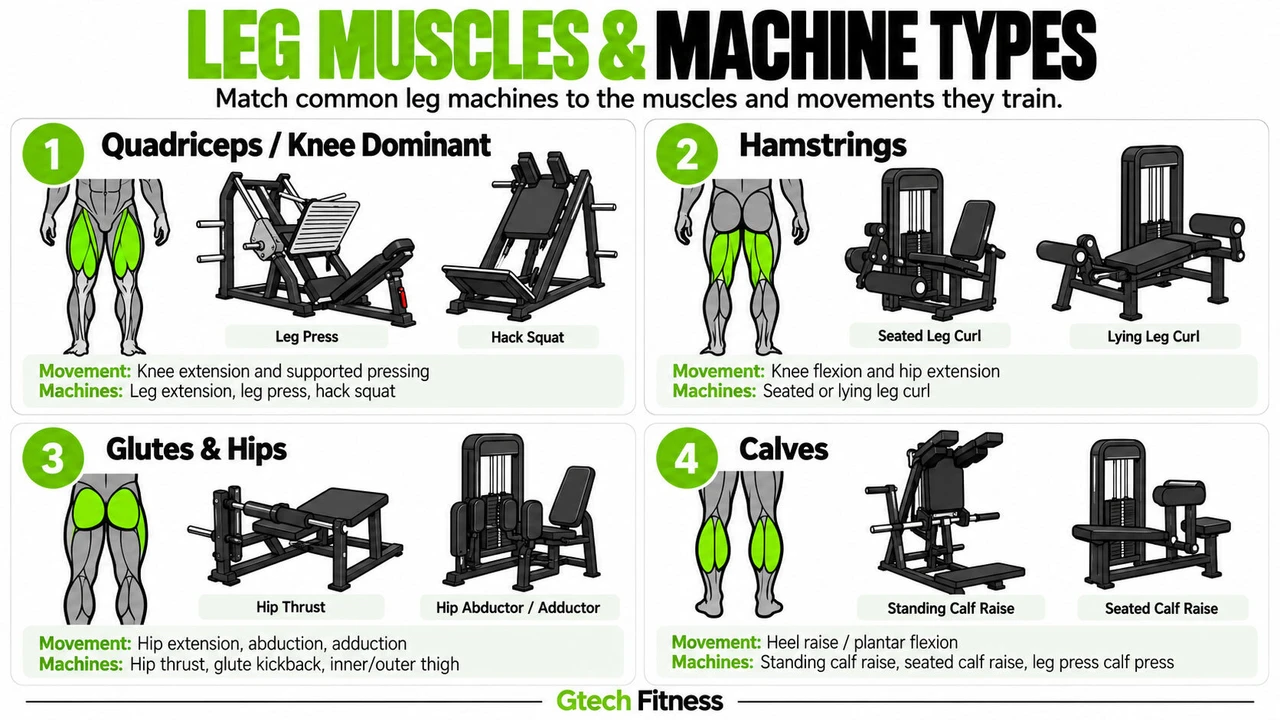
| Training Emphasis | Typical Movement | Common Equipment |
|---|---|---|
| Quadriceps | Knee extension; knee-dominant pressing or squatting | Leg extension, leg press, hack squat, squat press |
| Hamstrings | Knee flexion; hip extension | Seated leg curl, lying leg curl, glute-ham or hip-extension movements |
| Glutes and hips | Hip extension, abduction, adduction and related hip movements | Hip thrust, glute kickback, multi-hip, inner/outer thigh machine |
| Calves | Heel raising / plantar flexion | Standing calf raise, seated calf raise, leg press/calf press |
Leg Workout Machine Names at a Glance
The same general lower-body movement can appear on several different machine designs. A gym may have a 45-degree leg press, a selectorized seated press, a plate-loaded leverage press and a hack squat, all within the same training area. The table below summarizes the most common names so you can identify the equipment before deciding how it fits your workout.
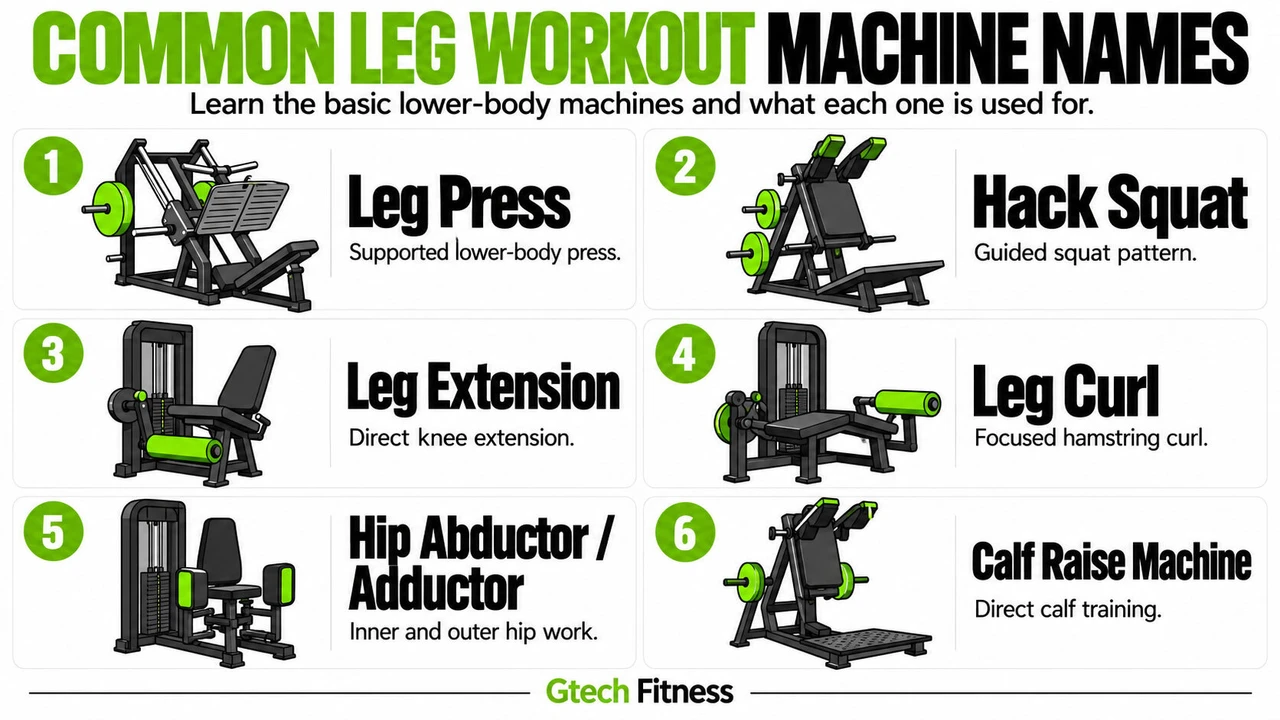
| Machine or Station | Primary Movement | Main Training Emphasis | Also Called |
|---|---|---|---|
| Leg Press | Supported lower-body press | Quads, glutes, hamstrings | Seated leg press, 45-degree leg press, sled press |
| Hack Squat | Guided squat on a sled or carriage | Quads and glutes with lower-body support | Hack squat sled |
| Squat Press / Leverage Squat | Guided pressing or squatting arc | Quads, glutes, hamstrings | Leverage squat, V-squat on some designs |
| Leg Extension | Knee extension | Quadriceps | Quad extension machine |
| Seated Leg Curl | Seated knee flexion | Hamstrings | Seated hamstring curl |
| Lying Leg Curl | Prone knee flexion | Hamstrings | Prone leg curl |
| Hip Abductor / Adductor | Legs move outward or inward | Outer and inner hip/thigh muscles | Inner/outer thigh machine |
| Glute Kickback | Hip extension / rearward leg drive | Glutes with hamstring assistance | Glute machine, rear kick machine |
| Hip Thrust Machine | Resisted hip extension | Glutes and posterior chain | Glute drive on some designs |
| Multi-Hip Machine | Multiple standing hip movements | Hip flexors, glutes, abductors and adductors | Rotary hip machine |
| Standing Calf Raise | Standing heel raise | Calves | Standing calf machine |
| Seated Calf Raise | Seated heel raise | Calves with bent knees | Seated calf machine |
Leg Press and Squat Machines
Leg presses and guided squat machines train several lower-body muscle groups at once. They are usually the largest leg machines in a gym and may use a weight stack, plate-loaded carriage, leverage arm or guided sled. Gtech Fitness offers a range of lower-body press and squat machines for home, school and commercial training spaces.
Seated Leg Press Machine
A seated leg press places the torso against a back pad while the user presses a footplate away from the body or moves the seat away from the platform. Selectorized commercial models often make resistance changes with a weight-stack pin, while plate-loaded leverage designs use Olympic plates. The supported position reduces the balance demands of a free squat and gives users a repeatable setup for lower-body pressing.
Adjust the seat or back pad so the starting position allows a comfortable bend at the hips and knees without forcing the pelvis away from the support. Place the feet securely on the platform, press through the intended path, and return under control. Do not assume one foot position or depth works for every user or every leg press design.
45-Degree Leg Press
A 45-degree leg press typically places the user below an angled sled or carriage. The user presses the platform upward along guide rails while the back and hips remain supported by pads. These machines often accept weight plates and can support substantial loading, which is one reason they are common in larger strength facilities.
The carriage angle, seat geometry and safety-stop design differ among machines. Before loading heavily, learn how to release and re-engage the safeties, choose an appropriate starting position, and make sure the sled can travel through a controlled range without the lower back losing stable contact with the pad.
Vertical Leg Press
A vertical leg press positions the resistance more directly above the user while the torso is supported in a back-lying position. It occupies a different footprint from a long sled-style machine and creates a distinct body orientation. The movement is still a lower-body press, but the setup, range and loading mechanics should be treated as specific to that machine.
Hack Squat Machine
A hack squat machine generally supports the back and shoulders against pads while the user bends and straightens the knees and hips along a guided sled or carriage. Compared with a seated leg press, the body is usually more upright relative to the platform. The quadriceps and glutes are heavily involved, with the hamstrings and calves assisting depending on the movement.
Hack squat platforms can be large enough to allow several foot positions, but changing foot placement does not turn the machine into a completely different exercise. Use a stance that keeps the feet secure and allows the knees and hips to move comfortably through the machine's intended path.
Squat Press and Leverage Squat Machines
Squat presses and leverage squat machines guide the resistance through a pivoting or arcing movement rather than a straight sled path. Some support the shoulders, some position the resistance through a back pad, and some use independent or linked movement arms. These machines can provide squat-like lower-body training while reducing the balance requirement of an unrestricted barbell squat.
Names are not perfectly standardized across manufacturers. A machine labeled V-squat, leverage squat or squat press may use a different body angle from another company's model with a similar name. Identify the actual movement path and user position rather than choosing the machine only from the label.
Leg Press vs. Hack Squat: What Is the Difference?
Both train the lower body through coordinated hip and knee movement, but the body position is different. A leg press generally supports the torso while the feet press a platform away, whereas a hack squat more closely resembles a supported squat with the torso traveling relative to the foot platform. Neither machine is automatically better. The more useful question is which design fits the user's mobility, comfort, training goal and available equipment.
Leg Extension Machines for the Quadriceps
A leg extension machine provides a dedicated knee-extension exercise. The user sits with the knees bent and places the lower legs behind a padded roller, then straightens the knees against resistance. This makes the exercise different from a leg press or squat, where the hips and knees move together.
Dedicated and combination quadriceps and hamstring machines are common in home gyms and commercial strength areas. Some units provide only leg extensions, while others switch between extensions and curls to cover both sides of the thighs in one footprint.
How to Set Up a Leg Extension Machine
Adjust the back pad or seat so the knees line up as closely as practical with the machine's intended pivot position. Place the lower-leg pad against the appropriate part of the shin or ankle area according to the machine instructions. Keep the hips and torso supported while extending the knees smoothly, then control the return rather than allowing the weight stack or lever to fall.
Selectorized vs. Plate-Loaded Leg Extensions
A selectorized leg extension uses an integrated weight stack and is convenient when many users need quick resistance changes. A plate-loaded machine uses removable plates and may use a lever or direct-link movement arm. The training movement is still knee extension, but the resistance feel, adjustment system and floor-space requirements can differ considerably.
Combination Leg Extension and Curl Machines
A dual-function leg extension/curl machine can be useful when floor space is limited. Some designs pair seated extensions with seated curls, while others combine seated extensions with prone or lying curls. Switching exercises may require changing the back pad, thigh restraint, roller position or starting angle. Buyers should compare the exact configuration rather than assuming every combination machine changes between exercises the same way.
Leg Curl Machines for the Hamstrings
Leg curl machines train the hamstrings through knee flexion. The two most common versions are seated and lying curls, although standing single-leg curls and combination stations also exist. Because the body position changes, users may prefer one design over another even though both train the same basic joint action.
Seated Leg Curl Machine
A seated leg curl holds the thighs in place while the user bends the knees and pulls the lower-leg pad downward and backward. A thigh restraint helps keep the upper legs from lifting as resistance increases. Seated machines are common in commercial circuits because entry, exit and resistance changes can be straightforward for a wide range of users.
Lying or Prone Leg Curl Machine
A lying leg curl positions the user face down while the heels or lower legs pull a roller toward the back of the thighs. The hip and torso pads support the body while the knees flex against resistance. Some designs angle or contour the pad rather than keeping the entire body perfectly flat.
Standing Leg Curl Machine
A standing leg curl trains one side at a time. The user stabilizes against pads or handles while one leg bends against the resistance arm. This format takes more attention to body position than a fully supported seated or lying station, but it provides a simple unilateral hamstring exercise when the facility has the appropriate machine.
Seated vs. Lying Leg Curl: Which Is Better?
Both can train the hamstrings effectively, and the better choice often comes down to comfort, equipment availability and program design. The seated version keeps the user upright and can be easy to integrate into a selectorized circuit. The lying version uses a prone position and may feel more familiar to lifters who have trained with traditional leg-curl equipment. A facility does not necessarily need both unless variety or user traffic justifies separate stations.
Glute, Hip Abductor and Hip Adductor Machines
Not every leg machine is built around squatting, pressing or curling. Glute, hip and thigh training equipment adds more targeted hip movements that can complement larger compound exercises.
Hip Abductor and Adductor Machine
An inner/outer thigh machine commonly performs two exercises from the same seat. During hip abduction, the legs press outward against the pads. During hip adduction, they move inward against resistance. The pads or starting position are changed between movements depending on the machine.
These machines are frequently mislabeled casually as only an "outer thigh" or "inner thigh" machine even when one station provides both functions. Check the placard and pad orientation to see which direction is currently set up.
Glute Kickback Machine
A glute kickback machine creates a controlled rearward leg drive. The user may stand, lean against support pads or kneel depending on the equipment design. The glutes are the main focus, with assistance from other posterior-chain muscles. Selectorized and plate-loaded versions are both common.
Hip Thrust Machine
A hip thrust machine provides a dedicated resisted hip-extension setup without requiring the separate barbell, bench and pad arrangement used for a traditional barbell hip thrust. Depending on the model, resistance may be applied through a belt, padded lever, plate-loaded arm or another guided mechanism.
Multi-Hip or Rotary Hip Machine
A multi-hip machine typically uses a standing position and adjustable movement arm to train several directions at the hip. Depending on the design, it may support hip flexion, extension, abduction and adduction. This makes it useful when a facility wants several targeted hip movements from one relatively compact station.
Are Hip Abductor Machines the Same as Glute Machines?
No. Hip abduction does involve portions of the gluteal musculature, but an abductor/adductor machine and a glute kickback or hip thrust machine use different movement patterns. Rather than labeling all of them simply as glute machines, identify whether the exercise moves the leg outward, inward or backward, or extends the hips from a supported position.
Calf Raise Machines
Calf machines apply resistance while the heels rise and lower. Gtech Fitness carries calf exercise machines that include seated, standing and combination designs for different training spaces.
Standing Calf Raise Machine
A standing calf machine usually places pads over the shoulders while the feet rest on a raised platform. The user keeps the body supported while raising and lowering the heels against resistance. Plate-loaded leverage versions and selectorized weight-stack versions are both available.
Seated Calf Raise Machine
A seated calf raise places the knees under pads while the feet rest on a platform or foot bar. The user raises the heels against the machine's lever resistance. Because the knees remain bent, the body position differs from a standing calf raise even though both involve plantar flexion.
Leg Press and Calf Press Combination
Some seated leg presses use the same large footplate for both leg presses and calf presses. This can be an efficient choice for facilities that want lower-body compound training and calf work without adding a separate calf station. The exact foot position and range for calf presses should follow the instructions for the specific machine.
Leg Exercises Using Smith and Cable Machines
Dedicated leg machines are convenient, but multi-purpose equipment can expand lower-body exercise variety. Smith machines guide a bar along fixed rails, while cable stations let users change pulley height and attachments. Neither should be treated as a substitute for every dedicated leg machine, but both can support useful lower-body movements when the equipment is designed for them.
Smith Machine Leg Exercises
Common lower-body exercises on a guided barbell training system include squats, split squats, lunges and calf raises. Some users also perform other squat or hinge variations, but the fixed bar path changes how the body must position itself compared with a free barbell.
| Smith Exercise | Movement Pattern | Main Training Emphasis |
|---|---|---|
| Smith squat | Bilateral squat | Quads, glutes and supporting lower-body muscles |
| Smith split squat | Split-stance squat | Quads and glutes with unilateral emphasis |
| Smith lunge | Split-stance knee and hip movement | Quads and glutes |
| Smith calf raise | Standing plantar flexion | Calves |
Cable Leg Exercises
An adjustable cable station can support lower-body exercises such as standing hip abduction, hip adduction, glute kickbacks, cable pull-throughs and certain squat or lunge variations when the pulley height, attachment and exercise position are appropriate. The advantage of adjustable cable exercise equipment is that one station can train the lower body along with the chest, back, arms and core.
| Cable Exercise | Typical Pulley Position | Main Emphasis |
|---|---|---|
| Standing hip abduction | Low | Outer hip / abductor muscles |
| Standing hip adduction | Low | Inner thigh / adductor muscles |
| Cable glute kickback | Low | Glutes through hip extension |
| Cable pull-through | Low | Hip hinge / posterior chain |
A cable machine's attachment rating, travel, pulley position and available working space determine which exercises are practical. Use the station according to its instructions and avoid creating improvised setups that pull the cable across the frame or place the user outside the intended exercise area.
Which Leg Machine Should You Use?
The best leg machine depends on what movement or muscle group you want to train, what equipment is available and how the exercise fits with the rest of your program. A balanced routine usually benefits from combining a larger multi-joint movement with more targeted exercises rather than trying to find one machine that does everything.
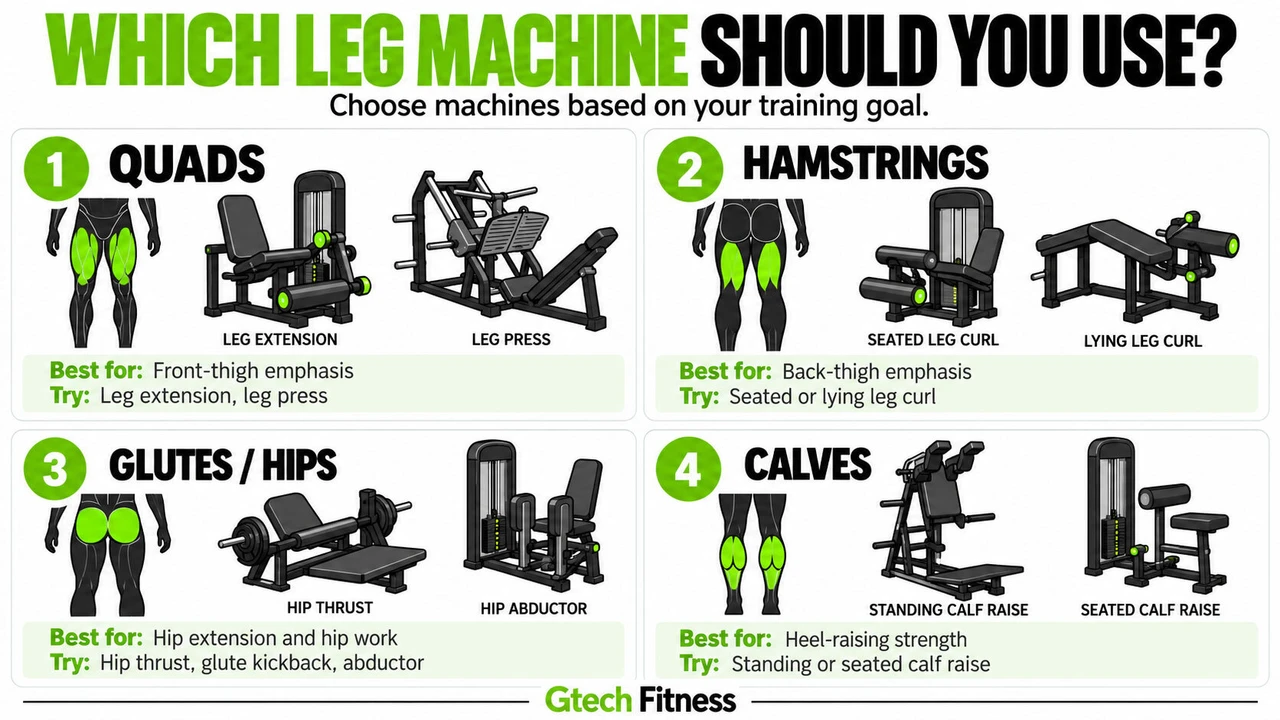
| Training Goal | Useful Machine Choice | Why It Fits |
|---|---|---|
| Train several lower-body muscles together | Leg press, hack squat or leverage squat | Combines hip and knee movement in one guided exercise |
| Emphasize the quadriceps | Leg extension plus a press or squat pattern | Adds direct knee-extension work to compound lower-body training |
| Emphasize the hamstrings | Seated or lying leg curl | Provides focused knee-flexion resistance |
| Add focused glute training | Hip thrust or glute kickback machine | Adds dedicated hip-extension work |
| Train inner and outer hip muscles | Hip abductor/adductor or multi-hip machine | Provides guided abduction and adduction movements |
| Train the calves directly | Standing or seated calf raise | Provides dedicated resisted heel-raising movements |
| Save floor space | Combination extension/curl, leg press/calf or multi-hip station | Covers more than one lower-body movement from one footprint |
What Is the Best Leg Machine for Beginners?
There is no single required beginner machine. A supported leg press is often easy to understand because the user can focus on pressing through a guided path, while leg extensions and curls make it simple to learn isolated knee movements. The best starting point is a machine that fits the user, has clear adjustments, and allows controlled repetitions with a manageable resistance.
What Is the Best Leg Machine for Quads?
A leg extension provides the most direct knee-extension exercise, while leg presses and hack squats train the quadriceps together with the glutes and other lower-body muscles. For many programs, combining one compound machine with leg extensions gives a broader training approach than relying on either one alone.
What Is the Best Leg Machine for Hamstrings?
A seated or lying leg curl directly trains knee flexion and is the most obvious machine choice for focused hamstring work. Hip-extension and hinge movements can also involve the hamstrings, but they are not the same exercise as a leg curl.
What Is the Best Leg Machine for Glutes?
Hip thrust and glute kickback machines provide focused hip-extension work, while leg presses and squat machines also involve the glutes during larger lower-body movements. The most useful choice depends on whether you need a compound exercise, a targeted exercise or both.
How to Set Up and Use Leg Machines
The adjustments vary by machine, but a few basic steps make most lower-body stations easier to learn. Follow the instructional placard and adjustment directions on the equipment in front of you. If the machine is unfamiliar, begin with a manageable load and learn the movement before increasing resistance.
1. Identify the Movement and Resistance System
Determine whether the machine is selectorized, plate loaded, leverage based, cable driven or body-position dependent. A selectorized leg extension changes load with a pin, while a plate-loaded hack squat requires compatible weight plates. Knowing how the resistance is created prevents setup mistakes before the exercise begins.
2. Adjust the Seat, Back Pad and Rollers
On seated machines, adjust the body supports so the hips, knees and contact pads line up with the intended movement. On leg extensions and curls, roller and thigh-restraint positions are especially important because the machine rotates around the knee. On presses and squat machines, use the available seat, back-pad or starting-position adjustments to establish a controlled beginning range.
3. Learn the Safety Stops and Start Position
Sleds, hack squats and some leverage machines use catches, stops or release handles. Learn how they work before loading the machine heavily. Set the start position so you can enter and exit without forcing the knees or hips into an uncomfortable angle.
4. Use a Controlled Range of Motion
Move through the range you can control while keeping the feet, hips, torso and support pads in the intended positions. A deeper range is not automatically better if it causes the pelvis to shift, the heels to lift unexpectedly or the user to lose contact with the machine.
5. Control the Return
The lowering or return phase should be deliberate. Do not let a weight stack slam, a sled drop into the stops or a lever arm fall back between repetitions. Smooth repetitions make it easier to maintain the same body position and evaluate whether the selected resistance is appropriate.
6. Increase Resistance Gradually
Add load only after the setup and movement are repeatable. If additional resistance causes shortened range, bouncing, abrupt locking or major changes in body position, reduce the load and re-establish control.
Example Leg Machine Workouts
You do not need every lower-body machine in one workout. The examples below combine a primary press or squat pattern with targeted exercises for the front and back of the thighs, then add optional hip or calf work. They are illustrative templates rather than required prescriptions. Training history, weekly schedule, recovery and available equipment should determine the final program.
Beginner Leg Machine Workout
This session uses a small number of easy-to-identify machine movements. It can fit into a full-body training plan or be used as a simple lower-body session while the lifter learns machine setup and controlled repetitions.
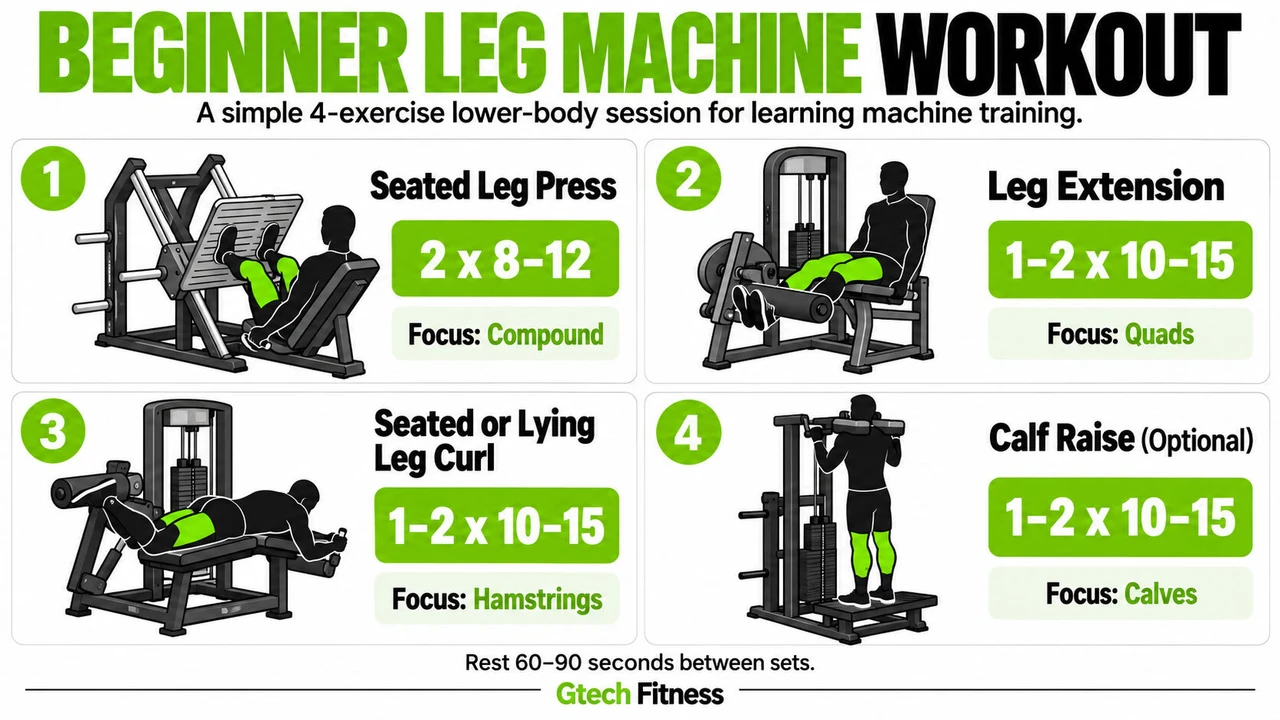
| Exercise | Sets | Repetitions | Focus |
|---|---|---|---|
| Seated leg press | 2 | 8-12 | Compound lower-body press |
| Leg extension | 1-2 | 10-15 | Quadriceps |
| Seated or lying leg curl | 1-2 | 10-15 | Hamstrings |
| Calf raise (optional) | 1-2 | 10-15 | Calves |
Warm up with easy movement and lighter practice repetitions before working sets. Keep the first sessions simple enough that you can learn the adjustments and record the resistance used. Our beginner strength training guide explains how resistance exercises can fit into a broader weekly program.
Intermediate Leg Machine Workout
This variation adds more training volume and a dedicated glute or hip exercise. Someone already performing demanding barbell squats, deadlifts or other lower-body free-weight work may need less machine volume than someone using machines as the primary strength-training method.
| Exercise | Sets | Repetitions | Focus |
|---|---|---|---|
| Hack squat or leg press | 3 | 6-12 | Compound lower-body work |
| Leg extension | 2 | 10-15 | Quadriceps |
| Seated or lying leg curl | 2-3 | 8-15 | Hamstrings |
| Hip thrust or glute kickback | 2 | 8-15 | Glutes / hip extension |
| Calf raise | 2-3 | 10-20 | Calves |
Compact Home Gym Leg Workout
If your home gym has only a Smith machine or functional trainer, you can still create a lower-body session using guided squats or split squats, cable glute kickbacks, cable abduction or adduction, and other exercises the equipment is designed to support. If you also have dumbbells and a bench, free-weight split squats, step-ups or Romanian deadlifts can fill movement gaps without requiring a separate machine for every muscle group.
When planning a small training room, prioritize movements before equipment count. Our home gym planning guide explains how to choose equipment around space, training goals, flooring and working clearance.
Leg Machines vs. Free Weights
Leg machines and free weights can both build lower-body strength. Machines guide some or all of the resistance path and often provide pads, seats or back support. Free weights require the user to control more of the load's path and usually involve greater balance and positioning demands. Neither approach is automatically superior for every goal.
Advantages of Leg Machines
Leg machines provide consistent setup points, clear resistance changes and predictable movement paths. Selectorized stations are especially convenient in shared facilities because users can change loads quickly. Dedicated machines also make it easy to add targeted exercises such as leg extensions, curls, abduction, adduction or calf raises after larger compound movements.
Advantages of Free Weights
Barbells, dumbbells and other free-weight strength equipment can support squats, lunges, split squats, deadlifts, Romanian deadlifts, step-ups and loaded carries without needing a dedicated machine for each movement. This can be useful in smaller gyms where one rack, bench and set of weights must support many exercises.
Can You Combine Leg Machines and Free Weights?
Yes. A workout might use barbell or dumbbell squats as the primary lower-body exercise, then add machine leg curls and calf raises. Another program might use a leg press as the main compound exercise and finish with dumbbell split squats. Choosing movements that complement each other is usually more useful than following a machines-only or free-weights-only rule.
Choosing Leg Equipment for Home, School and Commercial Gyms
If you are buying equipment rather than simply using a gym, machine selection should start with the facility, expected users, training goals and available floor space. A home gym may need one combination machine, while a busy commercial strength floor can justify separate stations for presses, curls, extensions, hips and calves.
Home Gyms: Prioritize Exercise Coverage
Home gyms benefit from equipment that adds movements you cannot already perform comfortably with existing free weights, racks or cables. A combination leg extension/curl, compact leg press or multi-purpose Smith/cable system can cover several needs without filling the room with single-purpose stations. Before purchasing, measure the machine itself plus the working area required to enter, load plates and perform the exercise.
School Weight Rooms: Plan for Repeated Setup and Coaching
School and college weight rooms should use equipment rated for the intended institutional environment. Look at how quickly students can adjust seats and resistance, how clearly the exercise is identified, and whether coaches can supervise movement around the station. Gtech Fitness provides school weight-room equipment for K-12, college and athletic training facilities.
Commercial Facilities: Balance Variety, Traffic and Floor Space
A large commercial gym may benefit from separate leg presses, hack squats, extensions, curls, glute stations, inner/outer thigh machines and calf machines so several people can train at once. Smaller apartment, hotel and corporate fitness rooms may be better served by combination machines that cover more than one movement in a compact footprint.
Home vs. Commercial Leg Machines
The name of the exercise does not determine the equipment-use rating. A residential leg press and a commercial leg press can perform the same general movement while differing substantially in construction, adjustability, upholstery, intended traffic level and overall size. Our home vs. commercial fitness equipment guide explains why equipment should be matched to its intended training environment.
Selectorized vs. Plate-Loaded Leg Machines
Selectorized machines use an integrated weight stack and make resistance changes quickly with a pin or other built-in adjustment. Plate-loaded machines use removable weight plates and may offer higher loading potential or different leverage characteristics depending on the design. Neither resistance system is automatically better; the right choice depends on the facility, user population, available plates and desired training style.
| Planning Question | What to Check |
|---|---|
| Which movements are essential? | Press/squat, knee extension, knee flexion, hip work, calf work |
| Who will use the equipment? | User height range, adjustment needs, expected traffic and required use classification |
| How is resistance changed? | Weight stack, Olympic plates, leverage arm or cable resistance |
| How much floor space is needed? | Machine footprint plus entry, plate loading, sled travel and circulation clearance |
| Can one station cover multiple exercises? | Leg extension/curl, leg press/calf, inner/outer thigh or multi-hip combinations |
For a broader selection of strength training machines, compare equipment by movement, resistance type, use classification and available space rather than choosing solely by appearance.
Common Leg Machine Training Mistakes
Using Every Machine in One Workout
A gym may have ten or more lower-body stations, but that does not mean a productive workout requires all of them. Select a few complementary movements that match the program. Repeating several nearly identical presses or squat machines can add training volume without adding much movement variety.
Skipping the Machine Adjustments
Seat backs, thigh pads, roller pads and start positions exist to fit different users. Leaving the machine in the previous person's settings can change the movement significantly. Take a few seconds to establish your own position before selecting a challenging load.
Adding Weight Before Learning the Range
A heavy sled or leverage arm can make it harder to determine whether the setup is comfortable. Use lighter practice repetitions to learn the safeties, start position and available range before adding more resistance.
Bouncing or Slamming the Resistance
Dropping a weight stack, rebounding a sled out of the bottom position or striking mechanical stops can reduce control and make each repetition less consistent. Keep both the working and return phases deliberate.
Treating Foot Position as a Muscle-Isolation Switch
Foot placement on a leg press or hack squat can change comfort, joint angles and how the movement feels, but small stance changes do not completely turn off one muscle group and isolate another. Use a secure stance that fits the machine and your body rather than chasing extreme positions based on a simplified muscle chart.
Confusing Similar Machine Names
Leg press, hack squat, squat press and leverage squat are related categories, but they are not interchangeable names for one universal machine. The same is true for glute kickback, hip thrust, multi-hip and abductor/adductor equipment. Look at the body position and movement path when identifying an unfamiliar station.
Frequently Asked Questions
What are the most common leg machines at the gym?
Common leg machines include the leg press, hack squat, leg extension, seated or lying leg curl, hip abductor/adductor machine, glute kickback, hip thrust machine and calf raise machine. Larger gyms may also have leverage squat machines, multi-hip stations, pendulum-style squat machines and several versions of the same basic movement.
Which leg machine works the most muscles?
Leg presses, hack squats and other guided squat or press machines involve several lower-body muscle groups because the hips and knees move together. They generally train more muscles in one exercise than an isolation machine such as a leg extension or leg curl. That does not make isolation machines unnecessary; they serve a different purpose.
What machine targets the quads?
The leg extension is the most direct quadriceps machine because it trains resisted knee extension. Leg presses, hack squats and squat presses also involve the quadriceps while training the glutes and other supporting lower-body muscles.
What machine targets the hamstrings?
Seated and lying leg curl machines directly train knee flexion and are the most common dedicated hamstring machines. Standing single-leg curls and certain hip-extension exercises can also involve the hamstrings, but they use different body positions and movement patterns.
What is the machine for inner and outer thighs called?
It is usually called a hip abductor/adductor machine or inner/outer thigh machine. Abduction moves the legs outward against resistance, while adduction moves them inward. Many commercial machines provide both exercises from one seat.
Is a leg press the same as a hack squat?
No. Both are guided compound lower-body machines, but the user position and movement path differ. A leg press generally keeps the torso supported while the feet press a platform away, while a hack squat places the body in a more squat-like orientation against a guided sled or carriage.
Should I do leg extensions and leg curls in the same workout?
They can be used together because they train opposing knee movements: extensions for the quadriceps and curls for the hamstrings. Whether both belong in the same workout depends on the rest of the training program, total volume and the exercises already being performed.
Are Smith machine squats considered a leg machine exercise?
Yes. A Smith machine is a multi-purpose guided barbell system rather than a dedicated leg machine, but squats, split squats, lunges and calf raises performed on it are lower-body machine exercises because the bar travels along fixed rails.
Can cable machines train the legs?
Yes. A suitable adjustable cable station can support exercises such as glute kickbacks, hip abduction, hip adduction and pull-throughs, along with other lower-body movements depending on the machine and attachments. Dedicated leg machines may still provide easier setup for certain exercises.
How many leg machines should a beginner use?
A beginner does not need a large number of machines. One compound press or squat pattern plus one or two targeted exercises can provide a simple starting point. The priority is learning the equipment, controlling the resistance and progressing gradually rather than completing every station in the gym.
What leg machines are useful in a small home gym?
Space-efficient choices include combination leg extension/curl machines, compact leg presses, Smith machines, functional trainers and leg press/calf combinations. The best option depends on which exercises are already covered by the rest of the home gym.
What should a commercial gym look for when buying leg machines?
Commercial facilities should consider the intended use classification, adjustment range, resistance system, user traffic, floor space, exercise variety and whether multiple users can train without creating bottlenecks. A combination station can save space, while separate machines may be more practical in a busy facility.
EXPLORE POPULAR ARTICLES
-
Cable Machine Exercises: Complete Guide
Oct 09, 2026A Complete Guide to Cable Exercises, Pulley Positions and Attachments Estimated Reading Time: 30 Min
-
Leg Workout Machines: Names, Exercises & Muscles Worked
Oct 09, 2026A Complete Guide to Leg Machines, Exercises and Muscles Worked Estimated Reading Time: 30 Minutes Le
-
Back Workout Machines: Names, Exercises & Muscles Worked
Oct 07, 2026A Complete Guide to Back Machines, Exercises and Muscles Worked Estimated Reading Time: 30 Minutes B