Back Workout Machines: Names, Exercises & Muscles Worked
A Complete Guide to Back Machines, Exercises and Muscles Worked
Estimated Reading Time: 30 Minutes
Back workout machines can look similar even when they train different movement patterns. A lat pulldown uses an overhead pulling path, a seated row brings resistance toward the torso, and a back extension works the muscles that help extend or stabilize the trunk. Learning the names of these machines is useful, but understanding how they differ makes it much easier to build an effective back workout.
This guide covers common back machines found in commercial fitness centers, school weight rooms, apartment gyms, training studios and home gyms. You'll learn how to recognize each station, which muscles it emphasizes, how to adjust it, and how to combine vertical pulls, horizontal rows and posterior-chain exercises. We'll also compare selectorized and plate-loaded designs and show how to train your back when you have only a cable station or a few pieces of equipment.
Quick Answer: The most common back workout machines are the lat pulldown, seated cable row, chest-supported row, plate-loaded leverage row, high row, low row, assisted pull-up machine, reverse pec deck, selectorized back extension and hyperextension bench. A functional trainer or cable column can also support several back exercises.
For a balanced routine, start with one vertical pull, such as a lat pulldown, and one horizontal pull, such as a seated row. Add rear-shoulder or lower-back work as needed rather than treating every machine as interchangeable.
Table of Contents
- What Muscles Do Back Workout Machines Train?
- Back Workout Machine Names at a Glance
- Vertical Pulling Machines: Lat Pulldowns and Pull-Ups
- Horizontal Pulling Machines: Seated and Supported Rows
- Upper-Back and Rear-Shoulder Machines
- Lower-Back and Posterior-Chain Machines
- Back Exercises Using Cable Machines
- Which Back Machine Should You Use?
- How to Set Up and Use Back Machines
- Example Back Machine Workouts
- Back Machines vs. Free Weights
- Choosing Back Equipment for Home and Commercial Gyms
- Common Back Machine Training Mistakes
- Frequently Asked Questions
What Muscles Do Back Workout Machines Train?
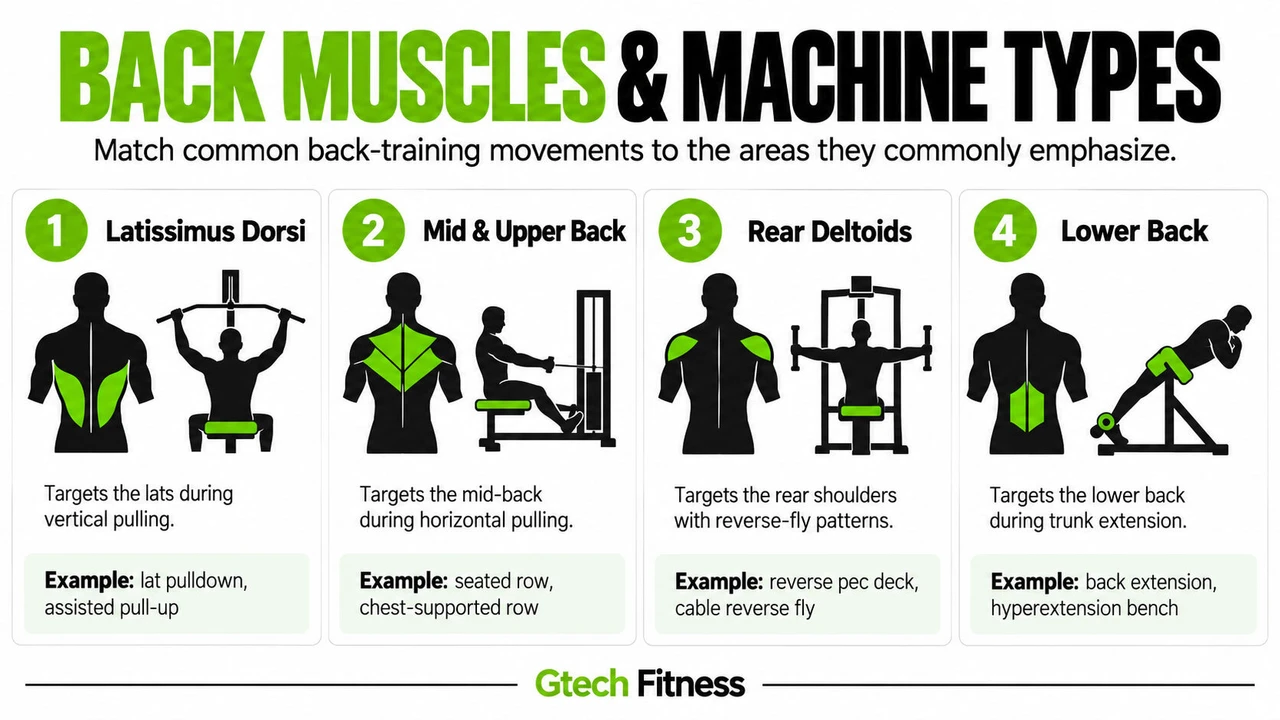
The back contains several muscle groups that move the shoulders and arms, support the shoulder blades, and stabilize or extend the spine. Most back exercises use several muscles together. A machine's name can suggest the main movement, but it does not mean the exercise isolates only one part of the back.
Latissimus Dorsi: The Lats
The latissimus dorsi are large muscles spanning much of the mid-to-lower back and attaching to the upper arms. They contribute to pulling the arms down and back. Lat pulldowns, assisted pull-ups, pullover-style cable exercises and several rowing variations train the lats. People sometimes call these lat machines or look for equipment that builds back width, although the visual result depends on overall training and individual anatomy.
Rhomboids and Trapezius
The rhomboids and portions of the trapezius help control the shoulder blades. Seated rows, chest-supported rows, high rows and rear-delt fly movements involve these muscles alongside the lats and other upper-back muscles. Rowing exercises with different elbow paths can place somewhat different demands on the surrounding muscles without creating completely separate training categories.
Rear Deltoids and Supporting Shoulder Muscles
The rear deltoids belong to the shoulders but assist many pulling movements. Reverse pec decks, rear-delt machines, high rows and cable reverse flys are useful when a program needs additional work behind the shoulders. These exercises complement, rather than replace, the larger pulldown and rowing movements.
Spinal Erectors and the Posterior Chain
The spinal erectors help extend and stabilize the torso. Back extension machines and hyperextension benches can train them, often with meaningful involvement from the glutes and hamstrings. This is different from pulling a handle with the arms. A complete back-training plan may include both upper-body pulling and a suitable trunk- or hip-extension movement.
| Training Emphasis | Typical Movement | Common Equipment |
|---|---|---|
| Lats and upper-body pulling | Pulling the upper arms down or back | Lat pulldown, assisted pull-up, leverage pulldown, rows |
| Mid and upper back | Horizontal pulling and shoulder-blade control | Seated row, high row, chest-supported row |
| Rear shoulders and upper back | Moving the arms outward or backward | Reverse pec deck, cable reverse fly |
| Low back and posterior chain | Controlled trunk or hip extension | Back extension machine, 45-degree hyperextension bench |
Back Workout Machine Names at a Glance
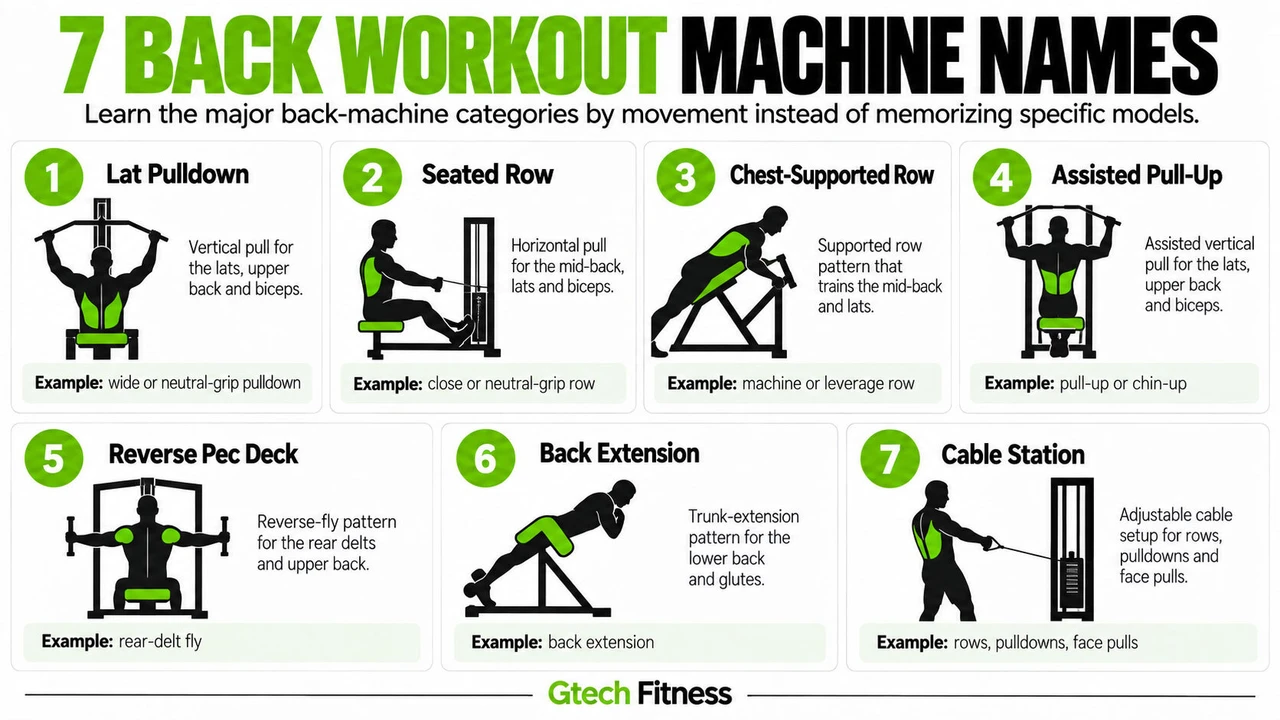
These are the main names to know when identifying back exercise equipment in a gym. Some names describe a full machine, while others describe a station or exercise that can be performed on several machine designs. For a broader equipment glossary that includes legs, chest, cardio and free weights, see our guide to gym equipment names.
| Machine or Station | Movement | Main Training Emphasis | Also Called |
|---|---|---|---|
| Lat Pulldown | Vertical pull | Lats, upper back, elbow flexors | Lat machine, high pulley |
| Leverage Lat Pulldown | Guided vertical or angled pull | Lats and upper back | Plate-loaded pulldown |
| Assisted Pull-Up | Assisted bodyweight vertical pull | Lats, back, biceps | Chin/dip assist |
| Seated Cable Row | Horizontal pull | Lats and mid-back | Low row, cable row |
| Chest-Supported Row | Supported horizontal pull | Mid-back, lats, rear shoulders | Seated leverage row |
| Independent-Arm Row | Unilateral or bilateral row | Lats and mid-back | Iso-lateral row, leverage row |
| High Row | Angled upper-body pull | Upper back, lats, rear shoulders | High leverage row |
| Low Row | Low-to-torso pull | Lats and middle back | Low leverage row |
| T-Bar Row | Row, sometimes chest-supported | Lats, upper and mid-back | Leverage T-bar row |
| Reverse Pec Deck | Reverse fly | Rear shoulders and upper back | Rear-delt machine |
| Back Extension Machine | Resisted trunk extension | Spinal erectors | Low-back machine |
| Hyperextension Bench | Bodyweight or loaded hip/trunk extension | Low back, glutes, hamstrings | 45-degree back extension, Roman chair* |
*Roman chair is an inconsistent equipment nickname. It may describe different bodyweight stations, so check the machine's pads and intended movement.
Vertical Pulling Machines: Lat Pulldowns and Pull-Ups
Vertical pulling brings the arms downward from an overhead position or lifts the body toward an overhead bar. It is an important movement pattern for training the lats and other pulling muscles. Many facilities dedicate one or more back workout machines to this pattern because the exercises can be adjusted for a wide range of users.
Lat Pulldown Machine
A lat pulldown machine usually has a tall frame, overhead cable, long or interchangeable pull bar, seated position and thigh restraint. The user pulls the handle toward the upper chest while keeping the torso controlled. The movement trains the lats, upper back and biceps, with grip and elbow position influencing how the exercise feels.
To set up, adjust the seat or thigh pad so you remain stable without lifting off the seat. Reach overhead, establish a comfortable grip, and bring the elbows downward while maintaining a controlled torso position. Finish the repetition without forcing the bar behind the neck, then return upward smoothly. Exact range and handle path depend on the machine, your mobility and the exercise instructions.
Some back training machines for pulldowns and rows offer both an overhead pulley and a lower rowing position. A dual-function station can cover the two main pulling directions while using less floor space than two dedicated machines.
Plate-Loaded Leverage Lat Pulldown
A leverage pulldown replaces the usual cable-and-stack arrangement with moving arms, often loaded using Olympic weight plates. Some models have independent left and right handles; others move both arms together. The lever path may arc or diverge rather than traveling in a straight line. Although the shape is different, its role is similar to a cable lat pulldown: guiding a vertical or angled pulling movement against resistance.
Set the seat and thigh support for your body, select the prescribed handle position, and pull through the machine's intended path. Do not assume that every leverage pulldown uses the same grip spacing or handle travel. The construction of the movement arms matters more than the machine's appearance.
Assisted Pull-Up or Chin/Dip Machine
An assisted pull-up machine has a pull-up bar and a moving knee pad or foot platform connected to a counterweight system. On this type of machine, selecting more assistance generally makes the pull-up easier because the counterbalance offsets more body weight. That is the opposite of what happens when you increase the resistance on an ordinary lat pulldown.
The pull-up or chin-up portion trains the back and elbow flexors while the assisted dip portion focuses primarily on pressing muscles. The same station therefore serves more than one purpose. Browse assisted chin-up and dip stations if your program includes progressive bodyweight work.
Which Is Better: Lat Pulldown or Assisted Pull-Up?
Both exercises train vertical pulling, but they manage resistance differently. A pulldown keeps the user seated while an external handle moves against selected resistance. An assisted pull-up moves the user against a bar while counterweight assistance reduces the effective body weight lifted. A pulldown is easy to adjust in small resistance steps; an assisted pull-up more closely practices the body position and coordination of an unassisted pull-up.
Neither is automatically the better choice. A beginner who wants controlled pulldown training may prefer a lat machine. Someone specifically working toward an unassisted pull-up may benefit from assisted repetitions. Both can fit into the same program without needing to perform them every session.
Horizontal Pulling Machines: Seated and Supported Rows
Rowing machines for strength training pull a handle or lever toward the torso. They involve the lats, middle and upper back, rear shoulders and elbow flexors. The exact emphasis changes with the handle path, elbow position, body support and machine design. Unlike a cardio rowing ergometer, these machines use repeated resistance-focused pulling exercises rather than continuous full-body strokes.
Seated Cable Row Machine
A seated cable row generally has a low pulley, a handle attachment and foot supports or a fixed seat. The user starts with the arms extended and pulls the handle toward the torso while keeping the trunk stable. Some low-row stations have an attached weight stack; others share a frame with a lat pulldown or a multi-station cable system.
For a standard cable row, sit with the feet supported, maintain a comfortable upright posture and pull the elbows back without swinging the torso. Pause briefly when the handle approaches your torso, then let the arms extend in a controlled return. Keeping each repetition controlled helps maintain a stable torso and a smooth return rather than relying on momentum.
Chest-Supported Row Machine
A chest-supported row uses a pad against the front of the torso. It may have a selectorized weight stack, a plate-loaded lever system or cable resistance. The supported position reduces the need to hold a bent-over stance during the exercise, making it a practical choice when someone wants to concentrate on the pulling motion.
Adjust the seat so the handles and chest pad line up with the intended movement. Pull the handles toward the torso without lifting the chest away from the pad. The machine's handle path determines whether the elbows stay closer to the sides or move outward. Either can be useful; they are simply different row designs.
Independent-Arm and Iso-Lateral Row Machines
Some leverage rows provide one moving arm for each side. They can allow simultaneous pulling, alternating repetitions or one arm at a time, depending on the model. A single-arm row can help a lifter pay attention to side-to-side differences and the movement of each shoulder blade. These machines may be called independent-arm rows, unilateral rows or iso-lateral rows.
Separate handles do not mean the resistance or range is identical between every brand. Use the machine's prescribed loading arrangement and adjustments, and keep any added weight balanced when the design requires it.
High Row and Low Row Machines
A high row pulls the handles down and back from a higher starting position, while a low row often starts below chest height and travels toward the lower or middle torso. The terms are not standardized across all manufacturers, so an individual high row can look substantially different from another company's version. Both are pulling movements with meaningful lat and upper-back involvement.
When choosing between them, compare the direction of the handles, chest support, seat adjustment and grip options. A wide-elbow high row may feel different from a close-elbow low row, but one does not exclusively train the upper back while the other exclusively trains the lower lats.
T-Bar Row and Chest-Supported T-Bar Row
A T-bar row uses a lever or anchored bar that travels through an arc as the lifter rows toward the torso. Some versions require a standing or hinged position; others provide a chest pad. Plate loading is common. These designs are useful for adding rowing resistance but require the same attention to controlled body position as other back exercises.
For gym owners, choosing between a T-bar row, seated selectorized row and chest-supported leverage row is partly a question of how much versatility, coaching oversight and floor space the room needs. Each can provide effective horizontal pulling without needing to purchase all three.
Upper-Back and Rear-Shoulder Machines
Vertical pulls and rows handle much of the major back work, but certain machines and cable exercises place extra emphasis on the rear deltoids and muscles around the shoulder blades. These are useful additions when a workout needs variety beyond another pulldown or seated row.
Reverse Pec Deck or Rear-Delt Fly Machine
A reverse pec deck is often the same machine family used for a chest fly station, with the user facing the opposite direction or changing the handles and moving arms. In the reverse-fly movement, the arms travel outward and backward to train the rear deltoids and upper-back supporting muscles. Some machines are dedicated rear-delt stations, while others combine pec fly and rear-delt functions.
Adjust the seat so the handles align with the intended shoulder position. Keep the torso supported and move through a comfortable arc without forcing the shoulders behind their natural range. Because the exercise is not a large lat-focused pull, it works best as a complement to rows and pulldowns rather than a substitute for them.
High Cable Row and Face Pull
An adjustable cable column can create higher pulling angles that are useful for the upper back and rear shoulders. A high cable row brings resistance toward the upper torso, often with elbows wider than in a conventional low row. A face pull brings a rope or suitable handle toward the face or upper chest area with controlled shoulder and elbow movement.
These are exercises performed on a cable machine, not necessarily the names of separate machines. Keep the resistance manageable enough that the shoulders and arms can follow the intended path without leaning sharply backward or turning the movement into a whole-body pull.
Lower-Back and Posterior-Chain Machines
When people ask about lower-back workout machines, they may mean selectorized trunk-extension equipment or bodyweight hyperextension benches. These are different from pulldown and row machines because the resistance is applied to the trunk or hips rather than pulled toward the body with the arms.
Selectorized Back Extension Machine
A selectorized back extension machine commonly positions the user in a seated or supported posture against a moving pad. The user extends the torso against a selected weight-stack load. Because the machine guides the path, the starting angle and pad arrangement should be set for the individual before resistance is increased.
Look for a unit labeled back extension, low back or abdominal/back machine. Some dual-function stations combine resisted trunk flexion and extension in one seat. Gtech Fitness carries guided abdominal and lower-back equipment for facilities that want dedicated core-resistance stations.
45-Degree Hyperextension Bench
A 45-degree hyperextension bench supports the pelvis or upper thighs on a pad and holds the lower legs in place. From there, the user performs a controlled hinge or extension movement. Depending on technique and body position, the erector spinae, glutes and hamstrings can all contribute. The bench itself does not supply a weight stack; body weight provides the base resistance.
Adjust the pad so the hips can move comfortably through the intended pattern without pressing into the abdomen. Move only through a controlled, comfortable range and avoid snapping the torso into an exaggerated arch at the top. Many gyms refer to this style as a Roman chair or back extension bench, though those names are used inconsistently.
Horizontal Back Extension and Glute-Ham Developer
A horizontal back extension places the torso closer to parallel with the floor in the starting or top position. A glute-ham developer (GHD) has a different pad and ankle-support arrangement and may be used for glute-ham raises, hip extensions and other posterior-chain exercises. These stations are related but not identical; the available exercises depend on their individual construction.
Browse back extension benches and glute-ham stations when comparing bodyweight posterior-chain equipment. For a shared gym, ensure the machine fits its users and training program rather than choosing a bench based only on its name.
Does a Back Extension Work the Lats?
Not in the same way as a pulldown or row. Back extensions primarily challenge the muscles controlling the trunk and hips, while lat pulldowns and rows involve pulling with the upper arms and shoulder girdle. A balanced program may include both, but one should not be used as a direct replacement for the other.
Back Exercises Using Cable Machines
Dedicated back exercise machines are convenient, but an adjustable pulley system can cover much of the same movement variety. A functional trainer, cable crossover, single cable column or multi-station gym may support rows, high pulls, pulldown variations and other back exercises when its pulley height, attachments and user positioning permit them.
The advantage of adjustable cable exercise equipment is its flexibility. A facility can use the same frame for back work, arm exercises, chest movements and core training rather than dedicating a separate machine to every exercise.
| Cable Exercise | Usual Pulley Position | Movement and Emphasis |
|---|---|---|
| Standing or Kneeling Lat Pulldown | High | Vertical pulling for lats and upper back; requires a suitable high-pulley setup |
| Seated or Standing Cable Row | Low to mid | Horizontal pulling for lats, mid-back and arms |
| Single-Arm Cable Row | Low to mid | One-sided row for back and shoulder-blade control |
| Straight-Arm Cable Pulldown | High | Shoulder extension with reduced elbow bending; emphasizes the lats |
| Face Pull | Upper to mid | Rear shoulders and upper-back supporting muscles |
| Cable Reverse Fly | Around shoulder height | Rear deltoids and upper-back muscles |
A cable station's rated attachments, cable travel, range of adjustment and approved exercise positions determine which movements are practical. A compact single cable column will not necessarily recreate the setup of a purpose-built seated lat machine or low row.
Which Back Machine Should You Use?
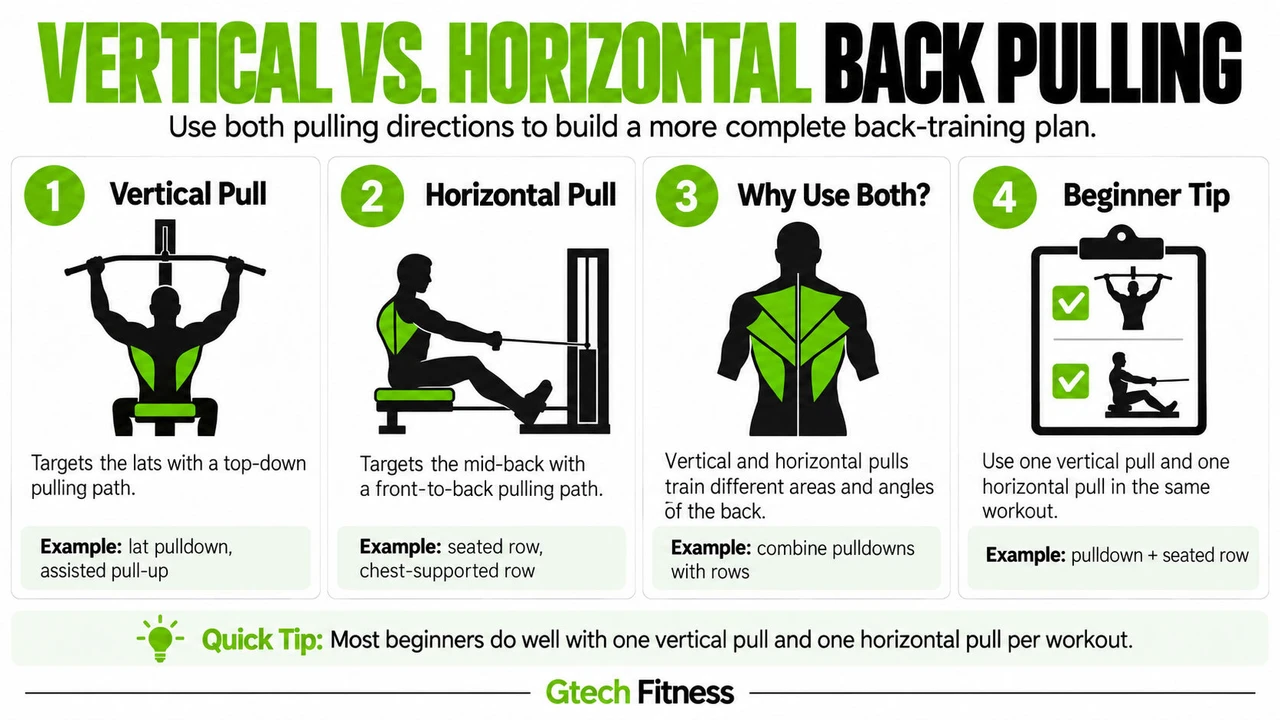
The answer depends on the pulling pattern you need and the equipment available. Rather than chasing a single "best" machine, choose exercises that complement each other. The chart below is a practical starting point for selecting machines by training priority.
| Training Goal | Useful Machine Choice | Why It Fits |
|---|---|---|
| Develop vertical pulling strength | Lat pulldown or leverage pulldown | Adjustable resistance with an overhead pulling path |
| Build toward unassisted pull-ups | Assisted pull-up station | Practices the bodyweight movement with adjustable assistance |
| Train horizontal pulling | Seated cable row or chest-supported row | Rows resistance toward the torso with consistent setup |
| Add single-arm training | Independent-arm row or single cable column | Allows each side to work separately when the setup supports it |
| Emphasize rear shoulders | Reverse pec deck or cable reverse fly | Adds a reverse-fly movement beyond larger pulls |
| Train trunk extension | Back extension machine or hyperextension bench | Challenges spinal erectors and other posterior-chain muscles |
| Save floor space | Combination lat pulldown/row or suitable functional trainer | Provides multiple pulling options from one station |
Vertical Pull vs. Horizontal Row: Do You Need Both?
For many programs, yes. A vertical pull and a horizontal row challenge the back from different arm positions and angles, which makes them a useful pair. A lat pulldown is not exclusively a lat exercise, and a row is not exclusively a rhomboid exercise; both involve overlapping muscles. The advantage is coverage of different movement patterns rather than a promise that each machine isolates a separate muscle.
Do Different Grips Change the Muscles Worked?
Overhand, underhand and neutral grips can change elbow position, joint comfort and the contribution of the arm muscles. A wider grip may also change the available range of motion. However, grip labels alone do not determine a single muscle that receives all the work. Select a grip supported by the machine that lets you pull comfortably and consistently through the intended range.
How to Set Up and Use Back Machines
The details differ by machine, but a few steps make most back exercises easier to learn. Always follow the instructional placard and adjustment directions for the actual equipment in front of you. If you're unfamiliar with the station, start with a manageable load and ask a qualified coach or gym staff member for help when needed.
1. Identify the Resistance System
Look for a selector pin and weight stack, a place to load plates, a cable with interchangeable handles, or a counterweight platform. The resistance system determines how you select the load. On assisted pull-up machines, more counterweight assistance means less of your body weight must be lifted; on ordinary selectorized machines, selecting more resistance generally makes the exercise harder.
2. Adjust the Seat, Pads and Handle Position
For a lat pulldown, the thigh pad should help prevent the body from rising with the handle. For a chest-supported row, the chest pad should support the torso without forcing the shoulders into an awkward reach. Set handles and range adjustments so you can begin the intended movement without a sudden jerk.
3. Establish a Stable Starting Position
Keep the feet and body supports where the machine instructions specify. Brace enough to control the torso without holding your breath unnecessarily. On cable machines, stand or sit where the cable moves freely without rubbing against the frame or pulling you out of position.
4. Pull With Control and Return Smoothly
Move the elbows through the intended path rather than throwing the entire torso into the repetition. Let the resistance return under control instead of allowing the weight stack or moving arms to drop. The complete motion should look similar from one repetition to the next.
5. Change the Load Only After the Movement Is Repeatable
When you can perform your planned repetitions consistently, consider a small increase in resistance or additional repetitions within your program. If the motion turns into swinging, shrugging or excessive trunk extension, reduce the load or review the setup. A machine can guide resistance without automatically guaranteeing good technique.
Example Back Machine Workouts
You do not need to use every back machine in one workout. Choose a manageable number of complementary exercises, use resistance that allows controlled technique, and progress gradually. The examples below are illustrative workout templates, not required prescriptions. Training history, other weekly workouts, recovery and available equipment should determine your final exercise selection.
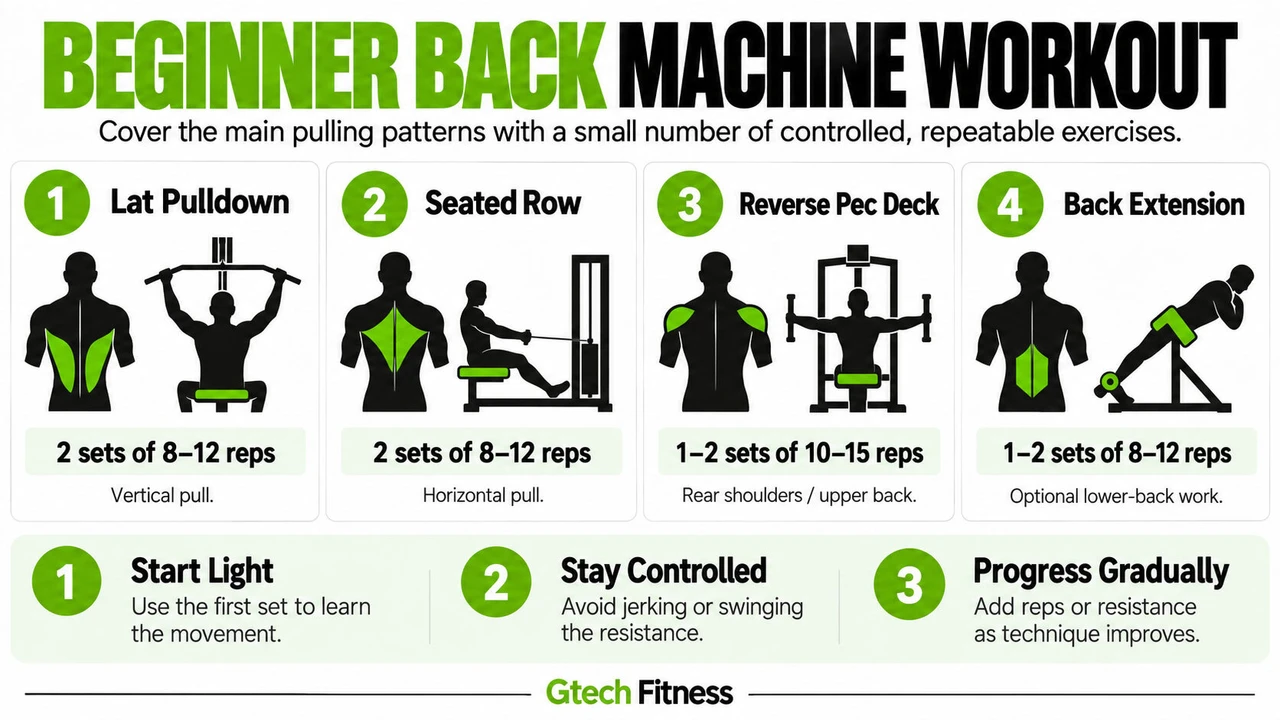
Beginner Back Machine Workout
This session covers vertical pulling, horizontal pulling and an optional rear-shoulder movement without making the workout unnecessarily complicated. A beginner might use it within a full-body routine rather than devote an entire training day to the back.
| Exercise | Sets | Repetitions | Focus |
|---|---|---|---|
| Lat pulldown | 2 | 8-12 | Vertical pulling |
| Seated cable row | 2 | 8-12 | Horizontal pulling |
| Reverse pec deck (optional) | 1-2 | 10-15 | Rear shoulders and upper back |
Warm up with easy movement and lighter practice repetitions before working sets. Rest long enough to maintain good technique. Record the resistance and repetitions so you can repeat the session and make gradual changes. Our beginner strength training guide explains how these machine exercises can fit into a complete weekly plan.
Intermediate Back Machine Workout
This variation adds a supported row and a lower-back or posterior-chain exercise. It suits someone who has already practiced the major movement patterns and can manage more work without letting technique deteriorate.
| Exercise | Sets | Repetitions | Focus |
|---|---|---|---|
| Lat pulldown or assisted pull-up | 3 | 6-12 | Vertical pull |
| Chest-supported leverage row | 3 | 8-12 | Supported horizontal pull |
| Single-arm cable row | 2 | 10-12 per side | Unilateral control |
| Reverse pec deck or cable face pull | 2 | 10-15 | Rear shoulders and upper back |
| Back extension (optional) | 2 | 8-12 | Trunk or hip extension |
The additional row is optional if similar back work is already present elsewhere in the week. Someone who performs demanding deadlifts, barbell rows or other posterior-chain exercises may not need extra back extensions in the same session.
Compact Home Gym Back Workout
If your training area has only a functional trainer, you can build a useful session around a high-pulley pulldown variation, a standing or seated cable row, and a light cable reverse fly. If you have dumbbells and a bench instead, substitute a supported dumbbell row for the cable row and use suitable free-weight movements to cover your goals. Match the exercise to what your equipment is actually designed to support.
Prioritize controlled repetitions and progressive resistance over adding more exercises. A compact program performed consistently offers more value than a complicated routine that requires machines you do not have.
Back Machines vs. Free Weights
Back machines and free weights can both develop pulling strength. Machines guide part of the movement or supply a fixed cable path, while free weights let the user control more of the load's path. That changes the setup and stabilization demands, but it does not make one approach universally superior.
Advantages of Back Machines
A dedicated lat machine or row provides a repeatable seat, handle and resistance setup. Selectorized designs allow fast resistance changes without moving plates. Chest-supported machines reduce the need to hold a bent-over position during rows, which can make the targeted pulling exercise easier to organize for some users. Shared facilities may also prefer machines for their consistent stations and straightforward instructions.
Advantages of Free Weights
Dumbbells, barbells and other gym weights for strength training allow a wide range of rows, hinges and pulling-related exercises with relatively little dedicated machine space. A dumbbell row, for example, can use a bench or suitable support while allowing each side to move independently.
One set of hand weights and dumbbells can also serve pressing, squatting, carrying and arm exercises, so free weights can be especially versatile in small training rooms.
Can You Combine Machines and Free Weights?
Yes. A program might use a pulldown machine and supported row for repeatable pulling resistance, then include dumbbell rows or barbell work for variety. It is usually more useful to select exercises by movement, training goal and available space than to follow a machines-only or free-weights-only rule.
Choosing Back Equipment for Home and Commercial Gyms
If you're purchasing equipment rather than simply using a gym, the most important questions are how many people will use the station, which exercises matter most, how much working space is available, and what equipment-use rating the setting requires.
Home Gyms: Prioritize Movement Coverage
A combination lat pulldown/low-row machine can provide two foundational exercises without requiring two separate stations. A functional trainer may offer even more variety if you also want chest, arm and core exercises. If your program already includes a rack and bench, a cable column or suitable row machine may be a better addition than several machines with similar pulling paths.
School Weight Rooms: Plan for Coaching and Repeated Use
Schools often benefit from equipment that is easy to identify, adjust and supervise. Consider how students approach the machine, how quickly resistance can be changed, and whether the training stations support the facility's program. Equipment should be rated for the intended school or institutional use rather than treating a home-use machine as a lower-cost substitute.
Commercial Facilities: Balance Variety and Traffic
Commercial gyms can use separate lat pulldowns, seated rows, leverage rows and rear-delt stations to accommodate more users. Smaller apartment, hotel and corporate wellness rooms may instead prefer a compact combination machine or multi-station strength system. The right mix depends on peak traffic, user needs, staffing and available floor space.
Selectorized vs. Plate-Loaded Back Machines
Selectorized machines change resistance with a pin or integrated adjustment and are convenient for circuits and groups. Plate-loaded leverage machines use weight plates and may offer independent arms, different resistance curves or particular pulling angles. Neither category is automatically better for all users. Compare the specific machine's movement, adjustment range, dimensions and stated use classification.
| Question | What to Check |
|---|---|
| Which movements are essential? | Vertical pull, horizontal row, rear-shoulder work, posterior-chain work |
| Who will use it? | User height range, adjustment needs, expected traffic and equipment-use rating |
| How is resistance changed? | Weight stack and pin, plate-loaded arms, cable resistance or assisted bodyweight system |
| How much space is needed? | Assembled footprint plus access, exercise movement, plate loading and circulation clearance |
| Can one station cover more? | Combination lat/row machines, adjustable cable stations or shared multi-station equipment |
| Will it reach the room? | Delivery route, doorways, turns, package sizes and assembly area |
For a broader selection of strength machines for home and commercial gyms, compare the categories based on the exercise rather than searching for one universal machine that is best for every facility. Our home versus commercial equipment guide also explains why matching the machine's use rating to the setting matters.
Common Back Machine Training Mistakes
Using Only One Pulling Direction
A routine built entirely around variations of the lat pulldown may miss opportunities to practice horizontal pulling. A routine made only of seated rows can overlook overhead pulling. For general back training, combining the two patterns is usually more useful than collecting several nearly identical handle variations.
Using Excessive Weight and Momentum
Leaning sharply backward during pulldowns or swinging through cable rows changes the exercise and can make repetitions difficult to compare. Select a load that allows a repeatable movement path. Heavier is not necessarily better when the intended motion is lost.
Skipping Seat and Pad Adjustments
Incorrect thigh-pad, chest-pad or seat settings can interfere with a stable setup. Before every session, check that the body supports match your size and the handle starts in a comfortable position. This is especially important in shared gyms where the previous user may have changed every setting.
Confusing Assisted Weight With Training Resistance
On a chin/dip assist machine, increasing the counterweight usually provides more help and makes the bodyweight movement easier. On a conventional weight-stack lat pulldown, selecting a higher weight makes the pull harder. Read the placard before changing settings.
Treating a Back Extension Like a Lat Pulldown
Back extensions and lat pulldowns train different movement patterns. The first challenges the trunk or hips; the second involves pulling the arms down against resistance. A lower-back extension is not a substitute for vertical or horizontal pulling.
Confusing Cardio Rowers With Strength Row Machines
A rowing ergometer uses repeated leg drive, body movement and arm pulling to create a continuous cardio workout. A seated strength row uses selected external resistance for repeated pulling sets. They share the word row but are not interchangeable equipment categories.
Adding Too Many Similar Exercises
If a workout already includes several pulldown and rowing variations, another nearly identical machine may add fatigue without giving you a useful new movement. Start with the training pattern and goal, then choose the station that fits best. More equipment names do not automatically mean a better program.
Frequently Asked Questions
What are the most common back workout machine names?
Common names include lat pulldown, seated cable row, leverage pulldown, chest-supported row, high row, low row, T-bar row, assisted pull-up machine, reverse pec deck, back extension machine and hyperextension bench. Functional trainers and cable columns can also perform several back exercises.
What is the best machine for working your back?
There is no single machine that is best for every back-training goal. A lat pulldown is useful for vertical pulling, a seated or chest-supported row provides horizontal pulling, and a back extension trains a different trunk- or hip-extension pattern. Choose based on the movement you need and the equipment that fits your body and program.
Which back machine works the lats?
Lat pulldown machines, leverage pulldowns and assisted pull-ups train the latissimus dorsi. Rows and some cable exercises also involve the lats. How much each muscle contributes depends on the movement, individual anatomy and technique rather than the machine's name alone.
What gym machine works the middle back?
Seated rows, chest-supported rows, high rows and other horizontal pulling machines are common choices for the middle and upper back. They involve the rhomboids, trapezius, lats, rear shoulders and arm muscles to varying degrees.
What is the difference between a lat pulldown and a seated row?
A lat pulldown pulls resistance downward from above the body, creating a vertical pulling pattern. A seated row brings resistance toward the torso, creating a horizontal pulling pattern. Both train overlapping back and arm muscles, but through different arm positions and movement paths.
Are plate-loaded back machines better than cable machines?
Neither is inherently better for everyone. Plate-loaded machines can provide guided leverage paths and sometimes independent arms. Cable machines provide pulley-based resistance and may allow more handle and exercise options. Consider how the machine feels, its intended movements, space needs and the users it will serve.
Can a functional trainer replace a lat pulldown and row machine?
A suitable functional trainer can perform several pulldown and rowing variations when its pulley heights, cable travel, attachments and exercise positions support them. A dedicated lat pulldown/row station may offer a built-in seat, thigh restraints, foot supports and a more convenient setup for those two exercises. Compare the actual machines before assuming they are equivalent.
Which machine works the lower back?
A selectorized back extension machine is designed for resisted trunk extension. A 45-degree hyperextension bench and other back extension stations can train the lower-back muscles along with glutes and hamstrings. These differ from pulldowns and rows, which focus on upper-body pulling.
Can beginners use back workout machines?
Yes. Many back machines offer adjustable resistance and repeatable positions that can make pulling movements approachable. Beginners should learn the machine's adjustments and exercise path, use manageable resistance, and keep the routine simple enough to perform consistently.
How many back machines do you need for a workout?
A basic session may need only a vertical pulling exercise and a horizontal rowing exercise. Additional rear-shoulder or back-extension work can be useful when it fits the rest of your program. The number of exercises should reflect your experience, weekly training volume and recovery rather than the number of machines available.
Can back machines replace dumbbell or barbell rows?
They can provide a different way to train many of the same pulling muscles. Machines may be easier to set up consistently, while free-weight rows require the lifter to control more of the load and body position. Either approach can be part of a complete program, and many people use both.
What is the difference between a back row machine and a rowing machine?
A back row machine is a resistance-training station used for repeated sets of horizontal pulls. A rowing machine or rowing ergometer is primarily cardio equipment that combines leg drive, trunk movement and arm pulling into continuous strokes. They share a name but have different training purposes.
Final Thoughts on Back Workout Machines
Understanding the names of back workout machines is the first step toward choosing equipment that suits your training. Lat pulldowns and assisted pull-ups provide vertical pulling, seated and chest-supported rows provide horizontal pulling, reverse pec decks emphasize the rear shoulders, and back extension stations train the trunk and posterior chain. These movements overlap, but they do not all serve the same purpose.
Start with the pulling patterns you want to develop, learn the correct setup for each machine, and progress at a pace that keeps the movement controlled. Whether you're exercising in a commercial gym or planning a home strength room, selecting a few complementary back machines is more useful than simply adding every station that has back or row in its name.
EXPLORE POPULAR ARTICLES
-
Back Workout Machines: Names, Exercises & Muscles Worked
Oct 07, 2026A Complete Guide to Back Machines, Exercises and Muscles Worked Estimated Reading Time: 30 Minutes B
-
Gym Equipment Names: Machines, Free Weights & Uses
Oct 06, 2026Learn the Names of Common Gym Equipment and What Each Piece Does Estimated Reading Time: 28 Minutes
-
Home Gym Setup Guide: How to Build a Home Gym
Oct 06, 2026How to Plan a Home Gym That Fits Your Space, Goals and Budget Estimated Reading Time: 26 Minutes A w