
What Is a Glassless Mirror? Mylar Mirror Guide
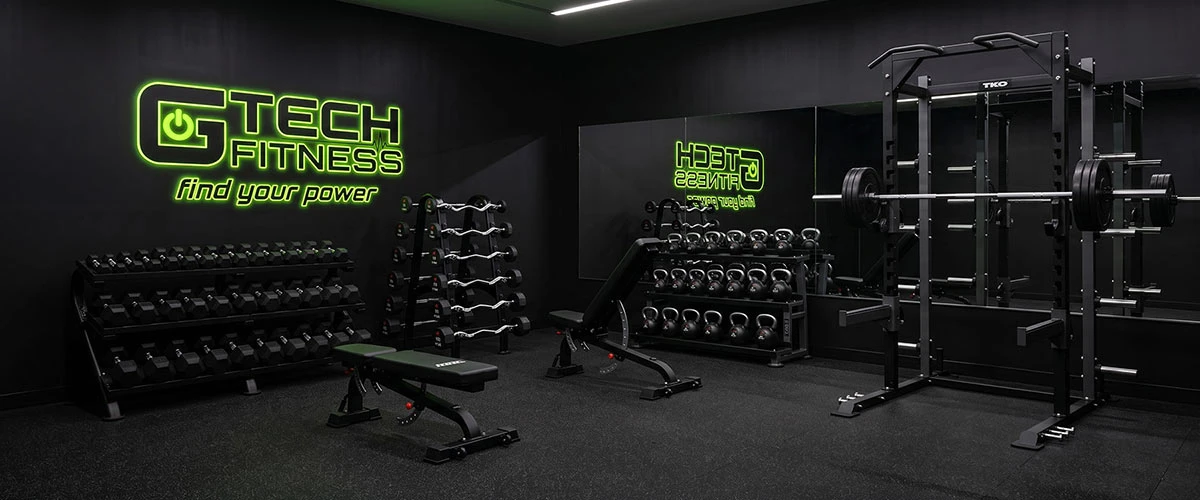
Glassless Mirrors for Home Gyms, Dance Studios, Schools & More
Glassless mirrors replace traditional mirror glass with a highly reflective film stretched across a rigid, lightweight panel. That simple difference changes how the mirror handles, mounts, moves, reacts to impact, and performs in active spaces. For dance studios, fitness centers, schools, rehabilitation facilities, home gyms, and multipurpose rooms, a properly selected glassless mirror can provide a large reflective surface without the weight and broken-glass risk of a conventional mirror.
This guide explains how glassless mirrors work, how they compare with traditional glass, the difference between wall-mounted and rolling models, available sizes, installation considerations, cleaning and repair, and some lesser-known characteristics such as tested sound absorption and surface-burning performance.
Quick Answer: What Is a Glassless Mirror?
A glassless mirror is a rigid, lightweight reflective panel that uses tensioned metallized polyester film instead of mirror glass. LiteMirror panels place the reflective layer at the front surface, eliminating shattered-glass risk while providing a clear reflection for fitness, dance, education, rehabilitation, and other active spaces.
Table of Contents
- How Do Glassless Mirrors Work?
- Are Glassless Mirrors the Same as Mylar Mirrors?
- Glassless Mirrors vs. Traditional Glass Mirrors
- Glassless Mirror Safety, Durability & Limitations
- Wall-Mounted vs. Rolling Glassless Mirrors
- Glassless Mirror Sizes & Weights
- Installation & Room Planning
- Acoustic & Fire-Test Performance
- Where Are Glassless Mirrors Used?
- Cleaning, Care & Dent Repair
- How to Choose a Glassless Mirror
- Frequently Asked Questions
How Do Glassless Mirrors Work?
A glassless mirror creates its reflective surface with thin metallized polyester film instead of a sheet of mirror glass. LiteMirror panels use 1.42-mil reflective film tensioned across an aluminum frame. A rigid polyurethane foam core helps support the panel while keeping the finished mirror lightweight and dimensionally stable.
The reflective layer is positioned at the front of the panel, making it a first-surface mirror. With a conventional mirror, light passes through glass before reaching the reflective backing and then passes back through the glass toward the viewer. A first-surface mirror removes that layer of glass from the optical path, avoiding the secondary reflection that can occur with traditional mirror construction.
Tension is a major part of the design. The reflective film is held across the rigid frame so the surface remains flat. Proper mounting matters because forcing the frame against an uneven surface or twisting the panel can affect flatness and create visible distortion. The goal during installation is to support the panel without forcing the frame out of its natural plane.
What Is Inside a LiteMirror Panel?
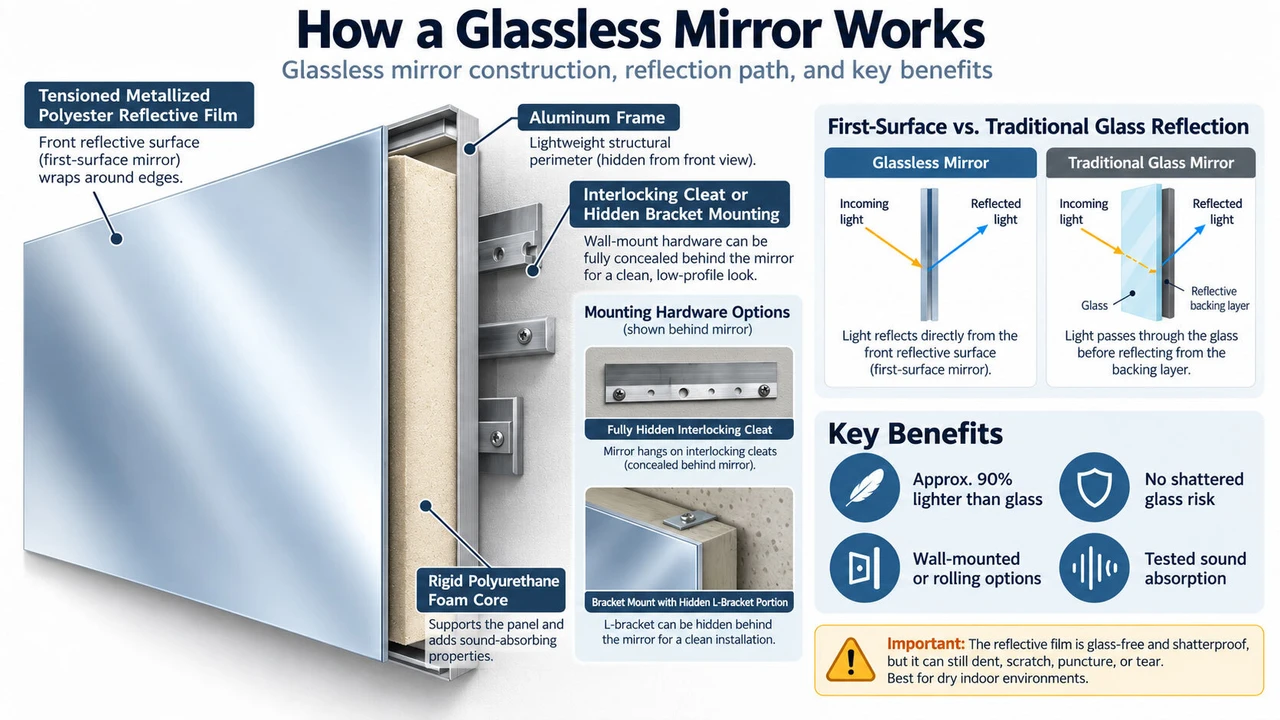
| Component | Purpose |
|---|---|
| Metallized Polyester Film | Creates the reflective first surface without traditional mirror glass. |
| Aluminum Frame | Keeps the tensioned film supported within a lightweight rigid panel. |
| Polyurethane Foam Core | Adds structural support while contributing thermal and sound-absorbing properties. |
| Mounting Hardware or Stand | Allows the panel to function as a permanent wall mirror or portable rolling mirror. |
Are Glassless Mirrors the Same as Mylar Mirrors?
The terms glassless mirror and Mylar mirror are often used interchangeably in fitness, dance, theatrical, and specialty-mirror markets. Mylar® is a familiar name associated with polyester film, while LiteMirror's current technical specifications describe the reflective surface more precisely as metallized polyester film.
For buyers, the more important distinction is the complete panel construction rather than the film name alone. A professionally manufactured glassless mirror uses a properly tensioned reflective surface, rigid supporting structure, and mounting system designed to hold the panel flat. A loose sheet of reflective film is not equivalent to a completed glassless mirror panel.
Glassless Mirrors vs. Traditional Glass Mirrors
The biggest differences between a glassless mirror and a conventional mirror are not simply appearance. The materials change the weight, safety characteristics, installation requirements, handling, sound behavior, and way each mirror responds to impact.
| Feature | LiteMirror Glassless Mirror | Traditional Glass Mirror |
|---|---|---|
| Reflective Material | Tensioned metallized polyester film. | Reflective mirror construction using glass. |
| Reflective Surface | First-surface reflection with no glass layer in front of the reflective film. | Reflective layer is typically viewed through the glass. |
| Broken Glass Risk | No mirror glass to break into sharp shards. | Glass can crack or shatter when broken. |
| Weight | Approximately 90% lighter than comparable glass mirrors. | Considerably heavier at comparable sizes. |
| Mobility | Available in wall-mounted and rolling configurations. | Depends on the mirror and support system; large glass installations are commonly fixed. |
| Impact Behavior | Film can dent, scratch, puncture, or tear, but does not create broken-glass shards. | Glass can crack or shatter under sufficient impact. |
| Cleaning & Handling | Exposed film requires gentle, non-abrasive cleaning and careful handling. | Rigid glass surface generally tolerates conventional mirror-cleaning methods. |
| Sound Characteristics | LiteMirror panel construction provides measurable sound absorption. | Hard glass surfaces primarily reflect sound energy. |
What About Acrylic or Plastic Mirrors?
Acrylic and other plastic mirror materials eliminate traditional mirror glass, but they are a different product category from a tensioned-film glassless panel. Large plastic sheets display visual warping when they are not kept perfectly flat, which is extremely difficult to achieve with large plastic mirrors. LiteMirror uses tensioned reflective film over a rigid framed structure specifically to control panel flatness and reflection quality.
This does not mean one mirror material is best for every application. Buyers should compare safety, reflection quality, expected contact, cleaning requirements, installation, portability, and budget before choosing a mirror system.
Glassless Mirror Safety, Durability & Limitations
The most important safety advantage of a glassless mirror is straightforward: there is no sheet of mirror glass to shatter into sharp fragments. This makes glass-free construction especially attractive in active environments where reducing broken-glass risk is important.
However, shatterproof does not mean impact-proof. The exposed reflective film can be scratched, dented, punctured, or torn if struck by equipment or contacted with a sharp object. Glassless mirrors should therefore be positioned where users can see them clearly without placing the reflective surface directly in the path of barbells, dumbbells, equipment, or contact activities.
Important:
Glassless mirrors eliminate broken-glass shards, but the reflective film still requires care. Standard indoor LiteMirror panels should not be used for contact sports or in locations where the mirror surface is likely to be struck, punctured, or repeatedly handled.
For current Gtech Fitness® LiteMirror models, the standard recommendation is indoor use in a dry environment. Specialty environmental applications should be confirmed before ordering rather than assuming a standard panel is appropriate for pools, wet areas, outdoor installations, or unusually humid spaces.
Wall-Mounted vs. Rolling Glassless Mirrors
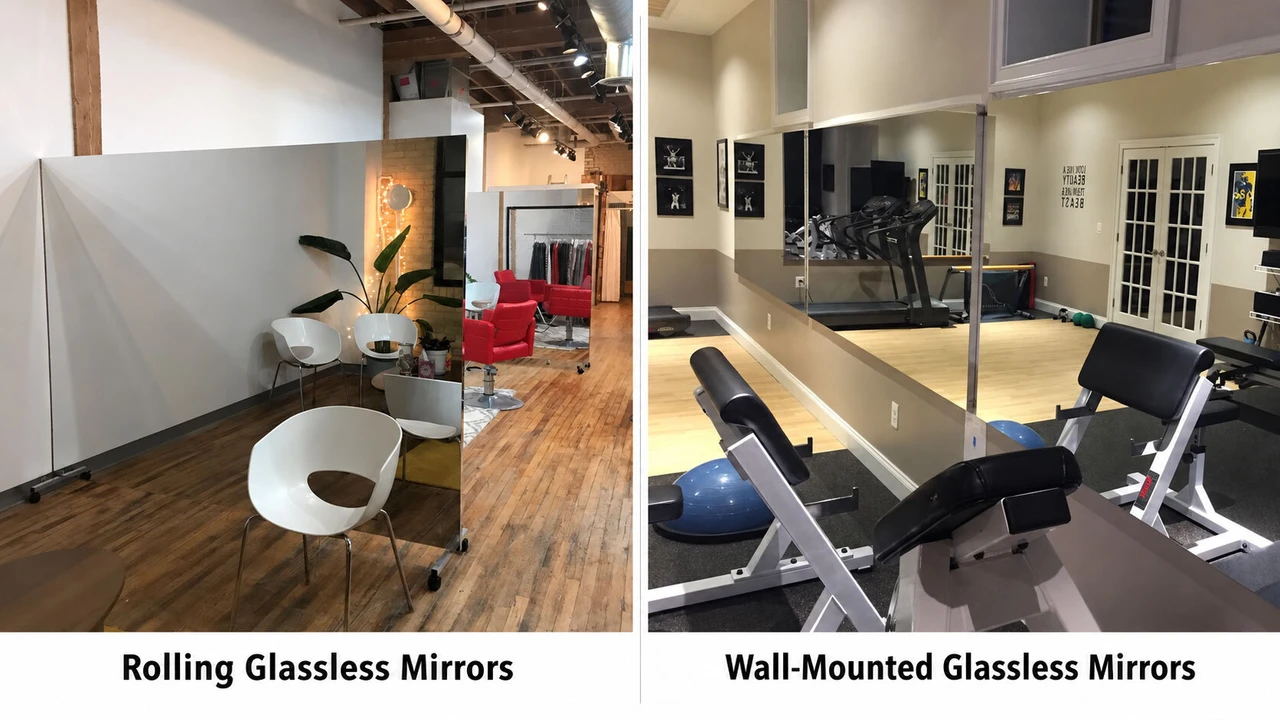
Gtech Fitness® currently offers two primary configurations: permanent LiteMirror Glassless Wall-Mount Mirrors and portable LiteMirror Glassless Rolling Mirrors. Both use the same basic glass-free reflective concept, but they serve different room layouts.
| Feature | Wall-Mounted Glassless Mirrors | Rolling Glassless Mirrors |
|---|---|---|
| Best Use | Permanent reflective walls and dedicated training areas. | Multipurpose rooms, classrooms, studios, stages, and spaces that change configuration. |
| Mounting | Interlocking cleats or direct wall-mount brackets. | Rolling stands with locking casters. |
| Orientation | Vertical or horizontal. | Vertical or horizontal. |
| Mobility | Designed to remain mounted in one location. | Can be moved between spaces and locked in position. |
| Storage | Uses no floor stand once mounted. | Multiple rolling stands can nest together to conserve storage space. |
| Backing Options | Standard wall-panel construction. | Standard silver, cork board, or dry-erase whiteboard options. |
| Double-Sided Setup | Not applicable to a normal wall installation. | Two compatible panels can mount back-to-back on one stand set. |
If you are unsure about the reflective surface before planning a larger facility purchase, Gtech Fitness® also offers a LiteMirror Glassless Mirror Sample so you can inspect the material and reflection before ordering full-size panels.
Glassless Mirror Sizes & Weights
Gtech Fitness® currently offers standard wall-mounted LiteMirror panels in fifteen sizes ranging from 2' x 6' through 6' x 8'. The table below reflects the current wall-mounted panel weights. Rolling configurations have different weights depending on mirror size and selected backing, so use the rolling product page when planning a portable installation.
| Wall-Mount Mirror Size | Current Panel Weight |
|---|---|
| 2' x 6' | 6 lbs |
| 2' x 7' | 7 lbs |
| 3' x 6' | 7 lbs |
| 3' x 7' | 8 lbs |
| 4' x 5' | 8 lbs |
| 4' x 6' | 9 lbs |
| 4' x 7' | 9 lbs |
| 4' x 8' | 10 lbs |
| 5' x 5' | 8 lbs |
| 5' x 6' | 11 lbs |
| 5' x 7' | 12 lbs |
| 5' x 8' | 13 lbs |
| 6' x 6' | 13 lbs |
| 6' x 7' | 14 lbs |
| 6' x 8' | 15 lbs |
These low panel weights are one of the biggest practical differences between glassless and conventional glass mirrors. Lightweight construction can simplify handling and mounting, particularly when a facility needs several large reflective panels.
Glassless Mirror Installation & Room Planning
Installation begins before the mirror arrives. Measure the intended wall or floor area, but also measure the route from the receiving point to the final room. Large glassless panels are lightweight, but their width and height still have to pass through doorways, hallways, stairwells, elevators, and turns.
Wall-Mounted Mirror Installation
Current LiteMirror wall-mounted models are available with interlocking cleats or direct wall-mount brackets and can be installed vertically or horizontally. The correct wall anchors or fasteners depend on the wall construction and should be selected accordingly.
The lightweight frame should be mounted without forcing it to twist or conform to an uneven wall. Excessive pressure on one area of the frame can affect panel flatness. When several mirrors are installed side by side, careful positioning and alignment help create a more continuous reflective wall.
Rolling Mirror Setup
Rolling LiteMirror models use stands with locking casters so the panel can be repositioned and then secured during use. The stands add approximately nine inches of extension to both the front and rear of the panel, so buyers should account for the complete rolling footprint rather than looking only at mirror dimensions.
Before choosing a rolling panel, also consider where the mirror will be stored. The nesting stand design helps multiple mirrors occupy less room when grouped together, which can be particularly useful in dance studios, schools, theaters, and other multipurpose facilities.
Do Not Plan to Cut the Mirror in the Field
A glassless mirror panel is a completed structural assembly rather than a sheet material that can simply be trimmed after delivery. Select the correct finished size before ordering. Required specialty cutouts or modifications should be addressed before manufacturing rather than attempted after the panel arrives.
Glassless Mirror Acoustic & Fire-Test Performance
One of the lesser-known differences between LiteMirror panels and traditional mirror glass is the way the panel interacts with sound. Hard polished glass primarily reflects sound energy. LiteMirror's framed film-and-core construction absorbs a measurable portion of that energy instead.
Independent testing conducted to ASTM C423 produced a Noise Reduction Coefficient (NRC) of 0.15 and a Sound Absorption Average (SAA) of 0.16. Those figures do not turn a mirror into a dedicated acoustic-treatment system, but they demonstrate measurable sound absorption that can be useful in fitness centers, dance and wellness studios, multipurpose rooms, hospitality environments, and other spaces containing many hard surfaces.
ASTM E84 Surface-Burning Classification
LiteMirror's fabricated panel construction is also listed as Class A (Class 1) under ASTM E84, with a Flame Spread Index of 25 and Smoke Developed Index of 85. ASTM E84 is a surface-burning characteristics test. Facility planners should still evaluate all applicable project, architectural, and local code requirements for the actual installation rather than treating a material rating as blanket approval for every location.
Where Are Glassless Mirrors Used?
Glassless mirrors work especially well in facilities that need a large, clear reflective surface while placing extra value on lower weight, easier handling, portability, or eliminating shattered-glass hazards.
| Environment | Why Glassless Mirrors Can Work Well |
|---|---|
| Dance & Ballet Studios | Large reflective coverage for posture, alignment, timing, choreography, and technique; rolling models can accommodate changing studio layouts. |
| Commercial Fitness Centers | Visual feedback for exercise form, posing, stretching, mobility, and group fitness without conventional mirror glass. |
| Home Gyms | Large reflective panels with substantially less weight than comparable glass mirrors. |
| Schools & Colleges | Glass-free construction for dance rooms, fitness areas, instructional spaces, and multipurpose rooms. See our school fitness equipment resources. |
| Physical Therapy & Rehabilitation | Visual feedback for gait, balance, posture, mobility, and movement instruction. |
| Military & Government Fitness Facilities | Large lightweight reflective panels for shared fitness spaces where broken-glass risk and facility handling are important considerations. See our military fitness equipment resources. |
| Theaters & Rehearsal Spaces | Portable or fixed reflection for movement practice, blocking, choreography, and changing production spaces. |
| Hotels & Wellness Studios | Lightweight reflective surfaces plus measurable sound absorption in active interior environments. |
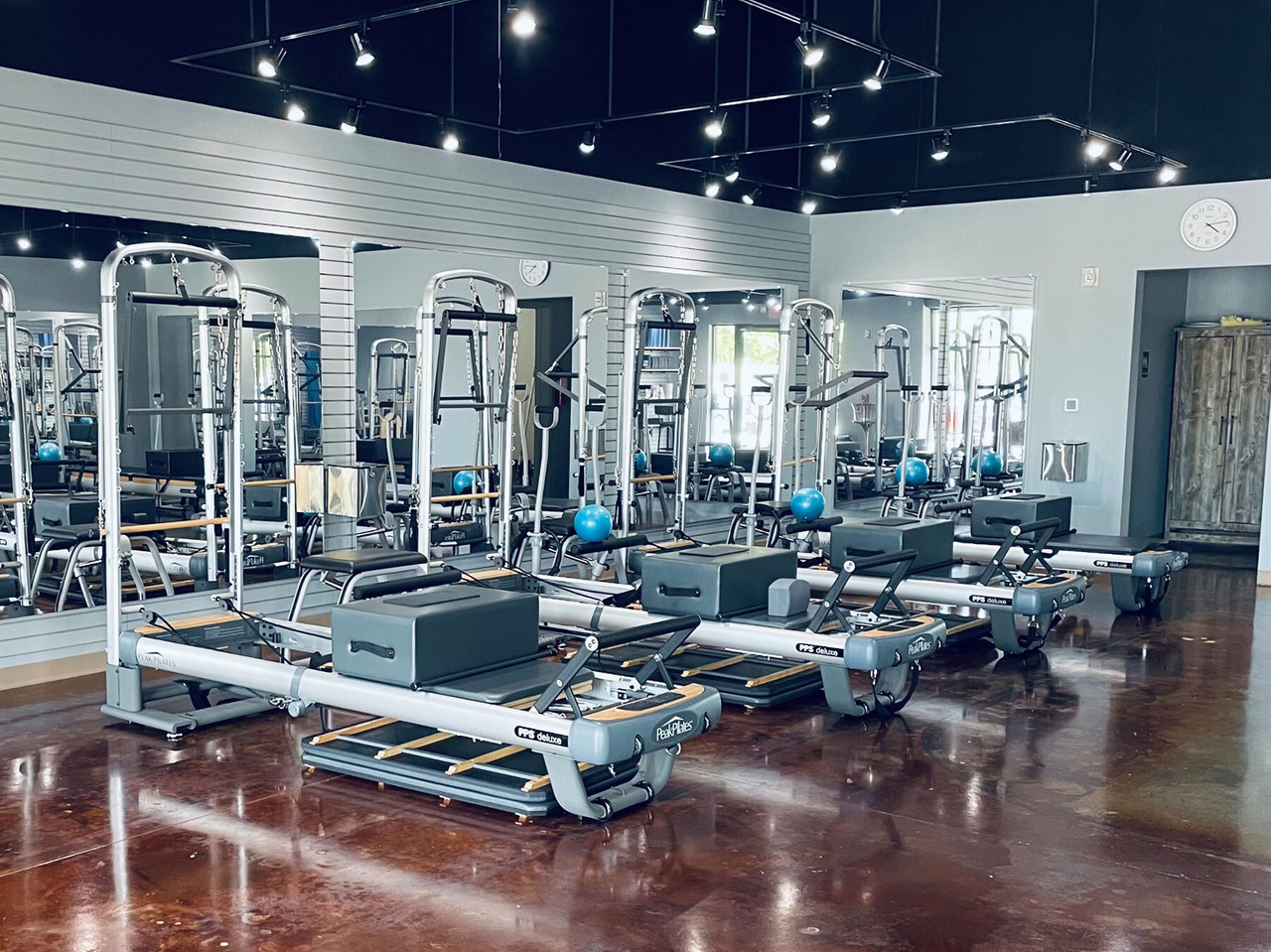
Glassless Mirror Cleaning, Care & Dent Repair
The reflective film is exposed, so glassless mirrors need more careful cleaning than a conventional rigid glass surface. Proper handling is important for maintaining reflection quality and avoiding scratches.
How to Clean a Glassless Mirror
Remove loose dust and hard particles before wiping the reflective surface. Use a soft, clean, non-abrasive microfiber or optical-quality cloth with a mild window cleaner applied to the cloth rather than sprayed directly onto the mirror. Wipe gently instead of applying heavy pressure.
Avoid paper towels, tissues, abrasive cleaners, rough fabrics, and any material that may contain grit. Even a small hard particle trapped between the cloth and reflective film can scratch the surface.
Can a Dented Glassless Mirror Be Repaired?
Minor dimples or wrinkles can often be corrected using LiteMirror's recommended heat-repair procedure. Because excessive heat can permanently damage reflective film, follow the proper manufacturer procedure rather than experimenting directly on the surface.
Scratches, punctures, and tears cannot be removed with the same heat method. Depending on the location and severity of the damage, the panel may require professional evaluation, resurfacing, or replacement. Contact Gtech Fitness® with your order information if you need assistance determining the appropriate next step.
How to Choose a Glassless Mirror
The best glassless mirror is the one that fits both the room and the way the room will actually be used. Before ordering, consider the following:
- Permanent or portable: Choose wall-mounted panels for a dedicated reflective wall or rolling stands for rooms that regularly change configuration.
- Available wall or floor space: Measure the complete area and account for equipment, baseboards, outlets, doors, and other obstructions.
- Delivery access: Confirm that the selected panel can pass through every doorway, hallway, stairwell, elevator, and turn on the route to the final room.
- Orientation: Determine whether vertical or horizontal mounting gives the best reflective coverage.
- Impact exposure: Avoid locations where weights, equipment, sporting activity, or sharp objects are likely to contact the reflective film.
- Room environment: Standard models should be used in suitable dry indoor environments unless a specialty application has been confirmed before ordering.
- Storage: If choosing rolling mirrors, reserve room for the complete stand footprint and stored mirror group.
- Backing needs: Rolling models can be configured with standard silver, cork board, or dry-erase whiteboard backing.
- Quantity: Multiple panels may be needed to create the desired reflective width in a studio, weight room, rehabilitation area, or other large facility.
For larger projects, a glassless mirror sample can be a practical first step before selecting full-size panels.
Frequently Asked Questions
Are glassless mirrors really shatterproof?
Glassless mirrors contain no traditional mirror glass, so they do not shatter into sharp glass shards. The reflective film can still be dented, scratched, punctured, or torn, so shatterproof should not be interpreted as impact-proof.
Do glassless mirrors distort the reflection?
LiteMirror uses tensioned reflective film over a rigid frame to maintain a flat reflective surface. When the panel is properly manufactured and installed without twisting or warping the frame, it is designed to provide a clear, accurate reflection. Improper mounting against an uneven surface can affect flatness.
What is a first-surface mirror?
A first-surface mirror places the reflective layer on the front surface instead of behind a sheet of glass. Light reaches the reflective surface directly, avoiding the secondary reflection that can occur when light travels through traditional mirror glass before reaching its reflective backing.
Are glassless mirrors the same as acrylic mirrors?
No. Acrylic mirrors use a rigid plastic sheet, while LiteMirror glassless panels use tensioned metallized polyester film supported by an aluminum frame and foam core. The two products differ in construction, handling, and the way they maintain surface flatness.
Can glassless mirrors be mounted horizontally?
Yes. Current Gtech Fitness® LiteMirror wall-mounted and rolling models can be configured vertically or horizontally, making it easier to match the reflective area to the room layout.
Are rolling glassless mirrors available?
Yes. LiteMirror Rolling Glassless Mirrors use locking casters for mobility and can nest together for more efficient storage. They are especially useful in dance studios, schools, rehearsal facilities, and multipurpose rooms.
How much lighter are glassless mirrors than glass?
LiteMirror currently describes its panels as approximately 90% lighter than comparable traditional glass mirrors. The exact panel weight depends on size and configuration.
Are glassless mirrors good for gyms and weight rooms?
They can be an excellent choice when the mirror is positioned outside likely impact zones. The glass-free construction removes the risk of shattered mirror glass, while the reflective surface gives users visual feedback for exercise form and movement. The film should not be placed where barbells, dumbbells, machines, or other equipment are likely to strike it.
Can dents in a glassless mirror be fixed?
Minor dimples or wrinkles can often be corrected using the recommended heat-repair procedure. Scratches, punctures, and tears cannot be repaired with heat and may require professional evaluation, resurfacing, or panel replacement.
How do you clean a glassless mirror?
Remove dust and hard particles first with a compressed air canister, then gently clean the reflective surface using a soft non-abrasive microfiber cloth with mild window cleaner applied to the cloth. Avoid paper towels, abrasive cleaners, rough fabrics, and aggressive rubbing.
Do glassless mirrors absorb sound?
LiteMirror panels have documented sound-absorbing properties. ASTM C423 testing produced an NRC of 0.15 and an SAA of 0.16. The panels do not replace dedicated acoustic treatment, but they absorb measurable sound energy instead of behaving entirely like a hard reflective glass surface.
Are LiteMirror glassless mirrors made in the USA?
Yes. LiteMirror panels are made in the USA and handcrafted in New York.
Where to Buy Glassless Mirrors
Gtech Fitness® offers glassless mirrors for sale for home gyms, dance and fitness studios, schools, rehabilitation facilities, commercial fitness centers, and other active spaces. Choose permanent wall-mounted panels or rolling mirrors with locking casters depending on your room and mobility requirements.
Current glassless mirror orders include free shipping within the contiguous United States, and quantity pricing is available for larger projects. Buyers planning a multi-panel installation can also request a written fitness equipment price quote before ordering.
EXPLORE POPULAR ARTICLES
-
Cable Machine Exercises: Complete Guide
Oct 09, 2026A Complete Guide to Cable Exercises, Pulley Positions and Attachments Estimated Reading Time: 30 Min
-
Leg Workout Machines: Names, Exercises & Muscles Worked
Oct 09, 2026A Complete Guide to Leg Machines, Exercises and Muscles Worked Estimated Reading Time: 30 Minutes Le
-
Back Workout Machines: Names, Exercises & Muscles Worked
Oct 07, 2026A Complete Guide to Back Machines, Exercises and Muscles Worked Estimated Reading Time: 30 Minutes B