
Weight Machine Training: Benefits, Exercises & Workout Guide
How Weight Machine Training Builds Strength and Muscle
Estimated Reading Time: 24 Minutes
Weight machine training can be a highly effective way to build strength, add muscle, improve muscular endurance, and create structured resistance workouts for a wide range of users. Selectorized machines use a built-in weight stack and a selector pin, while other resistance machines may use plates, cables, levers, or bodyweight-assisted systems. The common advantage is that the equipment provides a defined setup that can make resistance training easier to learn, easier to repeat, and faster to adjust.
Weight stack machines are especially common in commercial gyms, school weight rooms, apartment and hotel fitness centers, training studios, rehabilitation-oriented settings, and home gyms because they combine quick load changes with relatively simple exercise setup. They are not automatically better than dumbbells or barbells, and they are not automatically safer for every user. Their real value comes from the training problems they solve well: stable resistance, repeatable setup, target-muscle loading, efficient progression, and convenient workouts without handling loose weight plates.
Quick Answer: Weight stack machines can build strength and muscle effectively when the exercises are performed with enough effort and progressed over time. Their biggest training advantages are fast weight changes, greater external stability, easy exercise setup, reduced need to balance or control a free implement, convenient unilateral and isolation options, and the ability to train hard without holding a barbell or pair of dumbbells over the body.
Current evidence does not show that machines are universally superior to free weights for strength or muscle growth. Training results depend more on exercise selection, effort, volume, progression, and consistency, while strength gains are also specific to the movements you practice.
Table of Contents
- What Are Weight Stack Machines?
- How Selectorized Weight Machines Work
- 12 Training Benefits of Weight Stack Machines
- What the Research Says About Machine Training
- Weight Machines vs. Free Weights
- Types of Weight Machines and What They Train
- Best Weight Machine Exercises by Muscle Group
- Beginner Full-Body Weight Machine Workout
- Weight Machine Workout for Muscle Growth
- Sets, Reps, Frequency and Progression
- How to Set Up a Weight Machine Correctly
- Drop Sets, Supersets and Other Advanced Techniques
- Limitations of Weight Machine Training
- Common Weight Machine Training Mistakes
- Frequently Asked Questions
What Are Weight Stack Machines?
Weight stack machines are resistance-training machines that use a built-in stack of weight plates connected to the exercise mechanism through cables, belts, pulleys, cams, levers, or a combination of those components. The user typically selects resistance by inserting a pin into the desired position on the stack. For this reason, they are also called selectorized machines or pin-loaded machines.
Many selectorized machines guide the user through a defined movement path. Common examples include chest presses, shoulder presses, leg extensions, seated leg curls, lat pulldowns, seated rows, biceps curls, triceps extensions, abdominal machines, and back-extension machines. Other selectorized systems, such as functional trainers and cable stations, use weight stacks but allow a much freer cable path.
That distinction matters. “Weight stack machine” describes how the resistance is supplied, while “fixed-path machine” describes how the exercise moves. Many machines are both selectorized and fixed-path, but a cable-based cable machine may use a selectorized stack while allowing the user to choose the direction of movement.
How Selectorized Weight Machines Work
On a basic selectorized machine, a pin connects the selected portion of the weight stack to a top plate. When the user pushes or pulls the machine's handles, pads, or lever arms, the cable-and-pulley system lifts the selected plates. Guide rods keep the stack traveling vertically while the machine's frame and movement arms direct the exercise.
The number printed on the stack is useful for tracking progress on that specific machine, but it should not be treated as a universal measurement across different models. Pulley ratios, cam shapes, lever lengths, cable routing, friction, and machine geometry can change how much resistance the user actually feels at different points in the movement. A setting marked with the same number on two different machines may therefore feel very different.
Why Some Machines Use Cams and Levers
Human joints do not produce the same force equally throughout every exercise. Some machines use shaped cams, lever arms, or linkage systems to alter the mechanical demand as the movement progresses. The goal is usually to create a resistance profile that better matches the intended exercise. This does not mean the muscle experiences perfectly constant tension throughout the full range of motion; resistance still changes with joint angle, machine geometry, and the user's body position.
Why Machine Adjustment Matters
A selectorized machine can only guide the movement well when the user is positioned correctly. Seat height, back-pad position, start position, range-of-motion stops, thigh pads, and handle settings may all change joint alignment. When adjustments are available, the machine should be set so the user's joints line up appropriately with the machine's intended pivot points and the movement feels controlled rather than forced.
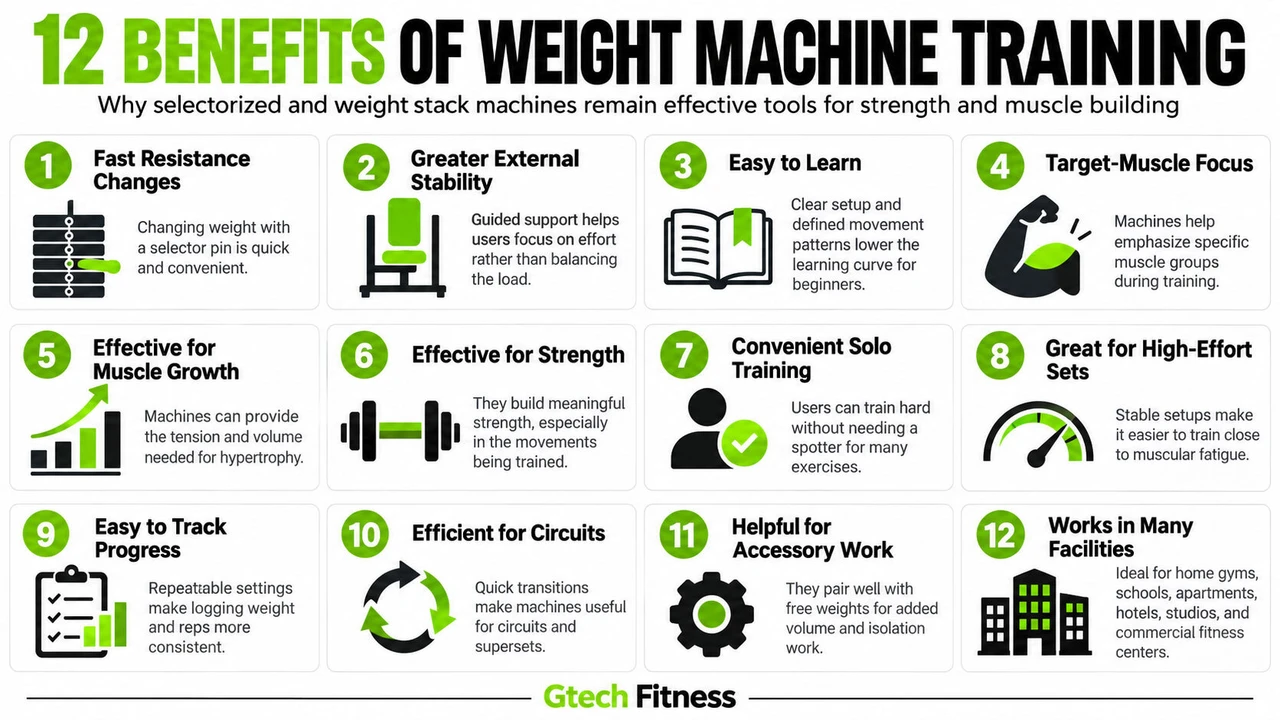
12 Training Benefits of Weight Stack Machines
1. Fast and Simple Resistance Changes
The selector pin is one of the clearest practical advantages of a weight stack. Changing resistance can take only a few seconds, which is useful during warm-up sets, progressive training, supersets, circuits, drop sets, trainer-led sessions, and workouts shared by people with different strength levels.
Quick adjustment also removes the need to load and unload plates between sets. In a busy commercial facility, that can reduce setup time and keep users moving through the workout without searching for matching plates or dumbbells.
2. Greater External Stability
Many machines support the torso or guide the resistance through a predetermined path. That reduces the amount of effort required simply to balance the implement. A seated chest press, for example, lets the user push against the handles while the machine supports the bench, weight stack, and movement arms.
This extra stability can be useful when the goal is to apply effort to a target movement without coordination or balance becoming the main limiting factor. It can also make machines useful later in a workout when stabilizing muscles are already fatigued.
3. Strong Target-Muscle Training
Machines can make it easier to focus on a specific muscle group because the setup reduces some of the stabilization demands found in comparable free-weight exercises. Leg extensions emphasize knee extension, seated leg curls emphasize knee flexion, pec fly machines emphasize horizontal shoulder adduction, and arm machines can focus heavily on elbow flexion or extension.
“Isolation” does not mean only one muscle works. Most exercises still involve assisting muscles and joint stabilizers. The advantage is that the machine can make the intended movement easier to repeat while reducing unrelated demands that might otherwise limit the set.
4. Machines Can Build Muscle Effectively
Weight machines can provide the mechanical tension and training volume needed for hypertrophy. When a machine fits the user well and allows a challenging range of motion, it can be an excellent tool for accumulating hard sets without requiring the user to stabilize a barbell or dumbbells.
This is especially useful for higher-volume bodybuilding-style training. A lifter can use free weights for some compound exercises and machines for additional presses, rows, leg work, arm exercises, or isolation movements without needing every set to challenge balance and coordination.
5. They Can Build Meaningful Strength
Machine-based resistance training can increase strength substantially. The key is specificity: if you train a chest press machine, you will become particularly skilled and strong at that machine movement. Some of that strength carries over more generally, but the greatest improvement usually occurs in the movements you practice directly.
For general strength, this is not a problem. For someone preparing for a barbell competition or a sport that requires a specific free-weight movement, machines are better used as complementary exercises rather than a complete substitute for practicing that skill.
6. Controlled Setup Can Lower the Coordination Barrier
Beginners often need to learn several things at once with free weights: how to balance the load, how to control the path, how to position the body, and how to select an appropriate weight. A well-designed selectorized machine reduces some of those decisions by providing a clear start position and a defined movement pattern.
That does not mean technique no longer matters. Seat settings, joint alignment, posture, range of motion, and repetition control still matter. The benefit is that the equipment can simplify the learning process enough for a new user to focus on producing controlled muscular effort.
7. Convenient Training Without a Spotter
Many selectorized exercises can be performed without holding a loose weight above the body. If a repetition cannot be completed, the user can usually lower the stack back to its resting position rather than needing to rerack a barbell or control a dropped dumbbell.
This makes weight machines particularly convenient for people training alone. It does not make every machine risk-free, and proper setup is still necessary, but it removes some hazards associated with handling loose free weights.
8. Useful for Training Close to Muscular Fatigue
Because the equipment provides external stability and the resistance returns to a contained stack, many users find machines practical for hard hypertrophy sets. The set can be taken close to muscular fatigue without worrying as much about balancing a pair of dumbbells or safely reracking a bar.
Training to complete muscular failure is not required for muscle growth, but challenging sets are important. Machines can make it easier to approach a high effort level while maintaining a repeatable setup.
9. Easy to Standardize and Track
Machines create a repeatable environment. If the seat setting, range-of-motion setting, grip, and stack selection remain the same, the user can compare performance from workout to workout more easily. That makes them useful for logging repetitions and resistance over time.
The most accurate comparison is always on the same machine. A 100-pound stack setting on one model should not be assumed to equal 100 pounds of effective resistance on another machine.
10. Efficient for Circuits, Supersets and Shared Facilities
Selectorized equipment is well suited to workouts that require quick transitions. A user can move the pin, adjust the seat, perform the next set, and move on without loading plates. That is useful in circuit-style training, group fitness rooms, school weight rooms, apartment gyms, hotel fitness centers, and commercial facilities where equipment turnover matters.
Single-station machines also make exercise selection obvious. Users can move from a leg station to a chest station, row, pulldown, shoulder press, and arm station without needing to redesign the setup for each movement.
11. Helpful for High-Volume Accessory Training
Machines can complement heavy free-weight training by adding volume without repeating the exact same coordination demands. After barbell squats, a lifter might use a leg extension or leg curl. After dumbbell or barbell pressing, a selectorized chest press or pec fly can add additional chest work.
This mixed approach takes advantage of the strengths of both equipment types. Free weights can provide highly transferable skill practice for free-weight lifts, while machines can add stable, targeted resistance where needed.
12. They Fit a Wide Range of Training Environments
Selectorized machines can be scaled from a single compact home gym to a complete commercial strength line. Facilities can choose single-function stations, dual-function machines, multi-station gyms, functional trainers, or combinations based on available space and user needs.
For shared environments, the built-in stack also keeps resistance attached to the machine. There are no loose plates to carry across the room, and users can usually identify the available resistance immediately.
What the Research Says About Machine Training
The strongest current evidence does not support the idea that either machines or free weights are universally superior. A 2023 systematic review and meta-analysis comparing free-weight and machine-based strength training found no meaningful difference between the two methods for hypertrophy or neutral measures of dynamic strength. The clearest strength difference followed the principle of specificity: people became better at the type of exercise they actually trained.
Research Summary: Machine training can build muscle and strength effectively. Free-weight strength improves most when free weights are practiced, while machine strength improves most when machines are practiced. For hypertrophy, current evidence does not show a clear overall advantage for either equipment type.
Read the 2023 systematic review and meta-analysis.
The American College of Sports Medicine's 2026 resistance-training position stand reached a similarly practical conclusion. Across a large body of resistance-training research, equipment type was not a consistent determinant of strength or hypertrophy outcomes. The larger priorities were high-effort resistance training, progressive programming, enough weekly volume, and training all major muscle groups consistently.
Machine-based resistance training is also supported in older adults. A systematic review and meta-analysis published in 2024 found that machine-based resistance training improved strength and measures of functional capacity. That does not mean machines are required for older adults, but it reinforces that well-designed machine training can be an effective resistance-training method across age groups.
View the 2026 ACSM resistance-training position stand and the review of machine-based resistance training in older adults.
Are Weight Machines Safer Than Free Weights?
It is reasonable to say that many machines reduce certain hazards, such as dropping a dumbbell or becoming trapped under a failed barbell repetition. However, research does not establish that machine training has a universally lower overall injury rate in every context. A poorly adjusted machine, excessive load, forced range of motion, or inappropriate exercise can still create problems.
The more useful conclusion is that machines can simplify setup and contain the resistance, which may make some exercises easier to manage for beginners, people training alone, and facilities serving broad user populations.
Weight Machines vs. Free Weights
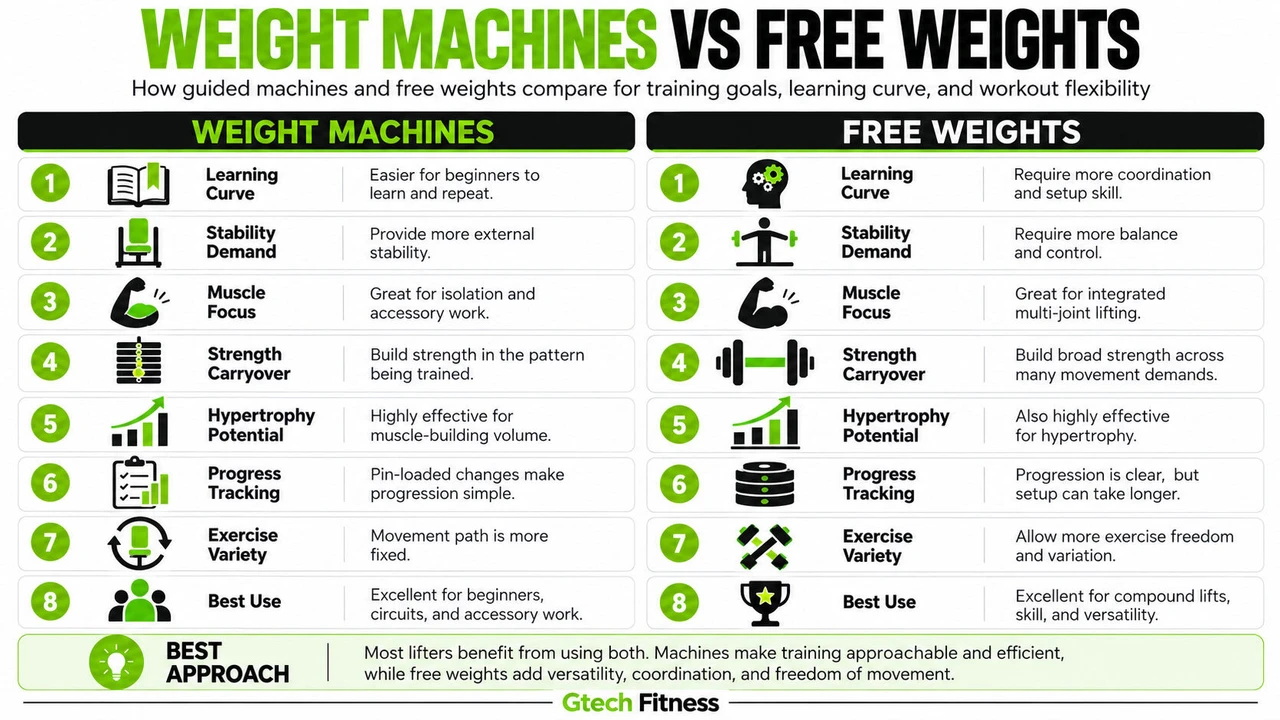
The choice between weight machines and free weights should be based on the training goal rather than the idea that one category is always better. Both can build muscle and strength. The differences are mostly in stability, movement freedom, setup, exercise specificity, and equipment logistics.
| Training Factor | Weight Machines | Free Weights |
|---|---|---|
| External stability | Usually higher because the machine supports or guides part of the movement | Usually lower because the user controls the implement in space |
| Movement freedom | Fixed-path machines are more constrained; cable machines can be highly adjustable | High; the user controls the path of the barbell, dumbbell, or kettlebell |
| Load changes | Very fast with a selector pin | Depends on implement; dumbbells are fast, plate-loaded barbells take longer |
| Maximum exercise specificity | Best for becoming stronger on that machine movement | Best for improving the specific free-weight lift being practiced |
| Muscle growth | Effective when effort, volume, range of motion, and progression are appropriate | Effective under the same principles |
| Space and cost | Single stations can require significant floor space and investment | A compact free-weight area can train many movements with fewer stations |
| Best use | Stable targeted work, easy setup, circuits, hypertrophy, broad-user facilities | Movement freedom, free-weight skill, athletic lifting, compact exercise variety |
Should Beginners Start With Machines?
Machines can be an excellent starting point because they reduce some of the coordination demands and make resistance selection straightforward. But beginners do not have to avoid free weights. A beginner can learn goblet squats, dumbbell presses, and other basic free-weight movements safely with appropriate instruction and conservative loading.
A strong beginner program can use both: machines for repeatable, stable exercises and free weights for movement skills the trainee wants to develop.
Can You Train Only With Machines?
Yes. A sufficiently equipped machine circuit can train the chest, back, shoulders, arms, quadriceps, hamstrings, glutes, calves, abdominals, and lower back. A machine-only routine can therefore build strength and muscle throughout the body.
Whether it is the best long-term choice depends on your goals. If you want to become skilled at free-weight lifting or need movements that require greater control of an external load in space, include those exercises directly.
Types of Weight Machines and What They Train
Weight machines are not one single category. Understanding the differences helps you choose exercises that fit the training goal.
| Machine Type | How It Works | Common Uses |
|---|---|---|
| Single-Station Selectorized | Dedicated weight stack and fixed or guided movement | Chest press, row, pulldown, leg extension, leg curl, shoulder press |
| Dual-Function Machine | One station performs two related exercises | Leg extension/curl, pec fly/rear delt, biceps/triceps |
| Multi-Station Gym | Several exercise stations share a frame and may use one or multiple stacks | Full-body facility training with multiple simultaneous users on some systems |
| Functional Trainer / Cable Machine | Selectorized stacks feed adjustable cable pulleys | Free-path cable presses, rows, raises, chops, curls, extensions and athletic patterns |
| Plate-Loaded Machine | Olympic plates load lever arms rather than a selectorized stack | Heavy presses, rows, leg presses, leverage squats and bodybuilding movements |
Best Weight Machine Exercises by Muscle Group
A complete machine program should train the major muscle groups rather than relying on only the most familiar stations. The best exercise lineup depends on the equipment available, but the following categories cover the main movement needs.
| Muscle Group | Machine Exercises | Training Role |
|---|---|---|
| Chest | Chest press, incline press, pec fly | Pressing strength and chest hypertrophy |
| Back | Lat pulldown, seated row, high row | Vertical and horizontal pulling strength |
| Shoulders | Shoulder press, lateral raise, rear-delt machine | Pressing and targeted shoulder work |
| Quadriceps & Glutes | Leg press, squat-style machine, leg extension | Knee-dominant lower-body strength and hypertrophy |
| Hamstrings | Seated leg curl, lying leg curl, standing leg curl | Knee-flexion strength and hamstring hypertrophy |
| Arms | Biceps curl, triceps extension, cable curl, pressdown | Direct elbow flexion and extension work |
| Core & Low Back | Abdominal crunch, torso rotation where appropriate, back extension | Trunk flexion, extension and rotational resistance |
For dedicated categories, browse lat pulldown and row machines, leg extension and curl machines, leg press and squat machines, arm machines, and ab and low back machines.
Beginner Full-Body Weight Machine Workout
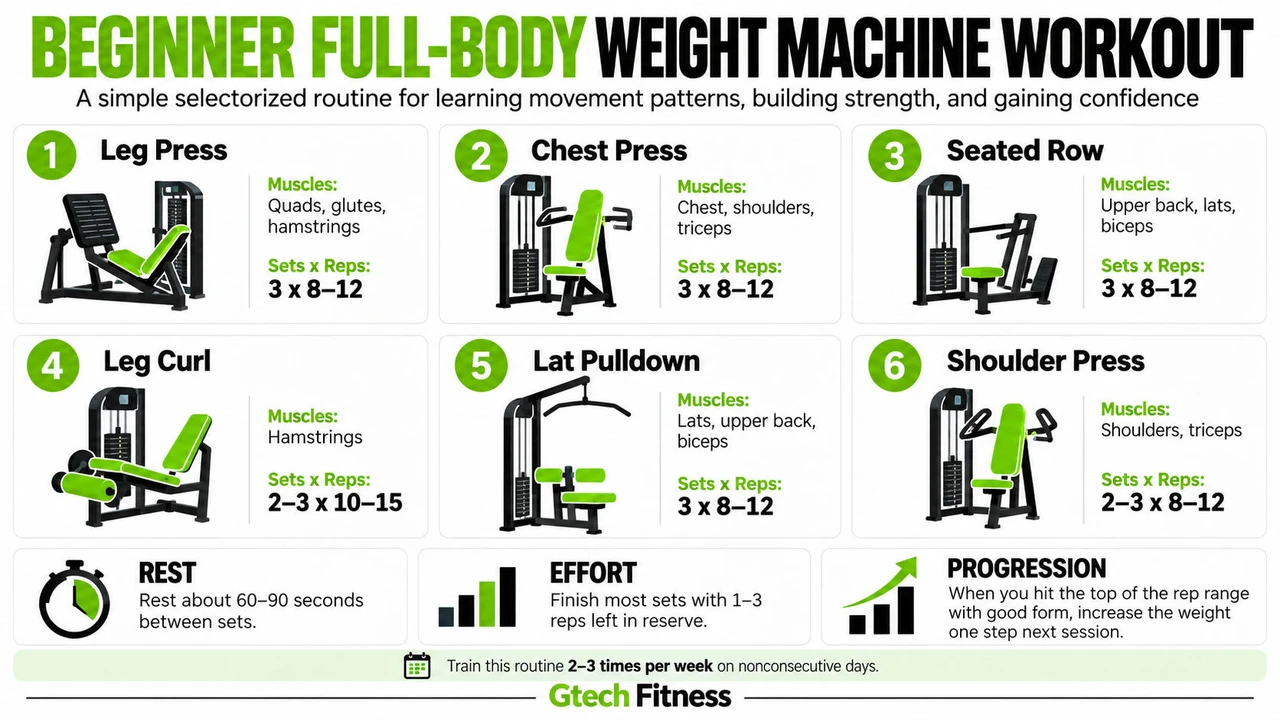
A beginner does not need to use every machine in the gym. A simple full-body circuit performed two or three times per week can cover the major muscle groups and make progression easy to track. Leave at least a day between hard full-body sessions when possible, especially while adapting to a new program.
| Exercise | Sets | Reps | Rest |
|---|---|---|---|
| Leg Press | 2–3 | 8–12 | 1–2 minutes |
| Chest Press | 2–3 | 8–12 | 1–2 minutes |
| Lat Pulldown | 2–3 | 8–12 | 1–2 minutes |
| Seated Leg Curl | 2 | 10–15 | 1–2 minutes |
| Seated Row | 2–3 | 8–12 | 1–2 minutes |
| Shoulder Press | 2 | 8–12 | 1–2 minutes |
| Abdominal Machine | 2 | 10–15 | About 1 minute |
Start conservatively. The final repetitions should feel challenging, but every rep should remain controlled. When you can complete the top of the repetition range on every set with consistent technique, move the selector pin to the next appropriate resistance at a future session.
Weight Machine Workout for Muscle Growth
For hypertrophy, machines are particularly useful because stable setups allow lifters to accumulate challenging sets for specific muscle groups. A four-day upper/lower plan is one practical option for intermediate trainees.
| Day | Exercises | Typical Work |
|---|---|---|
| Upper A | Chest press, lat pulldown, seated row, shoulder press, biceps curl, triceps extension | 2–4 sets each, mostly 6–15 reps |
| Lower A | Leg press, seated leg curl, leg extension, calf raise, abdominal machine | 2–4 sets each, mostly 8–15 reps |
| Upper B | Incline press, high row, pec fly, rear delt, lateral raise, cable arm work | 2–4 sets each, mostly 8–15 reps |
| Lower B | Leg press or squat machine, lying or seated leg curl, leg extension, hip-focused machine, calf raise | 2–4 sets each, mostly 8–15 reps |
This is a framework, not a prescription for every lifter. Total weekly volume should match experience, recovery, and training goals. Beginners generally need less work, while advanced trainees may benefit from additional volume when progress has stalled and recovery remains good.
Weight Machine Sets, Reps, Frequency and Progression
How Many Repetitions Should You Do?
For general fitness and beginner training, 8–15 repetitions works well for many machine exercises. Heavier sets with fewer repetitions can emphasize strength, while moderate and higher repetition work is commonly used for hypertrophy and muscular endurance. Muscle growth can occur across a broad range of loads when sets are sufficiently challenging.
How Many Sets?
Two or three working sets per exercise are enough for many beginners. More experienced lifters can increase weekly volume as needed. The 2026 ACSM position stand identified higher weekly set volume as one variable associated with greater hypertrophy, while also emphasizing that programming should be individualized.
How Often Should You Use Weight Machines?
For general health, U.S. physical-activity guidelines recommend muscle-strengthening work for all major muscle groups on at least two days per week. A full-body machine circuit two or three times per week is therefore a practical starting structure. More advanced programs may distribute training across three, four, or more weekly sessions.
How Heavy Should the Stack Be?
Select a resistance that lets you perform the target repetitions through a controlled range of motion while maintaining the intended body position. For most working sets, finishing with roughly a few good repetitions still available is a practical approach. If you could perform many additional reps, increase the resistance or use another progression strategy. If technique fails before the minimum target, reduce the load.
How to Progress on Selectorized Machines
The simplest method is double progression. Choose a repetition range, such as 8–12. Keep the same stack setting until you can perform the top number of repetitions across your planned working sets with consistent technique. Then move the pin to the next practical setting and build the repetitions back up.
Progression Tip: Record the machine, seat setting, range-of-motion setting, selected stack weight, sets, and repetitions. Repeating the same setup makes your training log much more useful.
How to Set Up a Weight Machine Correctly
1. Identify the Intended Movement
Read the machine placard and confirm the exercise, start position, and primary adjustment points. Do not assume that two machines with similar handles are designed to move the same way.
2. Align Your Body With the Machine
Where possible, position the relevant joint near the machine's pivot point. For a leg extension, that usually means aligning the knee with the machine's rotational axis. For a chest or shoulder press, adjust the seat so the handles begin at an appropriate height for the intended pressing path.
3. Set the Range of Motion
If the machine has start-position or range-of-motion adjustments, choose a setting that allows a comfortable, controlled movement without forcing the joint into a position you cannot manage. More range is not automatically better if the added motion requires compensation or discomfort.
4. Start With a Warm-Up Load
Use a lighter stack setting for the first set when the exercise is demanding or unfamiliar. This gives you a chance to check the seat position, movement path, and range before heavier work.
5. Control Both Directions
Lift the stack smoothly and lower it under control. Avoid letting the plates slam together between repetitions. Controlled repetitions make the movement easier to evaluate and reduce unnecessary impact on the equipment.
Drop Sets, Supersets and Other Advanced Techniques
The selector pin makes weight stack machines especially convenient for techniques that require fast resistance changes. These methods can be useful, but they are optional. Basic progressive training remains the foundation.
Drop Sets
After a challenging set, reduce the stack weight and continue with additional repetitions. The fast pin change makes this easy to perform without unloading plates. Drop sets can add training volume efficiently, but they also create substantial fatigue, so they do not need to be used on every exercise.
Supersets
Perform two exercises back-to-back with limited rest. Opposing muscle groups, such as a chest press followed by a seated row or a biceps curl followed by a triceps extension, are common pairings. Supersets can shorten the workout and increase local training density.
Pyramid Sets
Increase the resistance over successive sets while reducing repetitions, or reverse the pattern. The selector pin makes these changes fast. Pyramid training is a programming structure rather than a requirement for better results.
Rest-Pause Training
Perform a challenging set, rest briefly, and continue with a small number of additional repetitions at the same resistance. Because this is a high-fatigue technique, it is better reserved for experienced trainees and stable machine exercises rather than used throughout the entire workout.
Limitations of Weight Machine Training
Fixed Paths Do Not Fit Everyone Equally
Body proportions vary. A fixed machine path that feels natural for one user may feel awkward for another. Adjustable seats, pads, handles, and start positions help, but some machines simply fit certain body sizes better than others.
Machine Strength Is Exercise-Specific
If your goal is to improve a barbell squat, bench press, Olympic lift, or another specific free-weight skill, practicing that movement matters. Machine strength can support the muscles involved, but it does not replace the coordination and technique of the target lift.
Single Stations Require Floor Space
A full selectorized circuit can require substantial space because each machine may perform only one or two movements. That is often acceptable in large commercial facilities, but smaller gyms may prefer dual-function machines, multi-stations, functional trainers, or a mix of machines and free weights.
Stack Increments May Be Too Large or Too Small for Some Goals
The next pin position is determined by the machine's stack design. If the jump is larger than you want, use repetition progression, tempo, additional sets, or optional add-on resistance solutions that are approved for the specific equipment instead of forcing a load increase before you are ready.
The Stack Number Is Not Directly Comparable Across Machines
Machine geometry changes the effective resistance. Use the stack label to track progress on that machine rather than treating it as a universal strength score.
Common Weight Machine Training Mistakes
Skipping the Adjustments
Using the previous person's seat and pad settings can change joint alignment and range of motion. Take the time to set the machine for your body before the working set.
Using Too Much Weight
A heavy stack is not useful if the repetition becomes shortened, jerky, or uncontrolled. Select a load that lets the target muscles perform the intended movement.
Letting the Weight Stack Slam
Allowing the plates to crash at the bottom of every repetition adds impact and often signals that the eccentric phase is not being controlled. Lower the resistance smoothly.
Turning Every Machine Into a Partial-Range Exercise
Machines can make partial repetitions easy because the movement path is already guided. Use the intended range you can control unless a specific training strategy calls for otherwise.
Assuming the Machine Automatically Guarantees Good Form
The machine guides the equipment, not the entire body. Users can still arch excessively, shift position, lift the hips, shrug the shoulders, or force a range that does not fit. Technique and setup still matter.
Using Only Push Exercises
A balanced machine program should include horizontal and vertical pulling, lower-body training, posterior-chain work, and direct accessory work as appropriate—not only chest presses, shoulder presses, and leg extensions.
Changing Too Many Variables at Once
If you change the seat setting, grip, range of motion, stack weight, and repetitions from week to week, it becomes difficult to know whether you are progressing. Standardize the setup and change one training variable at a time when possible.
Frequently Asked Questions
What is a weight stack machine?
A weight stack machine is resistance-training equipment that uses a built-in stack of plates connected to the exercise mechanism. The user typically inserts a selector pin into the desired stack position to choose the resistance.
Is a selectorized machine the same as a weight stack machine?
Usually, yes. “Selectorized” refers to choosing resistance with a pin or similar selector, and most selectorized strength machines use a built-in weight stack. Some cable systems also use selectorized stacks while allowing a freer movement path.
Do weight machines build muscle?
Yes. Weight machines can build muscle effectively when exercises are performed with sufficient effort, training volume, and progressive overload. Research comparing machines with free weights does not show a clear overall hypertrophy advantage for either method.
Can weight machines build strength?
Yes. Machine training can produce meaningful strength gains. The greatest improvements occur in the movements that are practiced, so machine training develops machine-specific strength especially well.
Are weight machines better than free weights?
Neither is universally better. Machines provide more external stability and quick setup, while free weights provide greater movement freedom and directly develop free-weight lifting skills. Both can build strength and muscle.
Are weight machines good for beginners?
Yes. Many beginners find machines easier to learn because the equipment provides a clear setup and reduces some balance and coordination demands. Beginners can also learn free weights successfully with appropriate instruction, so the two methods can be combined.
Are weight machines safer than free weights?
Machines can reduce certain hazards associated with loose weights, such as dropping a dumbbell or becoming trapped under a failed barbell repetition. However, machines are not risk-free, and research does not establish that they are universally safer in every training situation.
Can I get a full-body workout using only weight machines?
Yes. A well-equipped gym can provide machine exercises for the chest, back, shoulders, arms, quadriceps, hamstrings, glutes, calves, abdominals, and lower back. A balanced routine should include both pushing and pulling plus upper- and lower-body work.
How often should I use weight machines?
Two or three full-body machine sessions per week are a practical starting point for many people. More advanced trainees can use upper/lower or body-part splits. General U.S. guidelines recommend muscle-strengthening activity for all major muscle groups on at least two days per week.
How many reps should I do on weight machines?
For general fitness, 8–15 repetitions is a practical range for many exercises. Lower repetition ranges can emphasize strength, while moderate and higher repetition ranges are commonly used for hypertrophy and endurance. The resistance should match the goal and allow controlled technique.
Should the weight stack touch down between reps?
That depends on the machine and exercise. In many cases, lowering the stack gently without slamming the plates helps maintain control. Follow the equipment instructions and avoid bouncing the stack to create momentum.
Why does the same weight feel different on different machines?
Pulley ratios, lever lengths, cam shapes, cable routing, friction, movement arms, and body position can all change the effective resistance. Use the stack number mainly to track progress on the same machine.
Are weight stack machines good for older adults?
They can be. Machine-based resistance training has been shown to improve strength and functional capacity in older adults. Exercise selection, range of motion, and resistance should still be matched to the individual's health, experience, and abilities.
Can I use weight machines for drop sets and supersets?
Yes. Selectorized machines are particularly convenient for these methods because resistance can be changed quickly with the pin. Advanced techniques add fatigue, so they should supplement rather than replace basic progressive training.
Do I need free weights if my gym has a complete machine circuit?
Not necessarily for general strength and muscle building. A complete machine circuit can train the entire body. Add free weights when you want their specific movement skills, greater movement freedom, or training that directly prepares you for barbell or dumbbell exercises.
Final Thoughts on Weight Machine Training
Weight stack machines are effective resistance-training tools because they make strength work easy to set up, easy to repeat, and easy to progress. Their external stability, contained resistance, fast selector-pin adjustments, and targeted exercise designs make them particularly useful for beginners, general fitness users, bodybuilders, people training alone, and facilities serving a broad range of members.
The most important point is that machines do not need to “beat” free weights to be valuable. Research supports both approaches. Use machines when their stability, exercise path, resistance system, or convenience helps you train the intended muscles more effectively. Use free weights when movement freedom and free-weight skill are important. Many of the strongest programs combine the two.
To compare options for home, school, institutional, and commercial facilities, browse weight machines for strength training at Gtech Fitness.
EXPLORE POPULAR ARTICLES
-
Weight Machine Training: Benefits, Exercises & Workout Guide
Oct 05, 2026How Weight Machine Training Builds Strength and Muscle Estimated Reading Time: 24 Minutes Weight ma
-
Dumbbell Chest Workout: Exercises, Form & Workout Plans
Oct 05, 2026How to Build a Complete Chest Workout with Dumbbells Estimated Reading Time: 22 minutes A well-desi
-
Strength Training With Dumbbells: Benefits & Exercises
Oct 05, 2026Why Strength Training With Dumbbells Works Estimated Reading Time: 22 Minutes Strength training wit